
Caroline supervisors approve short-term modular units, tie county funding to school board signoff for Bowling Green additions
Get AI-powered insights, summaries, and transcripts
Sign Up Free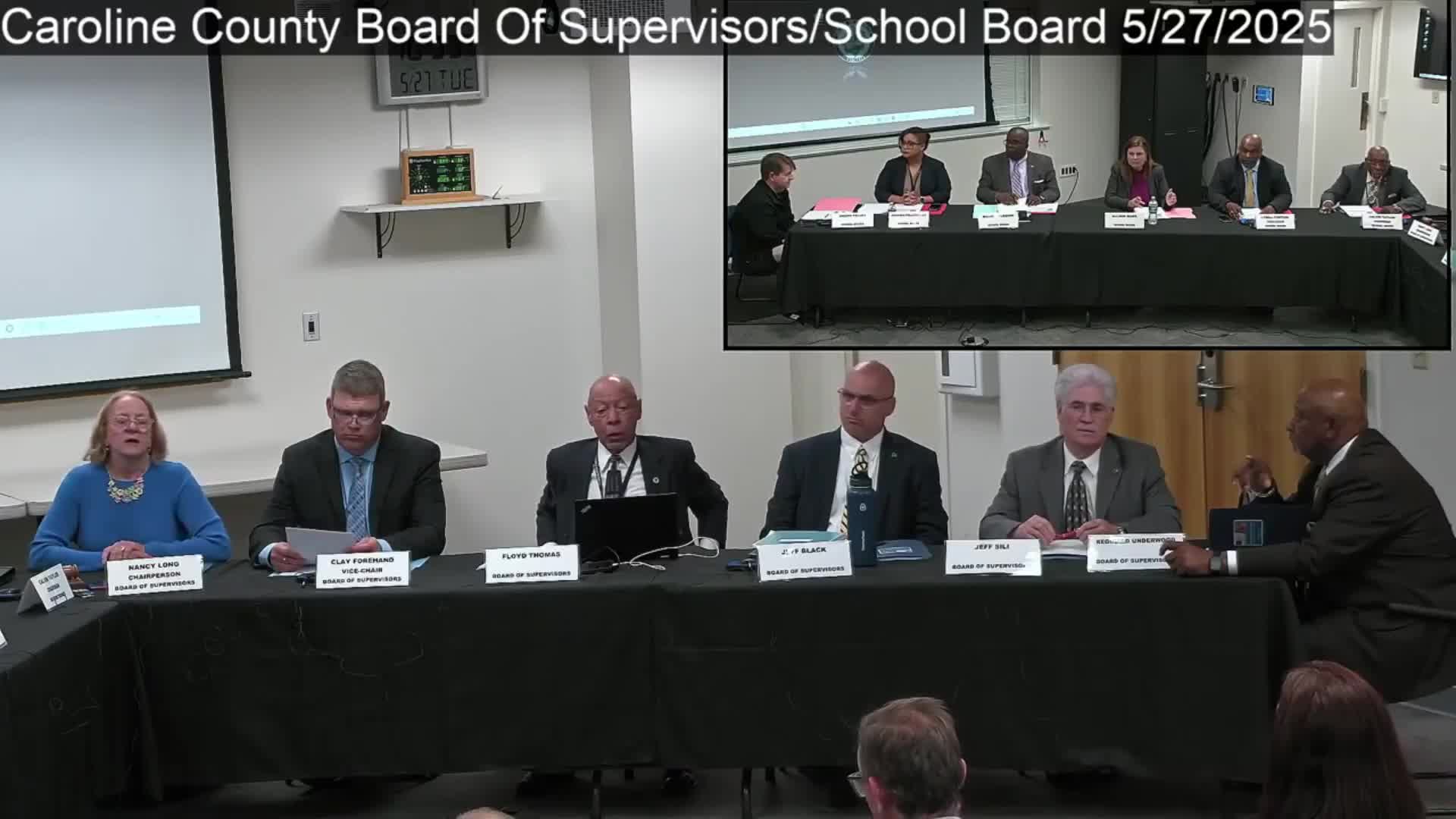
Summary
After weeks of joint meetings with the school board, the Caroline County Board of Supervisors approved using school-year reversion funds to buy or lease modular classroom units as a short-term fix for overcrowding and conditioned county-funded permanent additions at Bowling Green on school-board approval.
The Caroline County Board of Supervisors voted to appropriate the school division's FY2024 reversion balance to acquire modular classroom units to address immediate overcrowding at Bowling Green Elementary, and added Madison Elementary to planned facility work. The board said permanent construction at Bowling Green (additional classrooms and a gym) will proceed only if the school board formally approves the county’s role at its next meeting.
School leaders and county officials have met repeatedly this spring to address rising enrollment and a short timeline to be ready for the August school year start. Caroline County Public Schools presented a short-term bridge plan built around modular (factory-built) classrooms — described during the meeting as “high-performing modular units” with internal HVAC, bathrooms, and a 25-year useful life — while moving forward on longer-term projects including a new elementary school in coming years.
The debate opened with schools describing urgent needs at Bowling Green Elementary: missing classrooms, intervention spaces in hallways and no permanent room for a planned third English-language teacher and third counselor. School staff said modular units could be delivered and made operational in time for the start of the year if the county approves funding quickly. “If we get a decision tonight … they can be operational by this coming school year,” a school representative said during the joint meeting.
Supervisors split over whether to buy or lease modular units and over longer-term facility strategy. Supporters said modulars offer a faster, lower-cost way to relieve August overcrowding, and the units can be moved to future hot spots. Opponents warned about spending on temporary buildings without a firm long-range plan and argued that investing in permanent additions — including gyms at Bowling Green and Madison — would leave usable county assets after a new school is built. “There needs to be something for those years while we work on getting classrooms done,” a supervisor said, arguing for interim solutions. Another supervisor answered that additions would be more durable and longer-lasting county assets.
The board approved using $994,607 in school-year reversion funds to the school capital projects fund to procure modular units and instructed staff to add Madison Elementary to the current RFP/design planning. The board’s action also included a statement that any county-funded permanent additions at Bowling Green would proceed only after the school board provides formal authorization at its next meeting.
School and county staff also discussed technical details of modular installations: foundation options, site preparation, utility hookups and the typical warranty and mobilization costs. A vendor at the meeting estimated moving an installed module to a new site later could cost roughly $75,000–$100,000 depending on distance and disassembly needs, and said most modern modular units reclaim water and are factory-inspected.
The boards left the longer-term question — siting and funding of a new elementary school anticipated in the coming three to five years — open for continued joint work. County officials said the modular units are intended to be temporary “bridge” solutions while planning and finance for new permanent construction continue.
County and school leaders agreed to continue collaboration and to return to formal votes and budget adjustments in the next round of meetings.
The board vote to approve the appropriation and planning steps passed (tally recorded in the meeting as 4–2).