Get Full Government Meeting Transcripts, Videos, & Alerts Forever!
Get email alerts on the Community Engagement Budget Survey topic
No spam. Unsubscribe anytime.
Budget survey: Laredo residents rate infrastructure top priority and express dissatisfaction with roads and some services
Summary
City staff summarized results from a city budget survey completed by roughly 300 respondents, saying infrastructure (roads/drainage/water) ranked highest, residents reported dissatisfaction with road maintenance, and many respondents favored more transparent budgeting and participation.
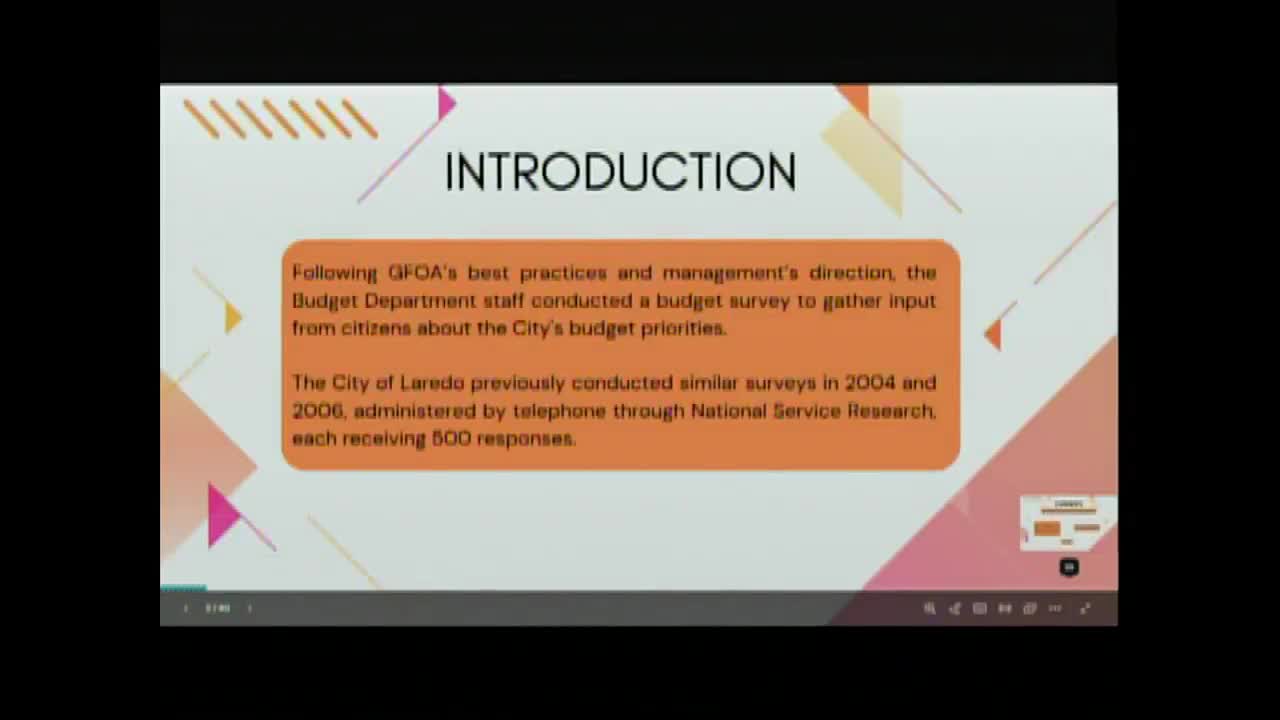
City staff presented the results of a recent budget survey at the March 28 workshop, saying the instrument provided directional—not statistically representative—input from residents about budget priorities and service satisfaction.
Staff reported 255 usable structured responses through May 19 (the internal survey was open March 24–27), and noted that the respondent sample represented roughly 0.1% of the city population and skewed older and toward higher incomes compared with census figures. Despite the limited sample, staff said the responses reinforced themes previously heard during the bond referendum and other outreach: infrastructure was the highest priority (infrastructure rated 8.8 on a 1–10 scale), public safety and parks followed, and roads and drainage produced the highest dissatisfaction.
On specific questions, staff said about 70.6% of respondents rated road and traffic maintenance as dissatisfied or very dissatisfied. Other findings included mixed satisfaction for police and fire (about 55.7% were satisfied or very satisfied), neutral or dissatisfied attitudes toward human resources and some municipal services, and that 74% of respondents indicated a willingness to participate in budget preparation.
Council members raised concerns about sample size and geographic skew (nearly half of responses came from North Laredo). Mayor pro tem and others urged staff to plan a more statistically robust poll tied to an election to improve representativeness. Staff said the survey was intended as directional input for budgeting and that the city will refine its approach and combine survey sources for broader outreach.
Staff also summarized common open‑ended comments: calls for more road, drainage and water work; interest in spay/neuter and animal care services; greater transparency in planning and spending; and requests for more equitable outreach to underrepresented neighborhoods. Staff recommended institutionalizing a recurring survey and supplementing it with targeted community meetings and district outreach during the upcoming budget cycle.