Get Full Government Meeting Transcripts, Videos, & Alerts Forever!
Get email alerts on the Local Economy Sales Tax topic
No spam. Unsubscribe anytime.
Sales tax, hotel receipts and bridge crossings: Laredo staff says local economy remains local‑driven, not tourist‑driven
Summary
Budget staff told the council that much of Laredo's sales tax and hotel‑occupancy receipts are driven by local and business travel rather than tourism. Staff showed monthly patterns indicating holidays and business travel peaks and said cultural events such as WBCA have limited measurable impact on overall sales tax.
Budget staff used three‑year averages and monthly reporting lags to argue that Laredo’s main taxable activity remains local and business related, rather than tourism‑driven.
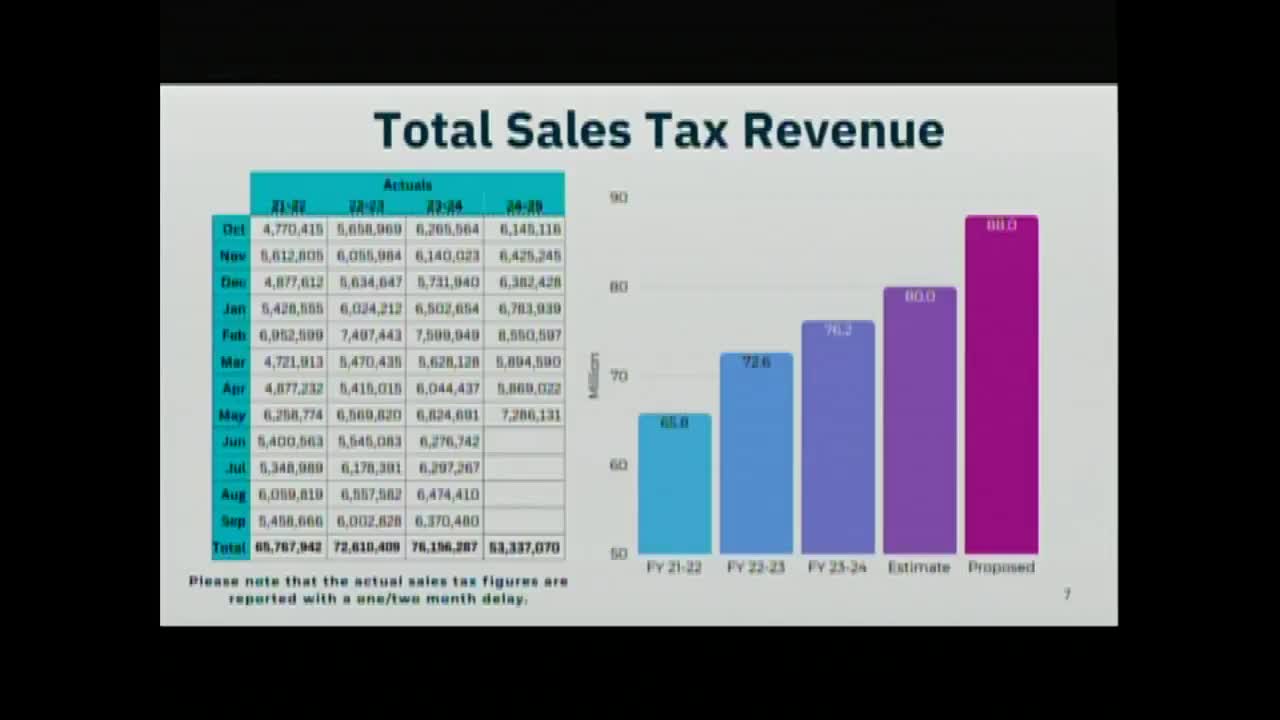
Assistant city staff and economic development staff walked council through sales‑tax and hotel‑occupancy trends, emphasizing the reporting delays that complicate short‑term interpretation: sales tax is reported to the state and then remitted to the city with roughly a two‑month lag; hotel taxes, typically, are reported with about a one‑month lag.
The staff presentation showed that the city’s largest sales‑tax inflows correlate with December (Christmas) and the Easter period, and that weekday hotel stays account for roughly 60% of local occupancy—consistent with business travel rather than leisure tourism. “Most of this hotel occupancy is driven by business travel. It is a Monday through Friday, is most of it,” a staff presenter said, and added that the visitor‑tracking software used by the convention & visitors bureau shows an average stay of 5.1 nights.
Council members asked whether festivals or large cultural events—cited often in public discussion—translate into measurable tax increases. Staff pointed to the charts and said that while cultural events (for example, WBCA and related festivals) are valuable community activities, they have not been strong drivers of additional taxable retail activity in the citywide sales‑tax data. “If you look at this chart, it is not really driving any high levels of sales tax… They’re more cultural. They’re more Laredo than they are economic drivers,” an economic development staff member said.
Staff told council members that the city will continue to analyze hotel, sales and bridge‑crossing data (the latter collected by both bridge operations and U.S. Border Patrol) to better understand spending patterns and to tailor promotion and economic development efforts. The presentation suggested that a more granular analysis (hotel surveys, more detailed daily tracking) would be required to quantify the incremental impact of specific events on local spending.
Council members requested deeper historic data and suggested cross‑checking event schedules against sales and hotel figures to assess whether events displace business travel or increase overall visitation. Staff said it will return with more detailed breakdowns of monthly trends and any correlations identified.