Get Full Government Meeting Transcripts, Videos, & Alerts Forever!
Get email alerts on the Municipal Budget topic
No spam. Unsubscribe anytime.
City of Laredo projects roughly $9 million general-fund shortfall; staff outlines tax-rate, financing and spending options
Summary
City budget staff told the City Council at a March 28 workshop that updated revenue estimates leave a multi‑million‑dollar gap for FY2025–26 and asked for council direction on borrowing and spending priorities.
City of Laredo budget staff told the City Council at a March 28 pre‑budget workshop that revenues currently projected for fiscal 2025–26 leave a gap with proposed expenditures and that council direction is needed on borrowing and spending priorities.
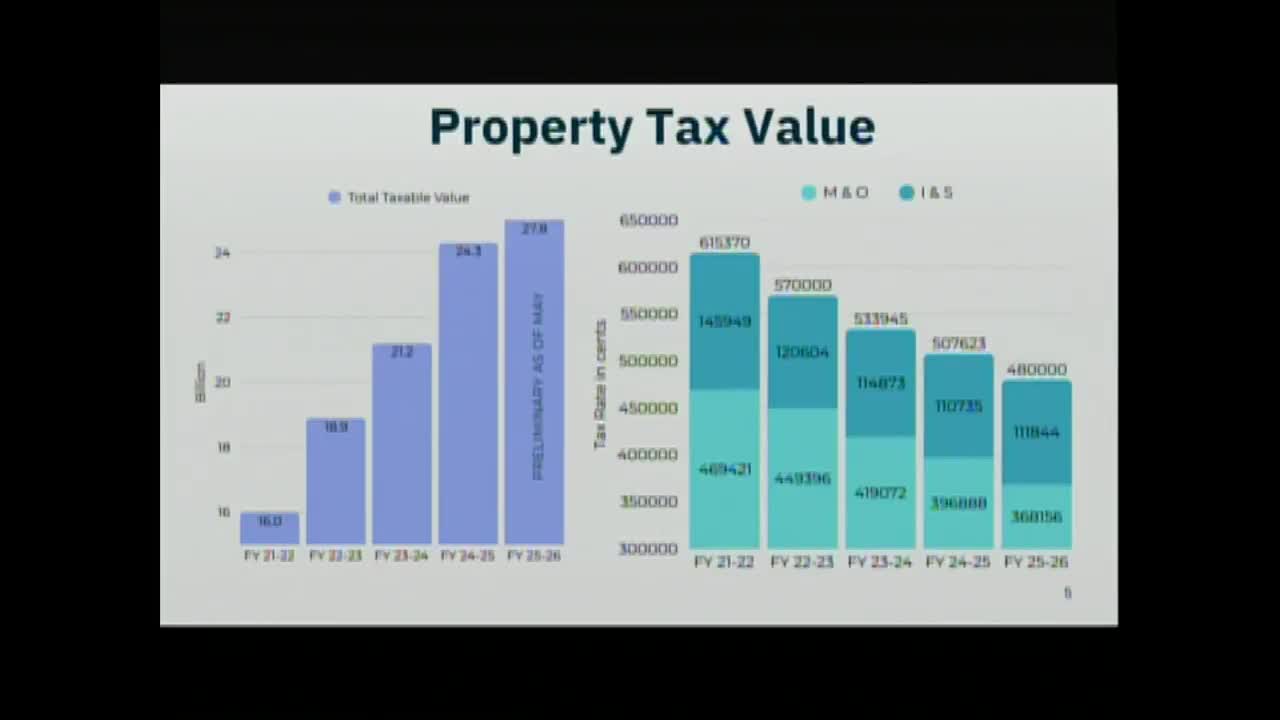
Jesus Esparza, budget department, presented updated revenue estimates and said the city’s preliminary taxable value is about $27.8 billion and that staff now expects about $98 million in property tax revenue for the general‑fund maintenance & operations (M&O) portion next year. “With now the preliminary values that come in, we’re projecting about $98,000,000 being generated through this the the new appraisal,” Esparza said. He and city manager Ramon Neff also flagged that some proposed expenditures and personnel requests would push general‑fund growth above the city’s 3.5% guideline.
The presentation said total projected general‑fund revenue for the current draft stands near $280 million while proposed unrestricted spending is about $289 million—leaving a multi‑million‑dollar shortfall unless the council directs changes in spending or revenue. “If we were to do nothing,” Esparza explained in a charted forecast, the city’s expenditures would outpace revenues as the year progresses.
Neff told council members staff will use a three‑phase approach as the city narrows the budget: 1) immediate fiscal discipline (freeze nonessential discretionary programs and review contracts), 2) concentrate on core municipal services (roads, water, public safety) and targeted financing for urgent repairs, and 3) selectively fund strategic projects after reassessing priorities and cost recovery. Neff said the city is also examining fee adjustments and other enterprise‑fund rate changes to reduce pressure on the general fund.
Staff asked council for direction on financing strategy tied to the recent bond referendum outcome. Esparza said the city’s tax assessor is running preliminary numbers showing a likely small drop—“about a 2¢ reduction in the overall tax rate” under current assumptions—but advised that the interest & sinking (I&S) portion of the rate (the share that pays debt service) could be increased to cover more capital if council prefers not to raise the M&O portion. “We’re projecting about a 2¢ reduction in the overall tax rate, and this is based on the constraints of the 3 and a half percent growth,” Esparza said. He added that proposed state legislation could change municipalities’ financing options if it passes in Austin.
Council members pressed for detail about cuts and revenue steps staff will recommend. Neff said staff will bring a balanced budget proposal forward in late July and use the June and August workshops to refine spending targets, including a review of unfilled positions and the results of an ongoing departmental efficiency study. “We’re going to present a balanced budget based on the number of cuts that we’re doing, reviewing our revenues again. We’re going to make those two lines match,” Esparza told council.
The workshop did not include any binding votes on tax rate or borrowing; staff said those formal actions would be scheduled separately under the city’s charter timetable for budget introduction, public hearings and adoption.