Get Full Government Meeting Transcripts, Videos, & Alerts Forever!
Get email alerts on the Grants And Contracting topic
No spam. Unsubscribe anytime.
MassDEP explains ECSDC grant contracting, invoicing and reporting requirements
Summary
MassDEP staff walked grantees through award letters, required registration forms, contract documents and monthly/final reporting templates for the Emerging Contaminants in Smaller Disadvantaged Communities (ECSDC) grants.
Abby Jacobs, ECSDC grant program manager at the Massachusetts Department of Environmental Protection, told grantees in a training webinar that award letters have been issued and that recipients must complete several administrative steps before receiving reimbursements.
The ECSDC grant program, administered by the U.S. Environmental Protection Agency and implemented in Massachusetts by MassDEP, provided about $38 million for federal fiscal years 2022–23 and an additional $19 million for fiscal 2024, Jacobs said. She said projects funded from those allotments must be completed by Sept. 30, 2029, or Sept. 30, 2030, depending on the award year.
MassDEP reviewed the contracting steps in detail so grantees can move from an award letter to a notice to proceed and then begin invoicing. "When you received the award letter, you received a grant contract intake form," Andrew Andresco, ECSDC grant program coordinator, said. Grantees must supply a unique entity identifier (UEI) via SAM.gov, complete a Massachusetts substitute W-9 form that collects the UEI, and—if applicable—register with the Commonwealth vendor portal COMMBUYS, Andresco said.
Andresco also described the settlement release process that applies when a grantee has incurred pre-contract expenses. He said MassDEP needs invoices and proof of payment for those expenses so the contract can set an appropriate start date tied to when "the shovel hit the ground," not the contract signature date. That settlement release frequently becomes the first reimbursement request.
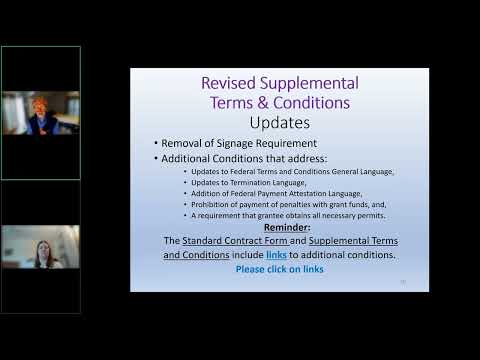
MassDEP will send a packet of contract documents that typically includes a standard contract form, revised supplemental terms and conditions, a project specifications form, a contractor authorized signatory listing, the Massachusetts substitute W-9, an EFT form for electronic payment, and, if applicable, a settlement release, Andresco said. The project specifications summarize scope, deliverables and milestones drawn from the grantee's scope-of-work and budget forms.
The agency provided templates grantees must use when requesting reimbursements and reporting progress. Andresco said the invoice template is a cover sheet that should include the grantee's letterhead, invoice numbers and dates, vendor names, brief descriptions and invoice amounts. Grantees should number reimbursement requests sequentially (the settlement release, if used, typically counts as reimbursement request No. 1), he said.
Monthly progress reports are due by the 15th of the month following the reporting period and must note project status, completed work, anticipated completion date and any delays or personnel changes. Andresco said the final report should include photos, data, lessons learned and a narrative of accomplishments; MassDEP reserves the right to post final reports on its website and will give grantees notice if it does so.
Why this matters: missing or incorrect administrative forms delay payments and can change contract start dates, which affects project timelines for infrastructure and treatment work that must finish before the EPA funding expiration dates.
Other details and next steps: Jacobs and Andresco urged grantees to contact MassDEP or the program director email for help with SAM.gov registration, the Massachusetts substitute W-9 template, COMMBUYS, or if their project scope or key contacts change. They emphasized that quick acknowledgement of MassDEP communications (within 72 hours) helps the agency process requests and payments.