Lifetime Citizen Portal Access — AI Briefings, Alerts & Unlimited Follows
Barnstable County charter review committee opens review; administrator, Cape Cod Commission and counsel offer preliminary recommendations
Loading...
Summary
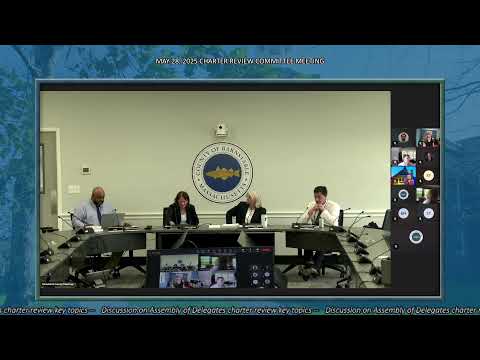
The Barnstable County Charter Review Committee opened its first formal stakeholder session May 28, 2025, at the Mary Pat Flynn Conference Center and agreed to invite town officials, municipal managers and other regional stakeholders as it begins a multi-month review of the county charter.
The Barnstable County Charter Review Committee opened its first formal stakeholder session May 28, 2025, at the Mary Pat Flynn Conference Center and agreed to invite town officials, municipal managers and other regional stakeholders as it begins a multi-month review of the county charter.
The committee’s work follows preliminary, section-by-section observations from Mike Dutton, Barnstable County administrator; an overview of the Cape Cod Commission’s authorities from Christy Sanatore, executive director of the Cape Cod Commission; and a proposed process for sorting topics from Lauren Goldberg, county counsel. The committee set a next meeting for June 25 and directed staff to begin outreach to select boards, town councils and town managers.
Why it matters: the charter establishes how the county’s legislative and executive branches function and how the Cape Cod Commission’s statutory authorities intersect with county law. Committee members described the review as an opportunity to update outdated references, clarify the allocation of powers and address procedural items — such as posting rules, quorum definitions and budget timing — that administrators said have caused confusion during recent business cycles.
Mike Dutton, Barnstable County administrator, detailed a slate of mostly nonstructural, technical edits he plans to deliver in a memo to the committee. Dutton reviewed specific charter sections and flagged language he said could be simplified or updated, including eligibility rules for delegates, the biannual election of the assembly clerk, quorum definitions for committee meetings, and inconsistencies around posting notice requirements. He urged caution on provisions that invite a quorum of delegates to committee meetings and recommended clarifying whether committees should be treated as full assembly meetings when most delegates are expected to participate.
Dutton also identified several matters with operational impact. He said the charter’s current limit on appointing an acting regional government administrator — three months with a single three‑month extension — may be too short for a national recruiting search and recommended making the period more flexible. He pointed to apparent conflicts in the fiscal sections over capital budget timing and recommended harmonizing deadlines, and he questioned a charter sentence that references the sheriff’s office as potentially obsolete. Dutton said he will circulate a written memo with suggested language to committee staff.
Christy Sanatore, executive director of the Cape Cod Commission, told the committee the commission was created by the Cape Cod Commission Act in 1989 as the region’s planning and regulatory agency and that the commission’s enabling statute and regulatory code should be considered alongside any charter edits. Sanatore said the commission is updating its regional policy plan and expects the commission to vote to release a draft for a 60‑day public comment period in late June or early July, followed by adoption later in the fall.
County counsel Lauren Goldberg recommended grouping the committee’s review topics into three categories to streamline the work: ministerial edits (typos, outdated references, and technology-related updates), large governance questions (form and separation of powers), and practical governance issues (grant oversight, committee practices, recall and dual-office-holding rules). "The elements that the assembly has provided for this committee can be broken down into maybe 3," Goldberg said, urging the committee to prioritize and sequence topics and to use stakeholder feedback to set the agenda for draft language.
Committee members and staff discussed stakeholder outreach and agreed to invite town managers, select board members, town councilors (including the Barnstable town council), municipal associations such as the Cape Cod and Islands municipal leaders group, the Cape Cod Chamber of Commerce, the League of Women Voters, the Association to Preserve Cape Cod, and representatives of the state delegation. The committee also agreed to try taking the review "on the road" by meeting with regional municipal groups to broaden participation.
The committee approved a routine motion at the start of the meeting to accept the minutes of the April 30, 2025 meeting (motion approved; Wayne Sampson recorded an abstention), and it adjourned by motion at the end of the session. The group scheduled its next meeting for June 25, 2025, and directed staff to begin stakeholder outreach and to circulate Dutton’s forthcoming memo and Goldberg’s proposed topic categorization.
The committee said its future work will include public stakeholder sessions and a sequence for moving ministerial edits forward quickly while reserving larger governance questions for extended public discussion and potential referral to the full assembly for ordinance or charter-change procedures.