Get Full Government Meeting Transcripts, Videos, & Alerts Forever!
Get email alerts on the Participatory Budgeting topic
No spam. Unsubscribe anytime.
Boston participatory budgeting pilot funds six projects with $2 million; advocates and some councilors press to grow fund
Summary
At a May 27 hearing of the Boston City Council Committee on Ways and Means, the Office of Participatory Budgeting presented results from its pilot year and a FY26 operating request that keeps a $2 million minimum for resident-chosen projects. Residents and council members said the allocation is too small and urged increases.
Boston City Council Committee on Ways and Means Chair Brian Worrell on May 27 heard a report from Renato Costello, director of the Office of Participatory Budgeting, on the office’s pilot year and the administration’s FY26 recommendation: a $2,134,250 operating budget and a $2,000,000 minimum allocation for participatory-budgeting projects, funded through a special revenue fund established by the PB ordinance.
The participatory budgeting, or PB, pilot ran from idea-collection in July 2024 through voting in January–February 2025. Costello told the council residents submitted roughly 1,200 ideas; staff and volunteers organized visioning forums that produced 15 proposals; the final ballot contained 14 projects and generated 4,460 votes. Six resident-chosen projects received awards totalling $2,000,000.
The pilot’s outcomes matter because the PB process was created to expand civic engagement and give residents direct control over a portion of public funds. Costello told the committee city staff and the office used prior appropriations and accumulated balances in a special revenue fund to sustain a $2,000,000 baseline for future cycles so the program can be predictable and not promise amounts it cannot guarantee.
Costello said the office rolled prior-year operating balances into a special revenue fund: about $1,999,000 moved into FY24, combined with an unspent FY24 allocation to create roughly $3,300,000 available; $2,000,000 was allocated to projects in the pilot, leaving an ending special revenue balance of about $2,700,000, and a projected $2,100,000 going into FY26 after the office holds a second-cycle award round.
Costello summarized the pilot’s results and winners. He said the process collected about 1,200 ideas, held three visioning forums (East Boston, Roxbury and Dorchester) with about 100 residents participating in those forums, and produced 14 ballot proposals that received 4,460 votes online and in person. Costello said six projects were funded citywide: expanded access to fresh food ($400,000); rat-prevention initiatives in dense residential areas ($500,000); programs for incarcerated and formerly incarcerated youth ($250,000); rental assistance for Boston youth ages 16 to 24 ($200,000); support for community gardens ($500,000); and benches at high-ridership public transit stops ($150,000). Costello added the office contracted an external evaluation team and prepared a public dashboard of submitted ideas and voting results.
Resident speakers who testified during the hearing urged a larger PB fund. Kathy Enriquez, an East Boston resident and member of the Better Budget Alliance, said turnout and engagement were strong during idea-collection and forums but that many residents were frustrated by the small size of the citywide pot: “Disappointment is the only word that I can think of right now to describe that energy that I felt afterwards,” Enriquez said, adding that she would like to see at least 1% of the city budget placed under direct resident control. Francesco Otenham, who described himself as a former manager of a youth participatory budgeting process, criticized what he called “process stagnation” and said PB should be a structure for democratic input at every stage rather than a single vote at the end of a narrow process: “Real participatory budgeting is a solution to that. It's not just a vote at the end of the process, but a structure, an infrastructure for democratic input at every stage,” he said.
Council members asked about outreach, sustainability and whether the program could be expanded. Councilor Flynn praised the collecting division staff’s service but said he was concerned about fiscal uncertainty and recommended a $1,000,000 decrease to the PB line as a demonstration of fiscal discipline. Other councilors — including Councilor Braden, Councilor Pepin and Councilor Mejia — spoke in favor of increasing PB funding over time and of working with community partners and council offices to boost turnout in neighborhoods with lower participation.
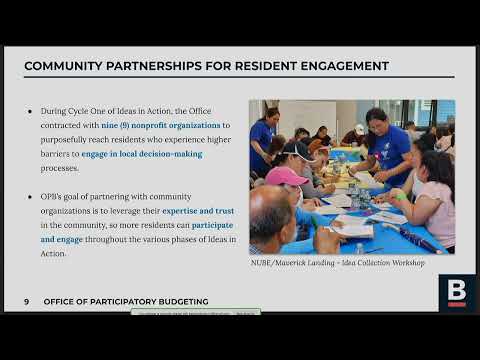
Costello and Ashley Grafberger, the city’s chief financial officer and chief of the finance cabinet, told the committee the office plans to expand partnerships with community organizations (about 18 groups applied to be partners for cycle 2), to add PB corners at city facilities, to explore BCYF (Boston Centers for Youth & Families) partnerships, and to make phone-line and web submission options available for accessibility. Costello said cycle 2 would kick off in July 2025, with idea review in August–September, proposal development October–December, voting January–February 2026, and project funding beginning in spring 2026.
The administration presented the PB funding approach as a balance between serving community demand and keeping an assured, sustainable baseline for future cycles. Costello said the office intentionally preserved a minimum of $2,000,000 in available project funding so future cycles can rely on a predictable amount even if annual appropriations fluctuate.
The hearing closed with calls from council members and public commenters for the council to consider amendments during the budget process to increase PB funding, and with the office promising quarterly or cycle-based updates and a public dashboard that will track project implementation and timelines.
Cycle 2 is scheduled to start July 2025; voting is planned for January–February 2026, and implementation timelines will be published as departments finalize plans.