Get Full Government Meeting Transcripts, Videos, & Alerts Forever!
Shelton council reviews draft camping ban, focuses on enforcement, legal risk and support services
Summary
At a May 27 study session the Shelton City Council discussed a draft ordinance to restrict camping on public property, reviewing enforcement procedures, legal risk and operational costs; staff said the draft is scheduled for a public hearing on June 3.
At a May 27 study session the Shelton City Council discussed a draft ordinance to restrict camping on public property, reviewing enforcement procedures, legal risk and operational costs; staff said the draft is scheduled for a public hearing on June 3.
City staff and the council focused discussion on how officers would respond in the field, what happens to a person’s belongings, the pathways for fines or criminal citations, and how the city could reduce litigation risk while coordinating with service providers. City staff repeatedly emphasized that the ordinance text is short by design and that the detailed implementation would be carried out through administrative policy and procedures developed by the city manager and involved departments.
Mark Ziegler, the city’s team manager, told the council that initial enforcement would typically begin with either a call for service or a proactive police contact: “the individual will be contacted in person, advised of the public camping ordinance, and given the opportunity to voluntarily leave,” he said. If a person accepts assistance or agrees to relocate, the ordinance text includes language allowing charges to be deferred and fines or penalties to be waived “to the degree permitted by law,” according to the bluelined draft staff presented.
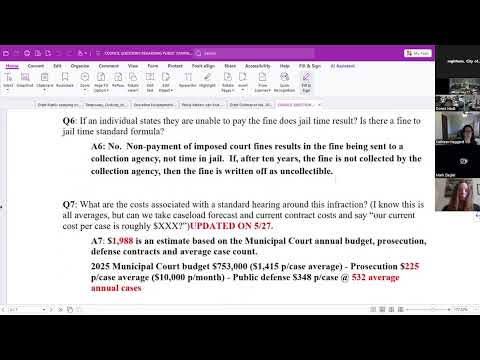
Staff outlined possible outcomes after a citation: if an individual remains after being cited, an officer could arrest the person; otherwise the person could be released with a court date. Ziegler also summarized state law on monetary fines, citing RCW 10.01.160 and noting that courts must consider indigence and may allow community service in lieu of monetary payment. The city attorney, Kathleen, cautioned that although the U.S. Supreme Court’s recent decisions change the landscape, the…
Already have an account? Log in
Subscribe to keep reading
Unlock the rest of this article — and every article on Citizen Portal.
- Unlimited articles
- AI-powered breakdowns of topics, speakers, decisions, and budgets
- Instant alerts when your location has a new meeting
- Follow topics and more locations
- 1,000 AI Insights / month, plus AI Chat