Get Full Government Meeting Transcripts, Videos, & Alerts Forever!
Get email alerts on the Regulatory Reform topic
No spam. Unsubscribe anytime.
Massachusetts announces cuts to 38 regulatory sets to ease burden on businesses
Summary
The Office of the Governor announced a package of regulatory changes that will rescind or revise 38 sets of state regulations and launch consumer- and business-facing modernization efforts, with officials saying the moves will reduce compliance costs and streamline services.
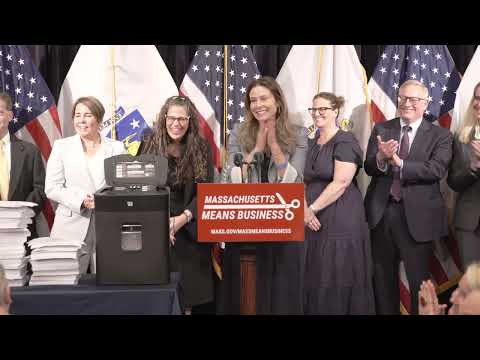
Governor, speaking at the Office of the Governor in Boston on Oct. 11, announced a first package of regulatory cuts and modernization measures aimed at reducing burdens on businesses and consumers across Massachusetts.
The governor said agencies reviewed more than 50 sets of regulations and are cutting 38 sets — "25% of the total of all regulations," she said — and detailed examples ranging from unit-pricing rules for grocery stores to requirements for barber poles and ski-area signage. "We're getting rid of that," the governor said of several rules she described as antiquated. "We're clearing the way so innovators can innovate and builders can build and entrepreneurs can thrive."
The announcement is part of the administration's broader economic agenda, which the governor tied to work begun under the Mass Leads Act and a recent energy infrastructure law. The administration asked agencies to look agency-by-agency at regulations and to solicit business feedback; officials said the work also identified modernization projects such as phasing out paper-only filings for banks and insurers and merging multiple licensing systems.
Ashley Stoba, interim secretary of economic development, called the package "one of many things" the administration is doing to streamline government and said the state will soon launch a "business front door," a website where businesses can request assistance and be routed to the correct state resource.
John Hurst, president of the Retailers Association of Massachusetts, praised the effort as "introspection" by state government after longstanding complaints from small business members about red tape. Brian Houghton of the Massachusetts Food Association said the unit-pricing regulations had not been comprehensively reviewed since 1996 and described the changes as a long-overdue modernization that would make compliance easier and help shoppers compare prices.
Undersecretary Leila D'Amelia said the Office of Consumer Affairs and Business Regulation (OCABRA) oversees about 150 sets of regulations in its portfolio and that staff worked nights and weekends to review what could be cut, amended or rescinded. She noted the Division of Occupational Licensure is leading a three-year project to consolidate three licensing platforms into one and that OCABRA recently deployed a new online registration platform for home improvement contractors.
Officials emphasized the reforms are intended to balance cutting unnecessary burdens with protecting public health and safety. Commissioner Sarah Wilkerson of the Division of Occupational Licensure said the changes to ski-area signage were not intended to reduce safety and could increase uniformity with national standards. "We don't think it's any less safe," Wilkerson said. "It's easier for the businesses to more cheaply acquire those signs, and it's more universal for the skiers to identify them."
The administration said some changes involve rescinding entire regulatory sets where divisions determine the rules are no longer necessary. Officials also said several consumer-protection and licensing reforms remain in active modernization projects, and the first package represents the "first installment" of ongoing work with businesses and the public.
Officials invited further feedback and said subsequent rounds of changes would follow. "Today is just a start," the governor said, asking businesses and residents to identify other regulations that cause delays or costs.
Clarifying details from officials included that agencies reviewed "over 50 sets" of regulations, OCABRA's portfolio includes about 150 sets, the administration counted the current package as 38 sets removed or revised (described as about 25% of the total identified in the review), and that roughly 1,200 people participated in the administration's initial economic-development planning process referenced by officials. Undersecretary D'Amelia also said the Division of Occupational Licensure licenses "over a half million people" in the Commonwealth and is leading a multi-year IT consolidation project.
No formal votes or legislative actions were taken at the announcement. Officials characterized the package as administrative regulatory changes and modernization work to be implemented through agency rulemaking and program updates, and they said additional stakeholder engagement will continue as the changes are implemented.
The event drew business and trade-group representatives including the Retailers Association of Massachusetts, the Massachusetts Food Association, the Greater Boston Chamber of Commerce, Associated Industries of Massachusetts and the Massachusetts Business Roundtable. Officials said the state will continue outreach and invited businesses to use the forthcoming online portal to report obstacles.
The governor concluded by saying the administration would continue to pursue regulatory reforms as part of a broader competitiveness agenda.