Get Full Government Meeting Transcripts, Videos, & Alerts Forever!
Get email alerts on the Renewable Energy Siting topic
No spam. Unsubscribe anytime.
Renewable‑energy siting emerged as flashpoint as counties and agencies debate limits on farmland
Summary
County planners and conservation groups described growing conflict over large renewable projects on farmland, while property‑owner and industry‑concerned witnesses urged expedited siting. Witnesses asked the legislature to reconcile energy goals with farmland protections and to use impact tests and coordination to reduce conflict.
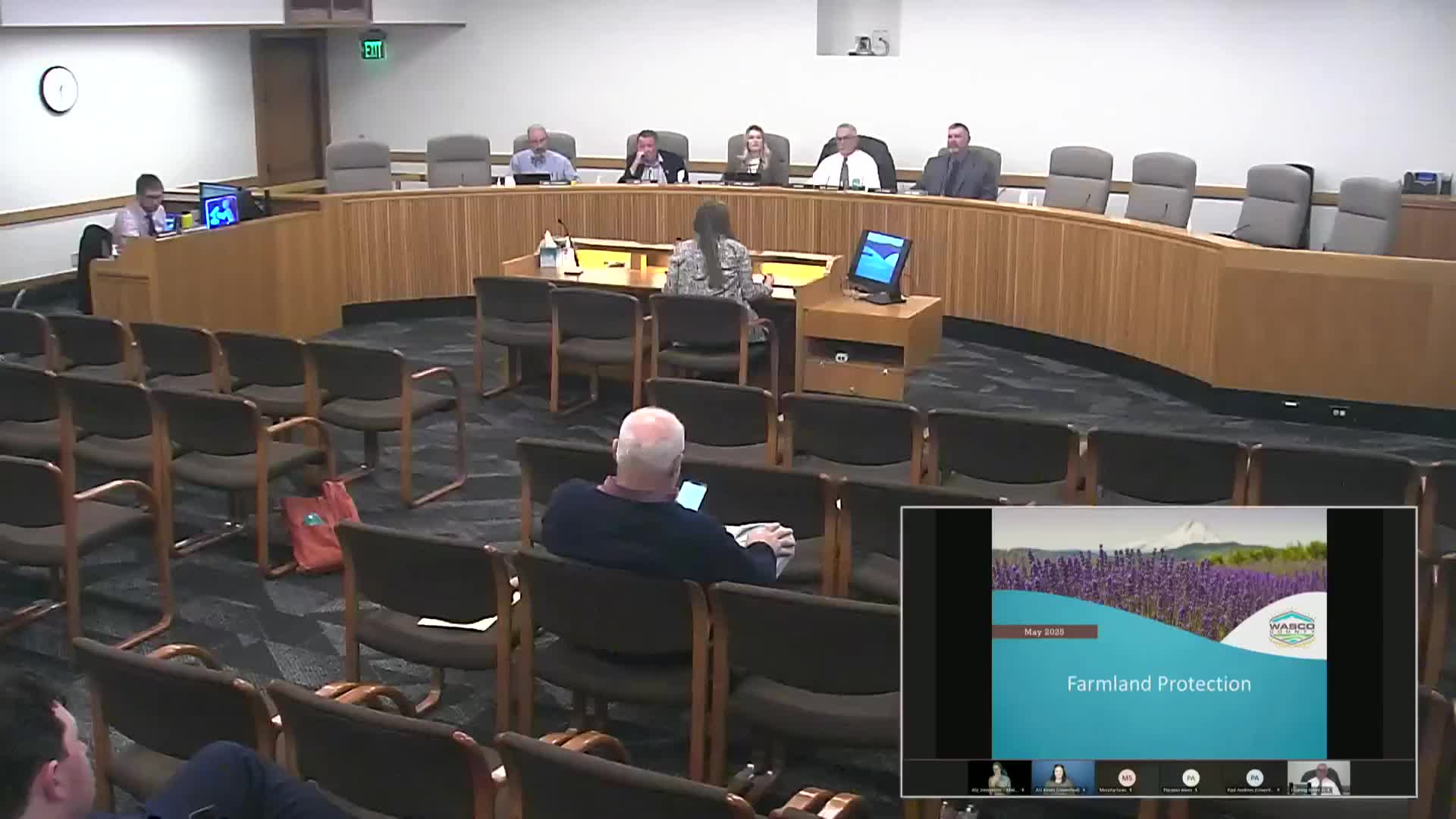
Renewable‑energy siting — particularly large solar projects — was a recurring concern at the Senate Committee on Natural Resources and Wildfire’s May 27 informational meeting on farmland protection.
Kelly Housley Glover, Wasco County’s community development director, said Eastern Oregon is seeing an increased number of commercial renewable projects and rising citizen fatigue with projects on agricultural ground. "We are definitely seeing a disparate more portioned amount of, commercial renewable energy popping up across Eastern Oregon," she said, and she urged stronger state‑agency coordination and alternatives such as prioritizing brownfield and urban sites.
Hillary Foote of DLCD explained the regulatory avenues: solar projects can be permitted under county processes or through a state exception route and the energy siting process. She told the committee that developers sometimes use exceptions and the energy facility siting process (state siting authority) to proceed even where local rules are more restrictive.
Several witnesses described the tension between statewide energy goals and farmland protections. Housley Glover told the committee that "there are some existing contradictions between the Oregon Energy rule and the land use planning rule," and she cited a recent Umatilla County conflict where siting review prevailed over local standards.
By contrast, Dave Honeycutt of the Oregon Property Owners Association said he supports broader renewable development on rural land. He framed renewable energy as a national and technological imperative: "Solar is absolutely essential," he said, adding that energy capacity is a national‑security concern and that Oregon is behind other states in production.
Speakers offered policy responses. County planners and conservation groups asked for a formal "farm impacts test" when new statewide measures affect EFU lands, improved interagency coordination, and stronger incentives to site projects on brownfields and inside urban areas. DLCD reiterated that its modernization program will examine such tradeoffs and that the agency can return to provide technical briefings to the committee.
No siting decisions were made at this informational session. Witnesses emphasized the need for clearer statutory direction to reconcile renewable‑energy buildout goals with Goal 3 agricultural protections and county land‑use authority.