Get Full Government Meeting Transcripts, Videos, & Alerts Forever!
Get email alerts on the Transportation Planning topic
No spam. Unsubscribe anytime.
Legislative committee hears consultants’ plan to centralize ODOT major-project delivery and increase transparency
Summary
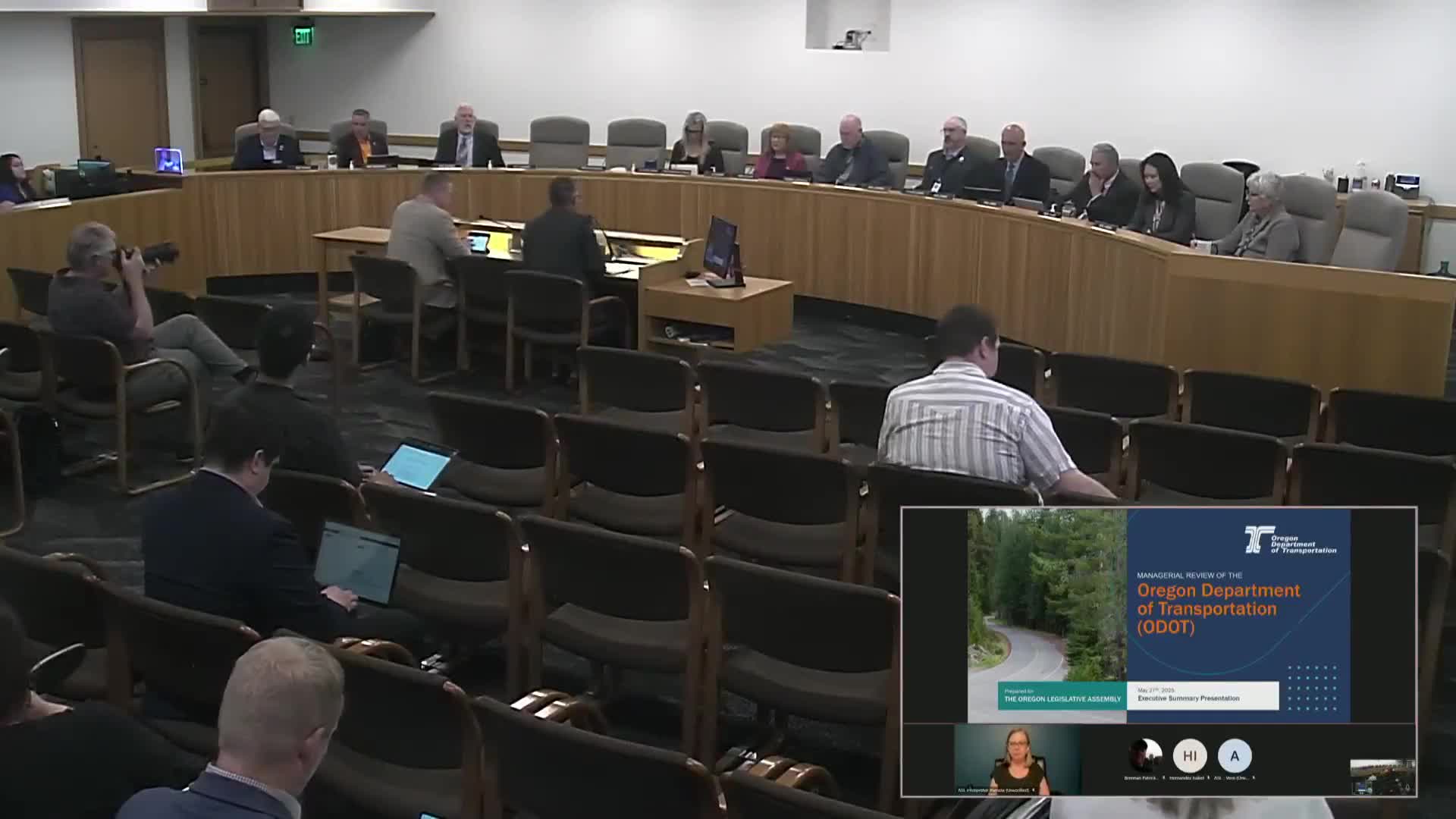
Consultants who reviewed Oregon Department of Transportation major projects told the state Joint Committee on Transportation Investment on May 27 that ODOT should centralize accountability for high‑cost projects, standardize contract processes and public reporting, and grow in‑house delivery capacity while using consultants to mentor staff.
Consultants who reviewed Oregon Department of Transportation major projects told the state Joint Committee on Transportation Investment on May 27 that ODOT should centralize accountability for high‑cost projects, standardize contract processes and public reporting, and grow in‑house delivery capacity while using consultants to mentor staff.
The recommendations, presented by Josh Lepley of Atkins Realis and Shane Marshall of Horox, urged converting the Urban Mobility Office into a Major Project Delivery Group accountable for delivering projects above a dollar threshold set by the legislature, instituting pre‑funding scoping and cost estimations, replacing legacy financial systems, and establishing a quarterly legislative review of major projects.
Why it matters: law‑makers and consultants said Oregon’s long lead times, inconsistent cost estimates and dispersed authority have contributed to rising project costs and delays. The presenters pointed to projects funded years ago whose scopes and costs changed substantially by construction time, and to examples where contract award to notice‑to‑proceed took as long as 18 months — a delay that increases price pressure.
Lepley, identified as a consulting engineer with Atkins Realis, summarized the review method and scope, saying the consultants “reviewed recordings,” stakeholder interviews and an internal 2024 strategic review, and focused on delivering major projects rather than ODOT’s entire program. He told the committee the team’s work included organizational structure, cost estimating and financial management, contract administration, risk management and decision making for major projects.
Marshall, identified as a consultant with Horox, summarized the recommendations as three overarching themes: “accountability, process improvements, and really transparency.” He said the first concrete recommendation is to “reform the urban mobility office into a major project group” that would own scope, cost and delivery for the largest projects and develop internal expertise. Marshall added the group could be accountable for projects above a legislatively determined dollar threshold — options discussed included thresholds in the $100 million range.
On staffing, the consultants told the committee the expertise to deliver major projects exists in ODOT but is scattered across regions and headquarters. “We think the department needs to be supplemented with consultants, with expertise in major project delivery,” Marshall said, while also recommending explicit scope in consultant contracts to “upskill staff” through mentoring so the state becomes less reliant on outside firms over time.
Several legislators pressed the presenters on outsourcing versus building internal capacity. Representative Bossard Davis warned the transportation “table” has grown too large and asked why the consultants did not recommend wholesale privatization. Lepley and Marshall said their recommendations favor preserving public ownership of projects and using private partners for design and construction where appropriate, with a blended approach intended to retain state ownership and to build internal capability.
On contract timing, presenters urged standardizing contract templates and limiting attorney‑general review to terms and conditions rather than revisiting scopes that cause months of delay. Lepley gave an example: “there was an example of one contract that was awarded and it took 18 months before they got to notice to proceed,” and added that prolonged procurement windows force contractors to price risk into bids.
The consultants recommended several procedural changes to reduce later scope change and cost growth: require a scoping, cost estimating and risk evaluation phase before projects receive construction funding; create intergovernmental agreements (IGAs) that document commitments between the state and local jurisdictions; adopt a risk‑based prioritization framework; and maintain a single public dashboard as the “one source of truth” showing project scope, schedule and budget.
They recommended higher contingency early in concept phases (Marshall said 30–40 percent contingency for 10–20% concept level work) and routine, scheduled reviews so the legislature and ODOT can track and agree on scope changes. The consultants suggested elevating the chief engineer’s role so that engineering sign‑offs are aligned with timely delivery and pushing more delegated authority to the lowest appropriate level in the organization to minimize delay.
Legislators raised concrete cost examples and asked whether inflation alone explains increases. Senator Pham listed projects with large increases in publicly cited figures and asked whether scope change or systemic estimating errors were the drivers. The presenters said both factors matter: construction‑input inflation (they cited a rough “15 percent year‑over‑year” example for some materials) and scope change together produce large differences from early estimates to final price. They emphasized better early scoping, a single dashboard, and quarterly legislative reviews to surface changes and choices while projects develop.
On procurement and legal review, the consultants said many DOTs use in‑house counsel for routine contract issues and reserve attorney‑general involvement for novel legal questions; they recommended stronger department‑based contract attorney capacity (CAU resources) to speed routine approvals. Committee members asked whether Oregon’s current reliance on the Department of Justice for contract review is typical; presenters said practice varies by state and urged ODOT to standardize templates to limit repetitive, lengthy DOJ reviews.
On oversight, the consultants proposed a statutorily recognized or legislatively empowered major‑projects committee that would meet quarterly with ODOT to review the dashboard and decisions. The presenters and several legislators framed the quarterly review as a place for transparency and for formally recording decisions about scope, funding and tradeoffs so that projects funded years earlier do not drift without legislative or public awareness.
No committee votes on project policy were taken at the meeting; the only formal action recorded was adoption of the committee’s proposed rules for the session. Several lawmakers asked the consultants for follow‑up briefings and said additional reviews (including inputs from the Transportation Commission and other reports) will be part of the continuing oversight process.
The consultants’ report and the committee discussion together frame next steps for the legislature and ODOT: formalize when scope and cost work must occur before funding, create a central major‑projects delivery office or codify its responsibilities, expand internal workforce development, standardize contracts and legal review, replace legacy financial and accounting tools, and stand up a public dashboard plus a regular legislative review. The presenters and legislators said those changes aim to reduce late scope growth, shorten procurement timelines and make cost data consistent and visible to decision makers.
The committee closed after the presentation and questions; the consultants and staff said they would return for further briefings as the committee schedules follow‑ups.