Get Full Government Meeting Transcripts, Videos, & Alerts Forever!
Get email alerts on the Farmloss Data topic
No spam. Unsubscribe anytime.
Witnesses disagree on scale and causes of farmland loss; economic viability emerges as central theme
Summary
Stakeholders at the Senate informational hearing differed on how much farmland Oregon has lost and why. County planners and farmland advocates highlighted conversion and parcelization, while property‑owner representatives questioned national census estimates and emphasized farmer attrition and economics.
Stakeholders at an informational meeting of the Senate Committee on Natural Resources and Wildfire on May 27 presented differing accounts of farmland loss in Oregon and what is driving it.
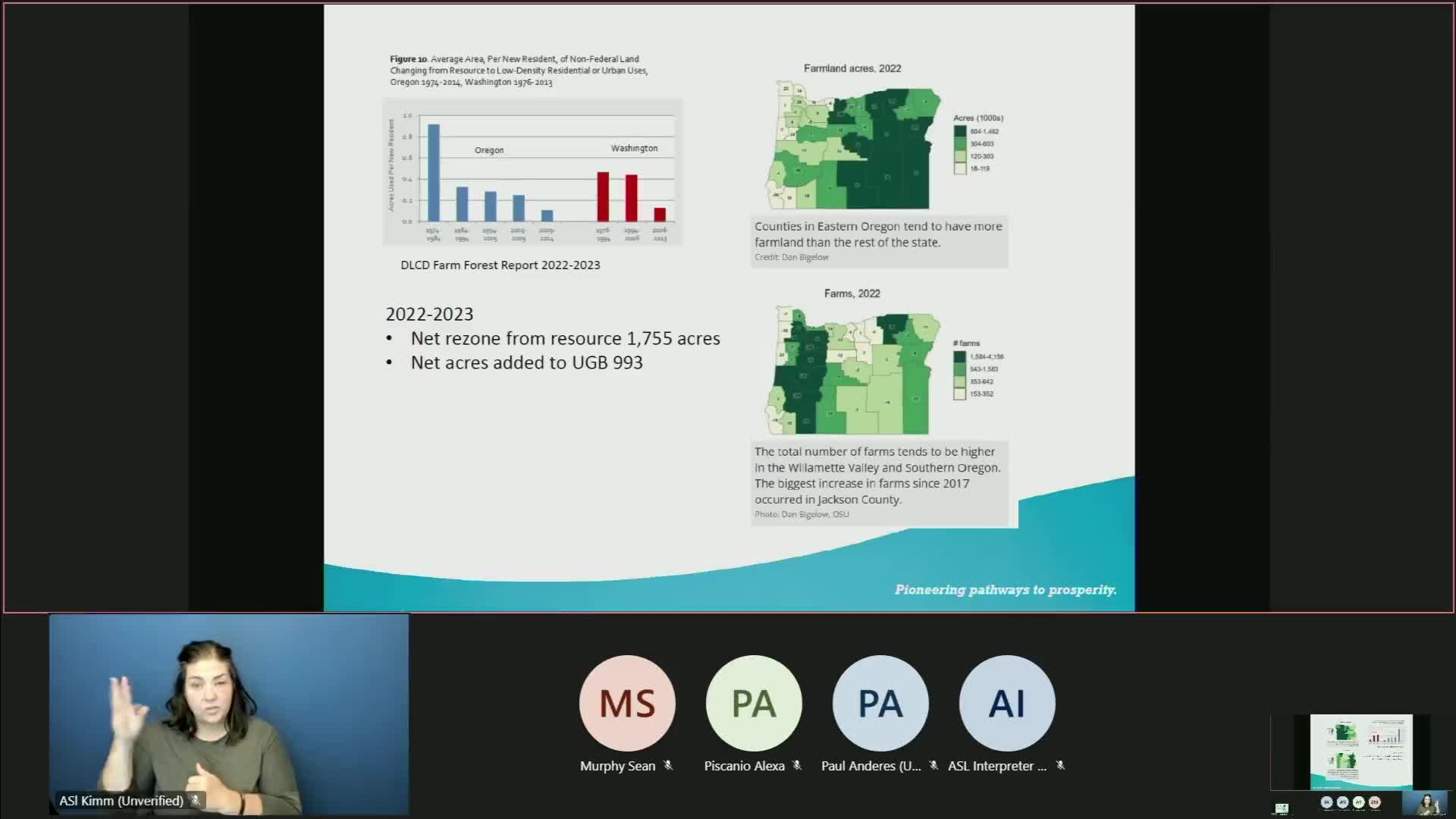
Kelly Housley Glover, Wasco County community development director and president of the Association of Oregon County Planning Directors, told the committee that DLCD’s farm and forest report shows about 2,700 acres were converted via exception or rezone in 2022–23, while approvals for nonfarm dwellings converted roughly 3,400 acres in the same period. "You can see why that nuance is really important when you're thinking about farm loss and farm, farm, loss and protection," she said.
Housley Glover also cautioned against using the U.S. Census of Agriculture without local verification. She said the 2022 census suggested a roughly 4% statewide loss and showed a 667,000‑acre decline that included a county entry showing 410,000 acres lost in Wasco County — a figure she described as inconsistent with local permitting and land‑use records.
Representing growers, Ryan Kraybill of the Oregon Farm Bureau said economic viability is the primary driver: "When farms can no longer support the families who operate them, that land becomes vulnerable," he said. Kraybill urged the legislature to reduce regulatory costs and craft policies that help farming remain economically viable so diversification into events, tourism or energy becomes less necessary.
Nellie McAdams, executive director of Oregon Agricultural Trust, listed three drivers she sees in her easement work: conversion to non‑ag uses, rising unaffordability, and the erosion of local agricultural infrastructure as farms fragment and services leave. She emphasized generational turnover—"about two‑thirds of Oregon's ag land is expected to change hands in 20 years," she said—and recommended funding the Oregon Agricultural Heritage Program to buy development rights and keep land in production.
By contrast, Dave Honeycutt of the Oregon Property Owners Association challenged the premise that Oregon is losing farmland. He cited state acreage figures and argued that most privately owned land remains in farm or forest zones. Honeycutt said the USDA census definition can count land that has temporarily ceased production as "converted," and he urged policymakers to focus on losing farmers — not land — and on measures that improve farm profitability.
Jim Johnson of 1000 Friends of Oregon and others presented data showing measurable loss of farm and range land over multi‑decade aerial and land‑cover studies and highlighted the "shadow" effect of nonfarm development on surrounding farms.
No member of the committee took formal action. Witnesses uniformly urged more careful data review, better local‑state coordination, and policy tools to bolster the economic viability of family farms.