Get Full Government Meeting Transcripts, Videos, & Alerts Forever!
Get email alerts on the Transient Lodging Tax topic
No spam. Unsubscribe anytime.
Revenue committee reviews transient lodging tax data gaps, administration and local uses
Summary
Legislative staff and Department of Revenue officials told the Oregon House Committee on Revenue on May 27 that collecting complete, reconciled data on local transient lodging taxes (TLT) is difficult because of differences in who administers taxes, whether rates are additive, and how local governments use proceeds.
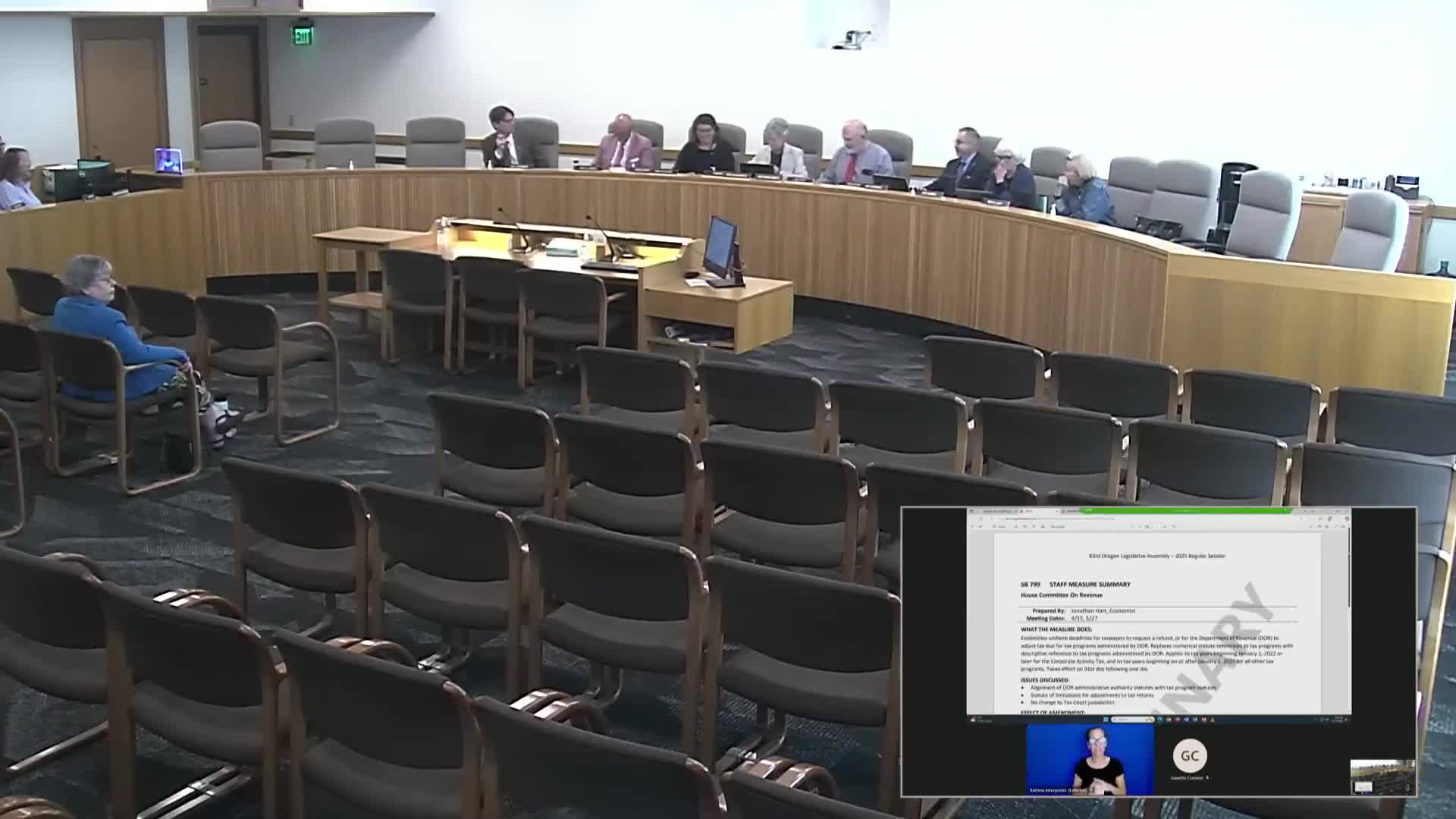
The Oregon House Committee on Revenue held an informational discussion May 27 on the state transient lodging tax (TLT) and the complexity of local TLTs, with Legislative Revenue Office staff and Department of Revenue officials telling lawmakers that assembling consistent, statewide data is time-consuming and incomplete.
Chris Alenac of the Legislative Revenue Office briefed the committee on three documents posted in OLIS: excerpts from LRO’s Basic Facts book about the state TLT, an Oregon Department of Revenue statistical report on the state tax, and an LRO “Issue Brief” summarizing local TLTs. Alenac said the state tax has existed since February 2003 and described several later rate changes. "It started at 1% in 2016. It went to 1.8% for 4 years and has been at 1.5% since 02/2020," he said while presenting committee materials.
Alenac and others told the committee the principal technical challenges are: identifying which jurisdictions impose local TLTs; determining whether listed city and county rates are additive or whether a city collects on behalf of a county; and finding how local proceeds are used. Travel Oregon (downloadable spreadsheets) and the Department of Revenue provide partial data, and the League of Oregon Cities is also collecting information, but reconciling those sources for all 36 counties and roughly 240 cities is labor-intensive.
Exanne Culver of the Department of Revenue told members that lodging providers must collect appropriate taxes and remit them either to DOR or separately to local governments depending on whether DOR administers a particular local tax. "For those that we do not administer for the local government they have to remit separately to those local governments," Culver said. She explained that when DOR administers a local tax, lodging providers report on a single return and DOR distributes funds to the local government; where DOR does not administer the local tax, providers file separate remittances.
Committee members asked several operational questions. Members discussed administrative efficiencies of having DOR administer local TLTs (one return versus multiple remittances), whether DOR charges a collection or administrative percentage, and how quickly DOR distributes local shares after receipt. Culver said DOR charges a percentage for administering local taxes but she did not have the percentage available; she offered to follow up. Culver said distributions to local governments occur the month after DOR processes returns and validates payments.
Lawmakers also asked about statutory limits on how local jurisdictions may use TLT proceeds. Committee materials and staff briefings noted that jurisdictions that enacted TLTs after February 2003 must generally follow a 70/30 rule: 70% for tourism-related activities (definitions in the handout) and 30% for city or county services. Jurisdictions that had TLTs before February 2003 were generally grandfathered and might use proceeds differently; some jurisdictions with long-standing taxes expanded rates later, which raises questions about whether only the newer increment is subject to the 70/30 constraint.
Members raised operational and policy concerns from smaller communities about cash flow. Culver and LRO staff said DOR’s processing and internal accounting require time to validate returns before distributions, and some small local governments prefer to manage collection themselves so they receive receipts more promptly.
The committee also asked why federal employees are exempt in some cases. Culver explained that "there is a prohibition for states and local governments to impose tax on the federal government," and that federal employees are exempt only when traveling on official federal business and when payment is made through official federal channels.
Representative Marsh told the committee that a statutory provision allows a lodging tax collector to retain a minimum of 5% of proceeds for collection responsibilities, citing the statute. Members discussed that actual retention rates and practices vary and that a comprehensive survey would be needed to report how much local collectors keep in practice.
Lawmakers asked staff to continue assembling a mutually exclusive dataset showing, by location, the combined total TLT that applies (sum of state, county and city rates) and to disambiguate where a city collects on behalf of a county. Committee members and staff said the effort is ongoing and that multiple data sources will need reconciliation before definitive statewide totals and use-of-proceeds breakdowns are available.
The informational meeting closed with the committee carrying over one remaining work session item (House Bill 2316A) to a future meeting when the fiscal-impact paperwork is available.