Get Full Government Meeting Transcripts, Videos, & Alerts Forever!
Get email alerts on the Farmland Protection topic
No spam. Unsubscribe anytime.
Oregon land-use framework aims to preserve limited farmland, DLCD tells Senate committee
Summary
State land-use officials briefed the Senate Committee on Natural Resources and Wildfire on Oregon's farmland-protection framework, the statutory limits on local and state roles, and the program's built-in flexibility including exceptions and allowable nonfarm uses.
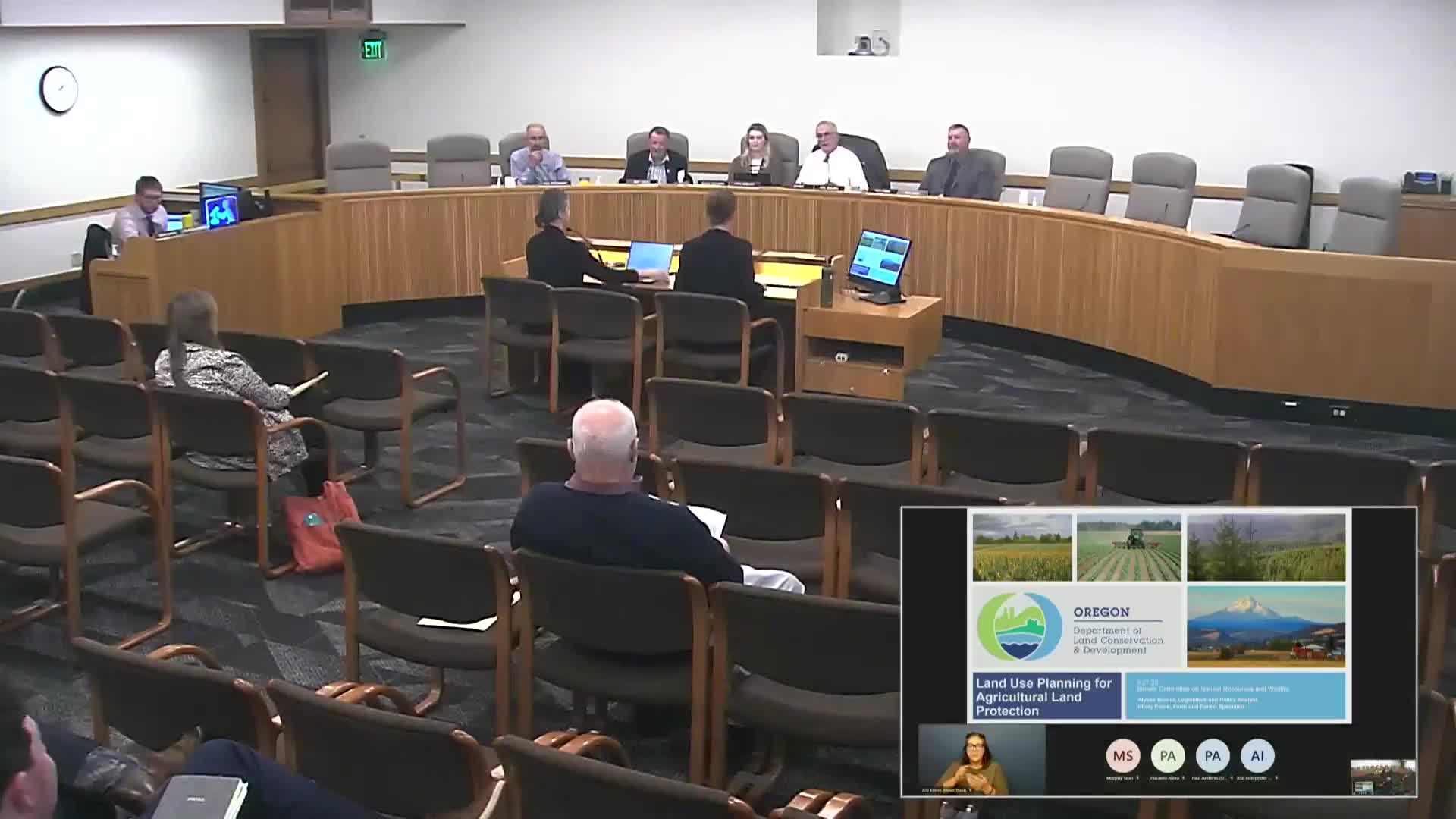
The Department of Land Conservation and Development told the Senate Committee on Natural Resources and Wildfire on May 27 that Oregon’s statewide land‑use framework is designed to preserve limited farmland and to concentrate urban development inside urban growth boundaries.
Alyssa Benini, legislative and policy analyst with the Department of Land Conservation and Development, said the program’s foundation is the Oregon Land Use Act of 1973 and the related statutory protections added afterward. “The statewide land use planning program began with the Oregon land use act of 1973, which was made up of Senate Bill 100 and Senate Bill 101,” Benini said.
The agency emphasized three core ideas: protecting resource lands through farm and forest zoning, planning urban communities inside urban growth boundaries to concentrate services, and state oversight of locally adopted comprehensive plans. Hillary Foote, DLCD’s farm and forest land‑use specialist, told the committee the state defines agricultural land primarily by soils data produced by the Natural Resources Conservation Service and that those soils‑based definitions underpin Goal 3 of the statewide planning goals.
DLCD staff reviewed how the program allows a growing set of statutory nonfarm uses on exclusive farm use (EFU) land. Foote said the list of permitted nonfarm activities has expanded from a handful in the 1960s to more than 60 today, split into “sub 1” uses that counties must allow and “sub 2” uses that counties may choose to allow after a conditional‑use review. She also described the exceptions process under Goal 2, which permits waivers for sites with exceptional circumstances, and gave Crane Hot Springs in Harney County as an example of a recent goal‑3 exception.
Foote told the committee that counties are responsible for inventorying rural lands, adopting local comprehensive plans, permitting most nonfarm uses, and enforcing those decisions. DLCD’s role is to set statewide policy (through the Land Conservation and Development Commission) and to acknowledge local plans for consistency with state goals.
On energy siting and farm land, Foote said state rules allow some solar development on high‑value farmland but noted options such as county exceptions and the energy siting process. “Our rules do permit solar projects with a 12‑acre footprint on high value farmland,” she said.
DLCD closed by describing its multi‑year Farm and Forest Modernization Program, a stakeholder process intended to review how the program is working and to recommend changes. Foote said DLCD is continuing work on that multi‑year effort and offered to return to the committee to brief the group on details.
The session was informational; no committee action was taken. The presentation established the statutory and administrative framework that other witnesses referenced in subsequent testimony about farmland loss, nonfarm dwellings and conversions, and possible policy responses.