Get Full Government Meeting Transcripts, Videos, & Alerts Forever!
Get email alerts on the Cascadia Preparedness topic
No spam. Unsubscribe anytime.
Officials warn Cascadia quake planning may be overwhelmed; county estimates differ from older state figures
Summary
Panelists told a Senate informational hearing that Cascadia Subduction Zone models and local assessments show potentially catastrophic impacts that would quickly overwhelm local response; county and regional studies show higher or differing casualty and displacement estimates than older statewide figures.
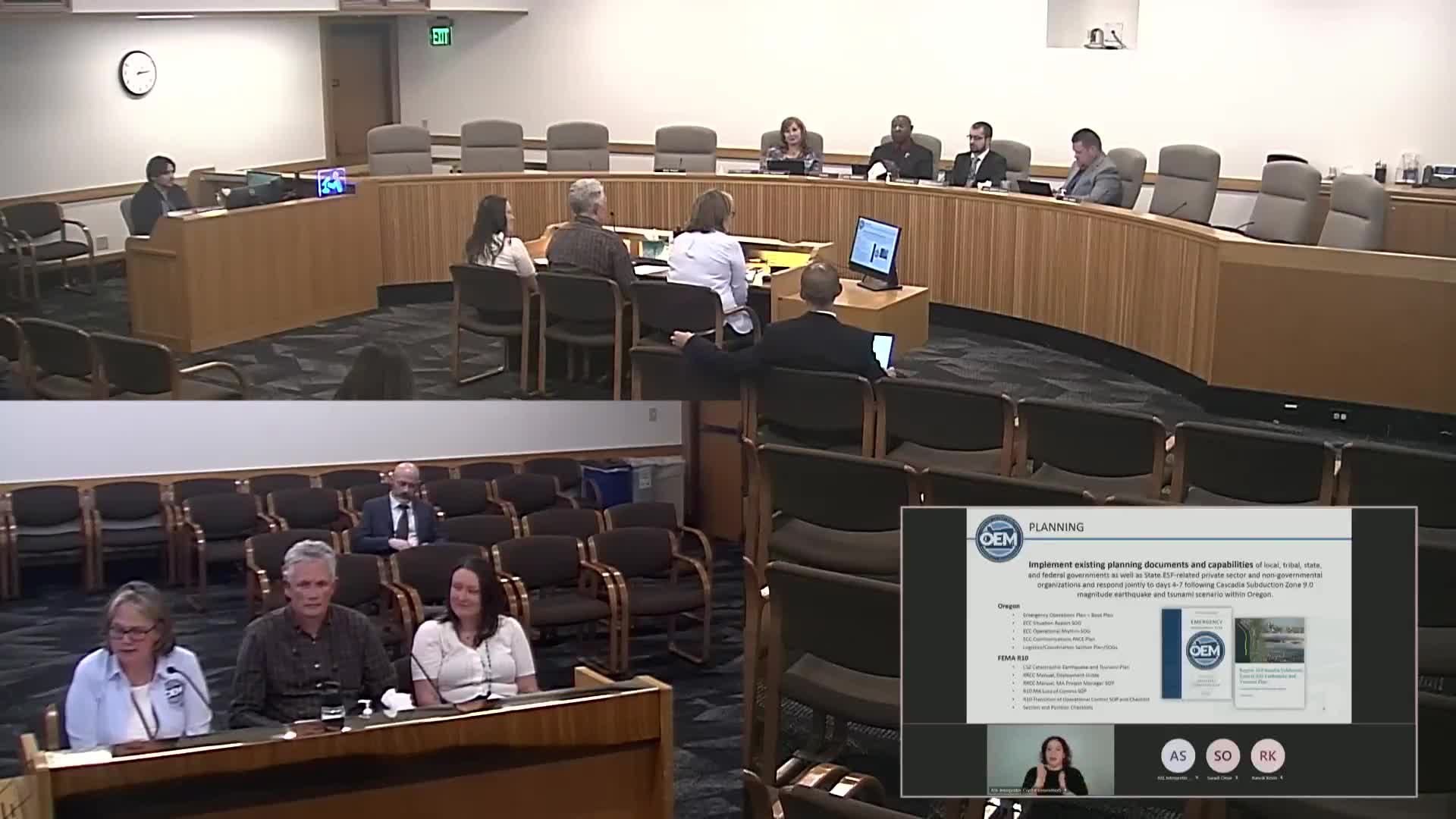
Senators and emergency managers at a May 27 informational hearing discussed the scale of a potential Cascadia Subduction Zone earthquake and the limitations of current planning data.
John Wheeler, manager of Washington County Emergency Management, cited a March 2018 Portland-Metro loss-estimation study that estimates about 14% building loss for the metro area, roughly 38,000 long-term displaced people in Washington County and about 8,000 casualties under that scenario. Wheeler said the models vary by scenario and noted worst-case results are worse if the ground is wet.
Patience Whittingham, deputy director of the Oregon Department of Emergency Management, referenced statewide planning documents and earlier Cascadia numbers and said the data are evolving. Whittingham told senators some widely cited state numbers date to 2011 and recommended consulting the Oregon Seismic Safety Advisory Council and more recent Department of Geology and Mineral Industries work for updated estimates.
Senator Brock Smith (Coastal Caucus) pressed for candid, up-to-date counts for displaced populations and deaths, telling the panel that some coastal communities may face very high mortality and isolation if bridges and roads collapse. Chair Manning and other members noted gaps in infrastructure and the costs required to address high-hazard dams and other aging systems.
Speakers emphasized that planning assumptions vary by scenario, by time of day and by local conditions. Wheeler said planners assume in a catastrophic event that fuel available after shaking will be the fuel already in ground storage and that transportation and utility networks could be critically disrupted, further limiting response.
The hearing did not adopt policy; panelists encouraged updated regional assessments and continuing exercises and mutual-aid planning to refine numbers and priorities.