Get Full Government Meeting Transcripts, Videos, & Alerts Forever!
Get email alerts on the State Police Budget topic
No spam. Unsubscribe anytime.
Subcommittee advances $711.9 million Oregon State Police budget; members warn of understaffing and push for more resources
Summary
The Public Safety Subcommittee approved the Legislative Fiscal Office recommendation for House Bill 5029, funding the Oregon State Police at $711.9 million for 2025–27. Lawmakers expressed concerns about trooper staffing levels, wellness funding and requested support for drug, human trafficking and animal-cruelty enforcement in rural counties.
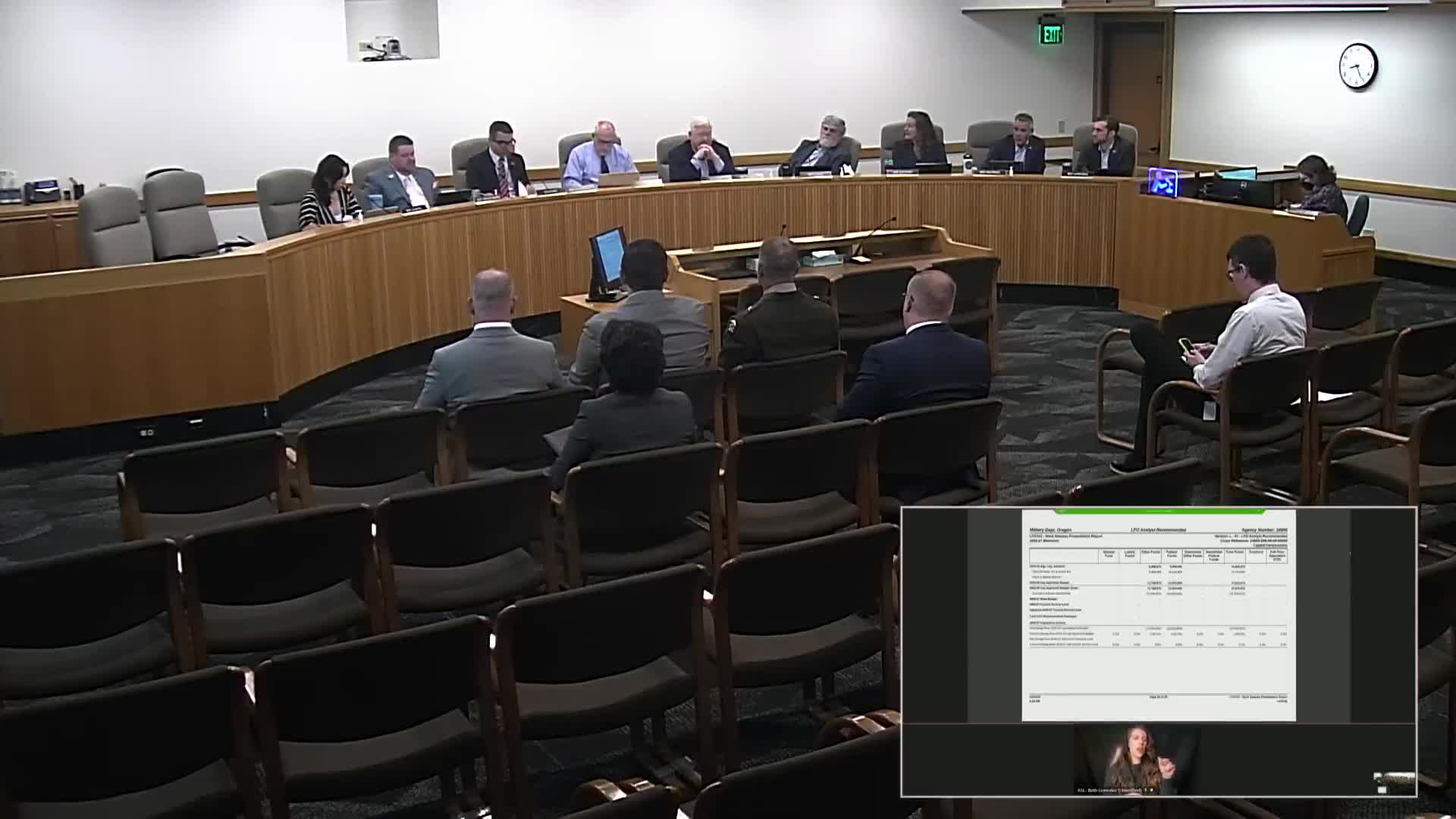
The Public Safety Subcommittee on May 28 voted to move House Bill 5029, the Oregon State Police primary budget measure, to the full Ways and Means Committee with a due-pass recommendation. The LFO recommended total funding of $711,900,000 for the 2025–27 biennium, supporting 1,390 positions (1,388.52 FTE).
LFO staff described a large restructuring in the department’s presentation and walked members through pages that shift budgets from the old structure into the department’s new organization. The recommendation includes $547,900,000 General Fund, $11,900,000 in lottery funds, $135,400,000 other funds and $16,600,000 federal funds. LFO said the department can carry forward approximately $2,000,000 in American Rescue Plan Act funds through Dec. 31, 2026, to support construction and improvements in Central Point, Springfield and other sites.
The subcommittee approved several LFO packages in the dash 1 amendment: reclassifications to bring positions on budget, establishment of eight positions to stand up the court-ordered record-of-arrest and prosecution background program (one-time general fund for 2025–27 with future fee funding), funding for trooper positions and compliance specialists, and Forensic Science Service investments including $2,000,000 for intoxilyzer instruments and a permanent fund shift for DUI breathalyzer-related programs.
Members spent substantial time on the department’s key performance measures (KPMs). Representative Judson asked whether targets had been changed because “9 out of the 10, the last reported result is lower than the target.” LFO staff responded that targets were updated to better align with prior outcomes and that the department had explained under-performance and plans to improve.
Several lawmakers voiced concern about officer staffing and wellness. One senator told the subcommittee trooper staffing is “at or...below 1985 levels” while the state’s population has grown substantially, stressing troopers and local departments that rely on them. Representative Helprich said mental-health and wellness programs are critical, noting the stresses on officers and urging anyone who is struggling to seek help: “If you see something, say something… it’s okay to go seek help.”
Lawmakers from southwest Oregon described persistent drug and human-trafficking problems and asked the superintendent for resources to support a regional drug-enforcement and human-trafficking capability; those members detailed a recent multiagency operation that seized what they described in committee as roughly 80 grams of methamphetamine, 44 firearms including one altered into a machine gun, 8 grams of cocaine, and about $1.6 million in cash and financial instruments. The subcommittee thanked the superintendent and agency leadership for their testimony and said they would try to find additional resources before the session’s end.
Actions: the subcommittee adopted LFO’s dash 1 amendment and moved House Bill 5029, as amended, to the full Ways and Means Committee with a due-pass recommendation. The vote carried without recorded roll-call opposition.