Get Full Government Meeting Transcripts, Videos, & Alerts Forever!
Get email alerts on the Education Workforce topic
No spam. Unsubscribe anytime.
Teachers tell Senate committee emergency licensing, multiple jobs and class-size pressure are straining classrooms
Summary
Educators who testified May 28 told Oregon senators that growing numbers of teachers on restricted or emergency licenses, widespread need for second jobs, and evolving staffing assignments are increasing workload and threatening program continuity.
Teachers from multiple districts told the Senate Education Committee May 28 that workforce shortages and credentialing pressures are reshaping classroom assignments and increasing burdens on individual educators.
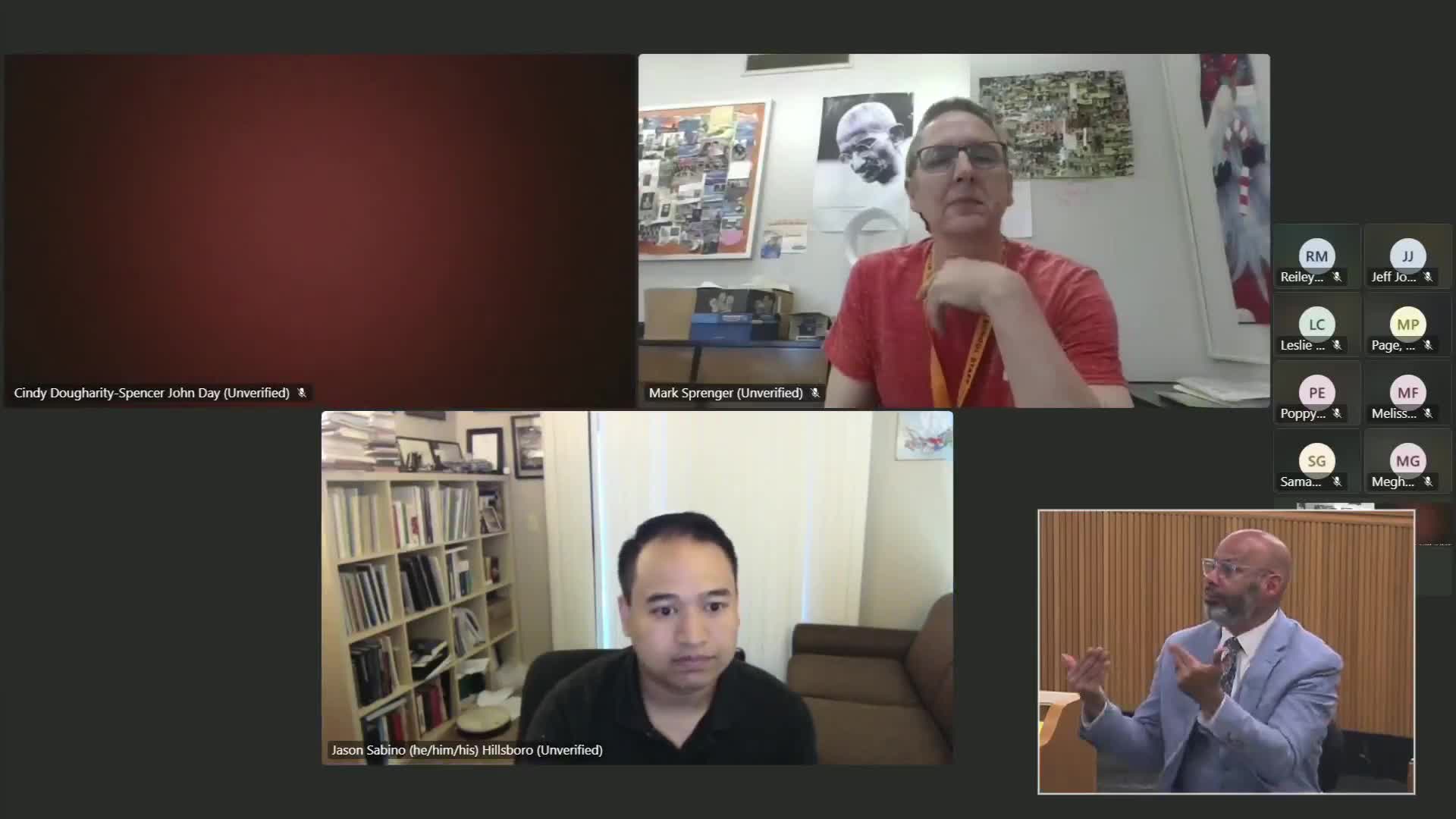
"It's unsustainable and it's becoming a norm," Jason Sabino, a choir director who teaches at R. A. Brown Middle School and Century High School, told the committee, referring to the rise in educators working without completed credentialing. "I'm on a restricted emergency license and like nearly 2,000 other Oregon educators this year. That number has grown by over 40% in just 1 year."
Sabino described working across two campuses, taking a second job as artistic director of a community choir to supplement household income, and losing part of his high-school full-time-equivalent assignment because of an involuntary staffing shift. He said cuts had nearly eliminated one of his three high-school choirs and that next year he may be reassigned to teach middle‑school physical education, a subject for which he has no background.
Other witnesses highlighted class-size pressure and the importance of paraprofessionals. Leslie Curran, a second-grade teacher, said a class size of 16 to 18 with an instructional aide is ideal for early grades; she reported having 23 pupils this year and 27 last year. Multiple witnesses warned that looming budget cuts would raise elementary classroom sizes by three to five students in many districts.
Mark Springer, a longtime math teacher, described programs such as "J Term" that support credit recovery and enrichment, and urged further investment to reduce class sizes and expand services for special education, English learners and mental-health supports.
Several teachers asked lawmakers to consider recruitment and retention measures, review emergency-licensing processes, and fund scheduling and staffing that match program realities. Senators thanked the witnesses and said the committee would consider the testimony during budget and policy deliberations.
No formal action was taken during the informational hearing.