Get Full Government Meeting Transcripts, Videos, & Alerts Forever!
Get email alerts on the Housing Omaha Bedbugs topic
No spam. Unsubscribe anytime.
Nebraska Legislature fails to override governor’s veto of bill targeting bed‑bug conditions in Omaha public housing
Summary
Senators debated whether to override Gov. Jim Pillen’s veto of LB287, which would have required Omaha Housing Authority to disclose and remediate infestations and allowed the City of Omaha permissive authority to enforce codes. The motion to override failed on a 24‑24 roll call.
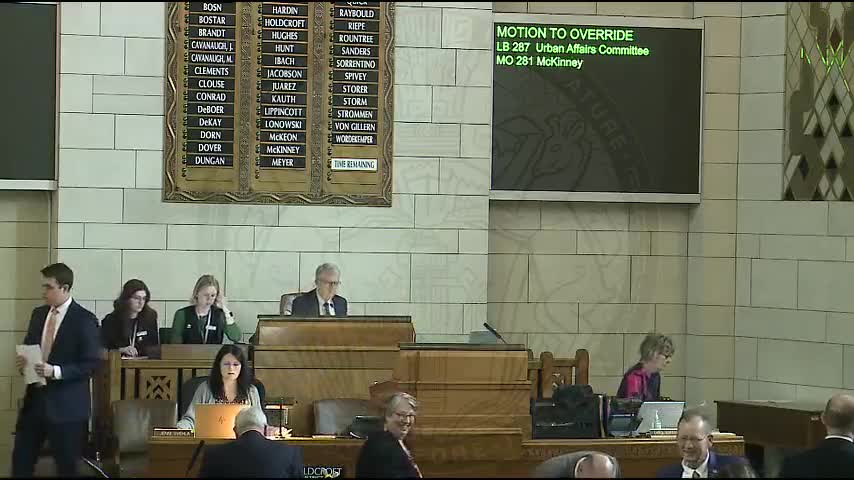
Senators on the Nebraska Legislature debated and then failed to override Gov. Jim Pillen’s veto of LB287, a package bill intended to increase accountability for the Omaha Housing Authority and require disclosure and prompt remediation of infestations such as bed bugs. Senator Justin McKinney introduced the motion to override; the roll call ended in a 24‑24 tie, so the veto stood.
Supporters said the bill would give city officials optional tools to address longstanding infestations and protect tenants’ health and dignity. Opponents cited constitutional and taxation concerns tied to an unrelated amendment in the same package that would affect sanitary improvement district (SID) assessments.
LB287, sponsored through the Urban Affairs Committee and advanced by Senator McKinney, would have required the housing authority to notify prospective tenants of known infestations, limit leasing of units known to be infested, and set timelines for remediation. The bill also included language from another senator concerning SID assessment authority that several senators said raised potential constitutional issues.
Senator McKinney, who led floor debate for the override, said the measure was permissive for the City of Omaha and aimed at public health and human dignity. “We’re giving you additional powers to hold the Omaha Housing Authority accountable,” McKinney said, adding that many residents live in towers that the senator described as infested and vulnerable. He asked colleagues to “think about the people who are living in these conditions.”
Senator John Kavanaugh, who also supported the override, said the bill “doesn’t tell the city it has to do it. It says if they want to do that, they have it,” and described repeated complaints and federal litigation over conditions in OHA properties. Several other senators — including Senators Spivey, Gareca, Duncan, Conrad and Rountree — described tower residents as primarily elderly, disabled or on fixed incomes and urged the body to act.
Opponents focused on a provision added to the package relating to SID assessments (referred to during debate as LB321). Senator Hallstrom, among others, said newly surfaced legal concerns and recent court interpretation raised questions about taxing property located outside of an SID’s corporate boundaries. Senator Klaus said he wanted to give Omaha’s newly elected mayor and administration time to act before overriding the veto.
Senator Sanders, whose separate bill on SIDs was incorporated into the package, said she considered that amendment “unfriendly” when it was added and that she would continue work on that issue later. Several senators who voted for LB287 on final reading explained on the floor that they later changed their votes on the override because of the SID questions or because they wanted more time for local officials to act.
After extended debate and a recorded roll call, the motion to override the veto failed on a tie vote, 24 ayes and 24 nays. The clerk’s roll call listing is recorded in the legislative transcript.
The vote leaves in place Gov. Pillen’s veto message, which said the bill was redundant with existing authorities; proponents countered that local officials and federal oversight have not remedied the reported conditions, citing at least one federal class‑action lawsuit and continuing tenant complaints. Advocates said they will continue to press for remedies through future legislation, local action or litigation.