Get Full Government Meeting Transcripts, Videos, & Alerts Forever!
Get email alerts on the Education Mental Health topic
No spam. Unsubscribe anytime.
Oregon teachers tell Senate committee student mental-health gap and special-education strain are crippling classrooms
Summary
Teachers and special-education staff told the Senate Education Committee during a May 28 informational hearing that rising student trauma and chronic shortages of mental-health services and special-education staffing are producing more disruptive behavior, long paperwork burdens and daily crisis responses that reduce instructional time.
Chair Frederick and members of the Senate Education Committee heard repeated testimony May 28 from classroom teachers and special-education staff that shortages in mental-health services and special-education staffing are producing emergency-level behavioral incidents and swallowing staff time.
The witnesses said students arriving with unmet basic needs and untreated trauma are increasingly dysregulated in class, and that existing school counselors and mental-health providers are insufficient to meet demand.
"The extreme needs of the students paired with the lack of staff combined with the paperwork needs and the high needs parents in special education is really not a sustainable job at this time," Poppy Elshaug, a special-education teacher at Grant Watts Elementary School, told the committee. "Special education is gonna implode the public school system if something isn't done on a much larger scale than my building and my district."
Elshaug described daily physical assaults on staff — kicking, biting, spitting and thrown chairs — and said rising behavior needs force special-education teachers to spend hours on documentation and scheduling rather than instruction. She told senators she spends roughly "2 to 3 hours" a day on required paperwork, and that she wrote "over 125 schedules last year" to cover rapidly changing student needs and staff shortages.
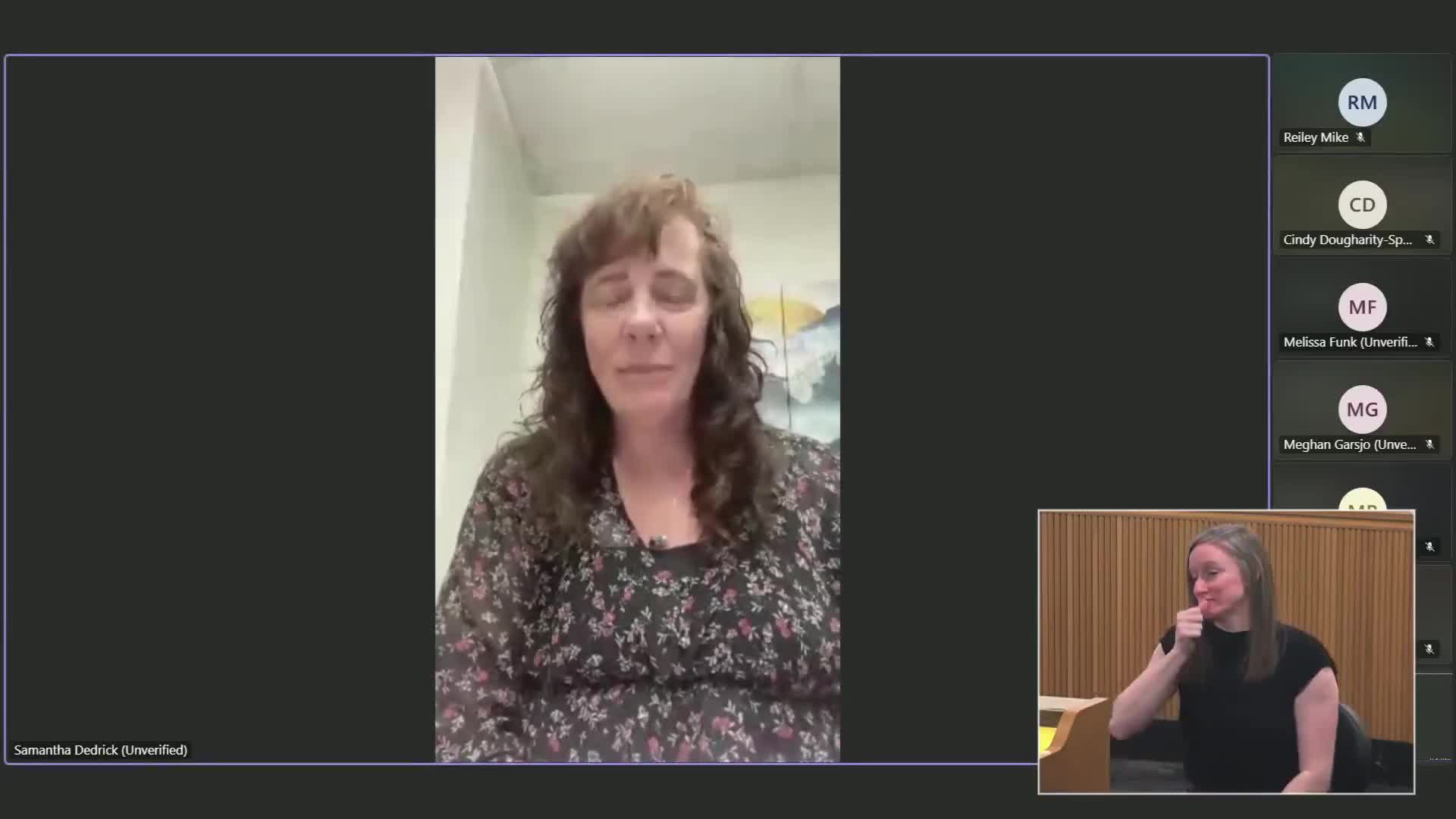
Teachers from rural and coastal districts echoed the call for more mental-health staffing. Samantha Dedrick, a first-grade teacher at a dual-language school, said post-pandemic cohorts show "a lack of empathy, a lack of social skills, a lack of resiliency" and that counselors and behavior specialists can no longer keep up when several students per classroom need intensive support. Cindy Doherty Spencer of Grant Union Junior Senior High said her district for the first time in 15 years had a full-time counselor funded by a federal grant, and she worried that the position would be lost when one-time funds expire.
Committee members pressed witnesses on root causes and prevention. Elshaug said schools are largely reactive; she and others pointed to unmet basic needs — housing instability, food insecurity, family trauma — and limited community mental-health capacity as upstream problems that leave teachers responding to acute incidents rather than preventing them.
Elshaug and other witnesses asked the committee for stable, increased funding for school-based mental-health services, more dedicated special-education staff, and policies that reduce paperwork burdens that currently divert teacher time from students.
If the committee chooses to act, staffers and teachers suggested investments in permanent counselor positions, increased recruiting and retention for special-education roles, and community-level mental-health capacity-building. Senators thanked the witnesses and said the hearing would inform future policymaking but did not announce immediate proposals.
The hearing included multiple teacher speakers across districts and grade levels; their testimony to the committee covered both classroom observations and program-level needs.
Looking ahead, witnesses said the demand for sustained mental-health services is likely to continue without targeted state or federal investment and urged lawmakers to consider funding models that avoid sudden loss when grants expire.