Get Full Government Meeting Transcripts, Videos, & Alerts Forever!
Get email alerts on the Capital Punishment Procedures topic
No spam. Unsubscribe anytime.
Senate panel clarifies execution procedures and witness rules in bill backed by governor's office
Summary
House Bill 394, presented by the governor's office, would clarify who serves death warrants, set timing rules for resetting executions after stays, and allow the corrections secretary discretion over spiritual advisers and witness seating; the committee reported the bill favorably despite one objection.
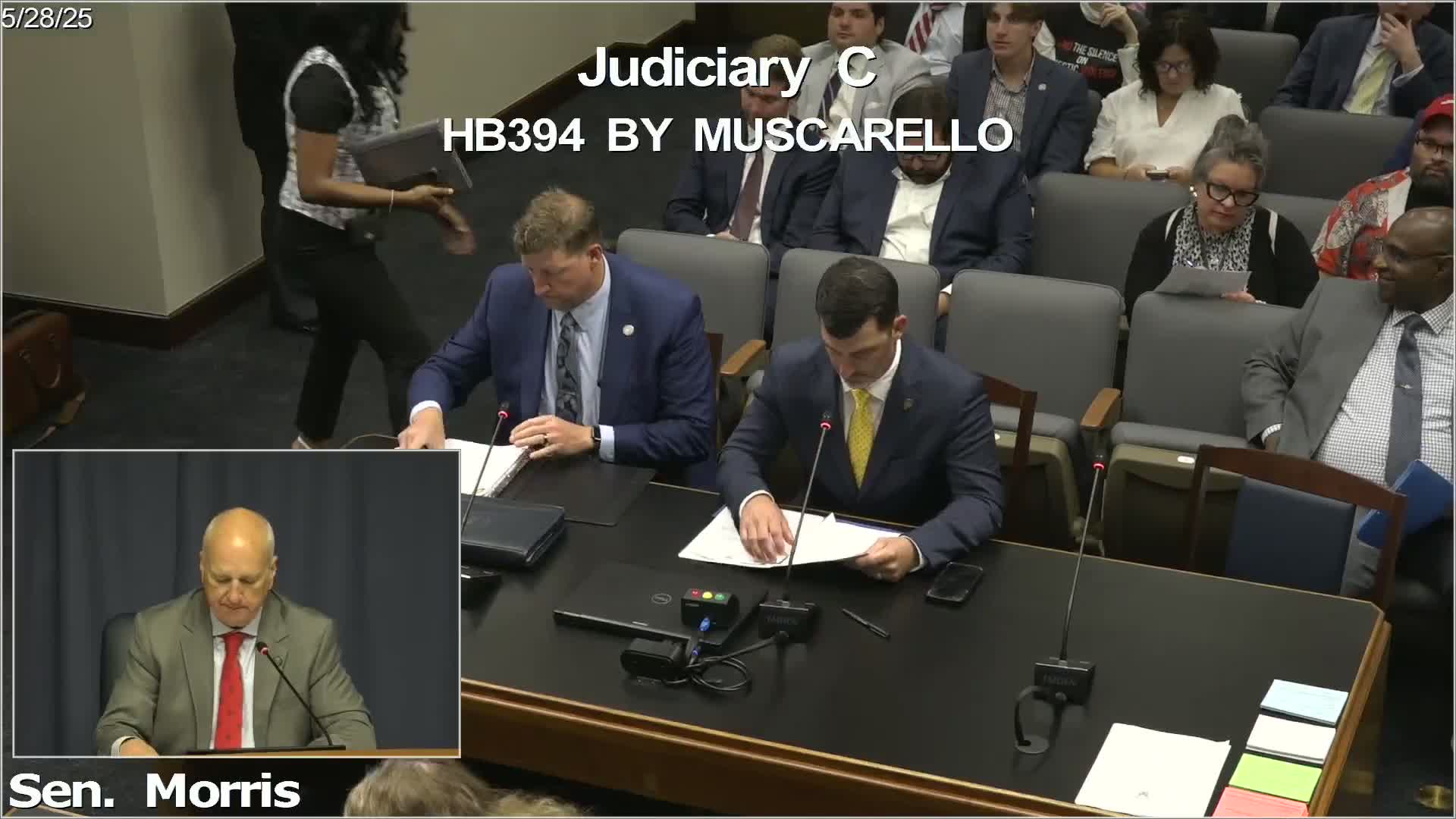
BATON ROUGE, La. — The Senate Committee on Judiciary C on May 20 voted to report House Bill 394, a measure revising parts of state law governing executions, after hearing from the governor’s counsel about procedural clarifications learned from recent cases.
Christopher Walters, deputy executive counsel to Governor Landry, told the committee the bill addresses practical issues identified during Louisiana’s recent experience with carrying out a death sentence. The bill would specify who serves a court’s death warrant, clarify when a trial court must reset an execution date after a reprieve or vacated stay, amend permissible execution start times, and change the statutory phrasing for spiritual advisers and witness seating to give the Department of Public Safety and Corrections secretary discretion.
Walters said the bill borrows language from the Louisiana Supreme Court’s decision in the Hoffman litigation to resolve disputes that arose when stays issued and then vacated led to confusion about whether multiple resets were required. The bill would direct that, if a stay or pause is no longer pending at the time an execution date arrives, the execution may proceed; if a stay remains pending, the date must be reset.
The measure also standardizes the term “spiritual adviser” to replace narrower language like “priest or minister” and removes a fixed numerical limit on witnesses, giving the corrections secretary discretion because witness rooms have limited seating. The statute’s execution time window was broadened to provide flexibility in the event of last‑minute legal actions, moving from fixed earlier start times to a range allowing more time for resolution.
Senator Barrow said he objects in principle to the death penalty and noted he would not support the bill for that reason, but acknowledged the technical amendments. Committee discussion focused on clarifying the process rather than policy change; Walters emphasized the changes were technical and intended to avoid procedural confusion during a complex, resource‑intensive process.
The committee recorded one objection from Senator Barrow when the chair called for objections on reporting the bill favorably; notwithstanding the objection, the roll call showed the measure was reported favorably by a majority vote and will proceed to the Senate floor. The committee also had supporters on the record from the governor’s office and the Louisiana District Attorneys Association.
Discussion versus formal action: the committee heard informational testimony and then voted on the bill; the formal vote to report the bill passed despite a recorded objection. The bill’s next steps are Senate floor consideration and any subsequent amendments or debate there.
Supporters at the hearing included the governor’s counsel and representatives of the Louisiana District Attorneys Association; no registered opposition appeared in the hearing record.