Get Full Government Meeting Transcripts, Videos, & Alerts Forever!
Get email alerts on the Tariffs Supply Chain topic
No spam. Unsubscribe anytime.
Small-business leaders say tariffs and supply-chain delays are forcing price hikes, missed contracts and closures
Summary
Multiple witnesses told the joint committee that recent tariff policy and supply‑chain disruption have increased equipment and materials costs, delayed deliveries and contributed to business pauses and closures among small firms in Massachusetts.
Small-business advocates and trade groups told the Joint Committee on Community Development and Small Business that tariffs and supply-chain disruption are driving up costs, delaying projects and in some cases forcing businesses to pause operations or close.
Representatives of the Black Economic Council of Massachusetts and other sector groups presented survey responses and anecdotes showing that increased import costs and longer lead times have affected a range of enterprises, from construction contractors to equipment-dependent service firms.
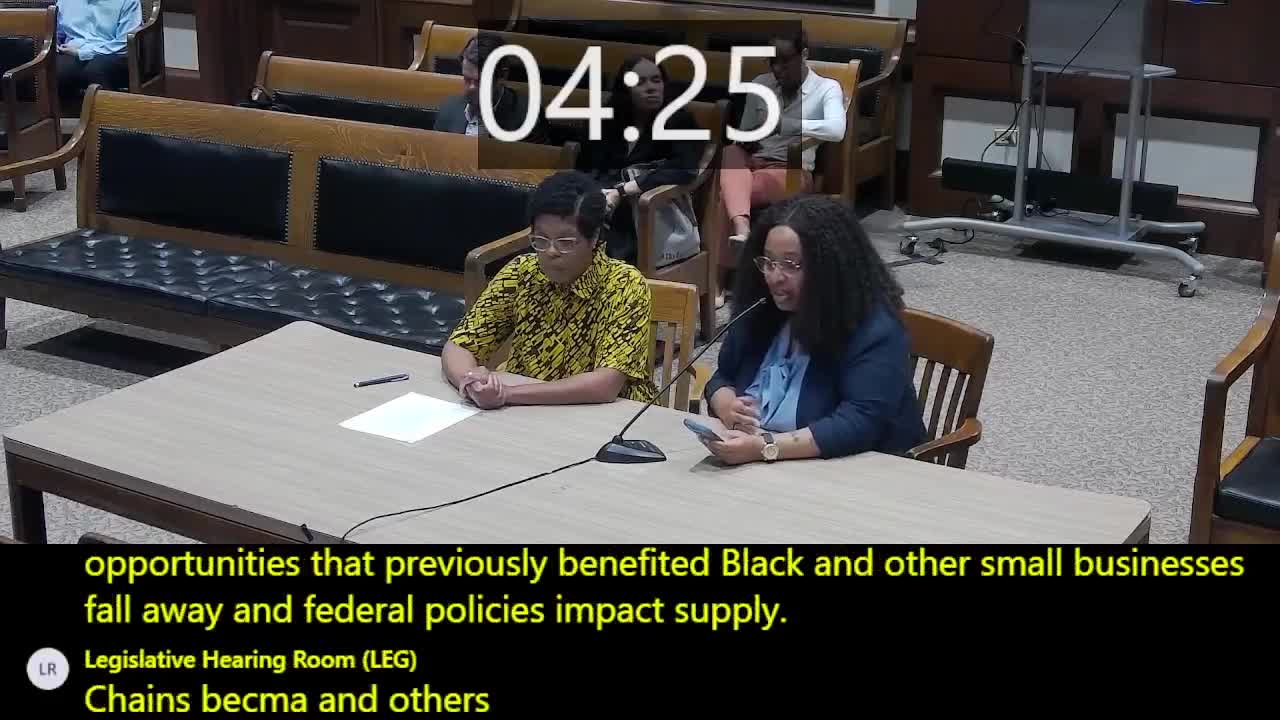
"This is contributing to rising costs, constant uncertainty around inventory and pricing," said Alyssa Banelphi Ramos, chief of policy at the Black Economic Council of Massachusetts (BECMA). She told the committee BECMA has collected member reports that equipment and parts have doubled or tripled in price and that supply delays are increasingly common.
Survey responses presented by BECMA and other witnesses reported that affected businesses had to find new suppliers, raise prices, reduce offerings or pause operations. "A microphone system that they use now cost from $2,000 to over $4,000. LED video panels went from $700 to over $1,300. One of the consoles that are key to their business went up by 40%," Alyssa Banelphi Ramos recounted using a member example.
Another member example described a shed project delayed more than 32 days because basic siding and corner trim were backordered; missing components prevented final inspection and completion, the witness said.
Advocates said the immediate consequences are both economic and social: lost revenue, higher labor costs because crews wait idle, and lost opportunities to grow into larger contracts. "Large contractors can't always pass through these costs or renegotiate, leaving smaller subcontractors to absorb the hit," Nicole Lobe, president and CEO of BECMA, said.
Retail and trade associations reported similar concern. Bill Rennie of the Retailers Association of Massachusetts told the committee that members worry about tariff-driven uncertainty even when their primary supplies are sourced domestically, because smaller components in machinery may originate overseas.
Witnesses urged the legislature to consider procurement and supplier-development strategies that help small businesses aggregate purchasing power, expand local sourcing and reduce the immediate cash‑flow impacts of higher input prices. They also asked for state support for CDFIs and microgrants so businesses can bridge gaps while supply-chain volatility persists.
Committee members asked witnesses to share their survey data and case details for follow-up. BECMA said its survey was newly launched and had over 20 member responses at the time of testimony, with all respondents reporting tariff or supply impacts; three respondents had closed and two had paused operations.