Get Full Government Meeting Transcripts, Videos, & Alerts Forever!
Get email alerts on the Health Insurance Pediatric Neuropsychiatric topic
No spam. Unsubscribe anytime.
Senate Insurance Committee backs bill to require insurance coverage for PANS/PANDAS treatment
Summary
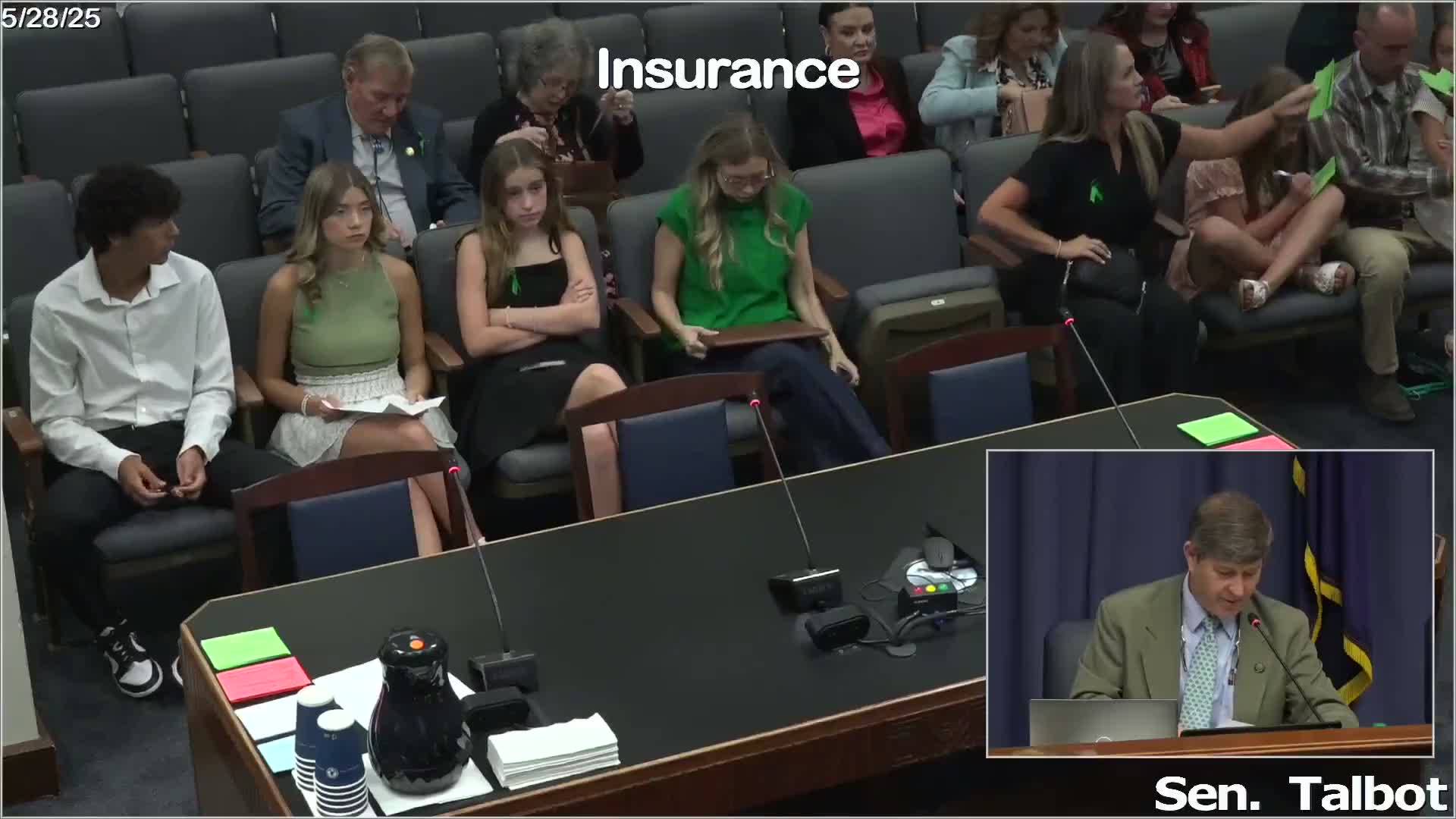
The Senate Insurance Committee reported House Bill 408 favorably on May 28, directing that the bill, as amended, move forward to the full Senate.
The Senate Insurance Committee reported House Bill 408 favorably on May 28, directing that the bill, as amended, move forward to the full Senate. The measure would require health insurers to cover treatment for pediatric acute‑onset neuropsychiatric syndrome (PANS) and pediatric autoimmune neuropsychiatric disorders associated with streptococcal infection (PANDAS), while allowing insurers to follow recognized best‑practice guidance and a phased implementation for higher‑cost therapies.
The measure matters because parents and physicians told the committee that timely access to treatment can reverse severe psychiatric and neurological symptoms and, in some cases, restore a child’s prior functioning. Supporters said certain treatments — including intravenous immunoglobulin (IVIG) — have out‑of‑pocket costs that place them beyond reach for many families.
Representative Kelly Dickerson, sponsor of House Bill 408, told the committee that PANS and PANDAS involve an autoimmune reaction that can cause “anxiety, aggression, depression, tics, hallucinations, and paranoia” and that the condition can follow common infections such as strep, mycoplasma pneumonia and Lyme disease. Dickerson said similar laws have passed in other states and that the bill aims to reduce misdiagnosis and increase access to treatment.
Dr. Abraham, introduced to the committee as Surgeon General and a physician who has treated children with PANS/PANDAS, described the condition as a rapid and dramatic personality and behavioral change in otherwise healthy children and said diagnosis can be difficult because the triggering infection may be separated in time from the behavioral onset. “If IgG therapy helps and it does seem in some cases to make a dramatic difference, then I think it’s something we should entertain as a potential and hopefully, good treatment to cure that child that has PANDAS or PANS,” Dr. Abraham said.
Multiple parents and children gave testimony. Caitlin Tiafrita described her daughter’s sudden decline, the course of antibiotics and other therapies, and the family’s decision to pay $10,500 out of pocket for an IVIG infusion. “Once we paid that, about within about 2 to 3 weeks after that, that threshold started to lower and we started to have longer periods of clarity,” Tiafrita told the committee. Other family members said they faced long diagnostic paths, misdiagnoses and prolonged flares when antibiotics alone did not resolve symptoms.
Senator Myers explained the set of adopted amendments — described to the committee as technical changes and policy clarifications — were intended to protect mandated patient access while giving insurers a way to apply recognized best practices, to set reasonable limits on IVIG utilization unless medical necessity is shown, and to create a phase‑in period for insurers to adjust contracts. Senator Myers also praised sponsor Dickerson’s work with families and clinicians during the drafting process.
After committee discussion and adoption of multiple amendment sets, Senator Barrow moved to report House Bill 408 favorably as amended. Seeing no opposition, the committee approved the motion and reported the bill to the Senate floor.
Discussion versus decision: the committee’s adoption of specific amendment sets and the motion to report the bill favorably are formal committee actions; medical witnesses and family members provided factual testimony and personal accounts that the committee cited in its deliberations. The bill will next be scheduled for consideration by the full Senate.
Details from the hearing: Representative Dickerson said more than a dozen states have enacted similar coverage laws; Dr. Abraham emphasized diagnostic challenges and treatment options; parents provided concrete cost and testing details (Tiafrita reported an IVIG out‑of‑pocket expense of $10,500 and a mycoplasma antibody result she described as “well over 4,000” compared with a normal range she cited as about 700). The committee adopted language intended to let insurers use accepted guidelines but not to block coverage outright.
The committee record shows unanimous consent to report the bill with amendments; no roll‑call vote totals were recorded in the transcript.