Get Full Government Meeting Transcripts, Videos, & Alerts Forever!
Get email alerts on the Drug Dispensing Policy topic
No spam. Unsubscribe anytime.
Committee advances bill allowing ivermectin dispensing under LDH standing order after amendment on prescriptive authority
Summary
The committee reported Senate Bill 19, which would allow a standing order to authorize pharmacists to dispense ivermectin for human use; members adopted an amendment requiring the standing order be issued by a health care professional with prescriptive authority within Louisiana Department of Health before reporting the bill favorably.
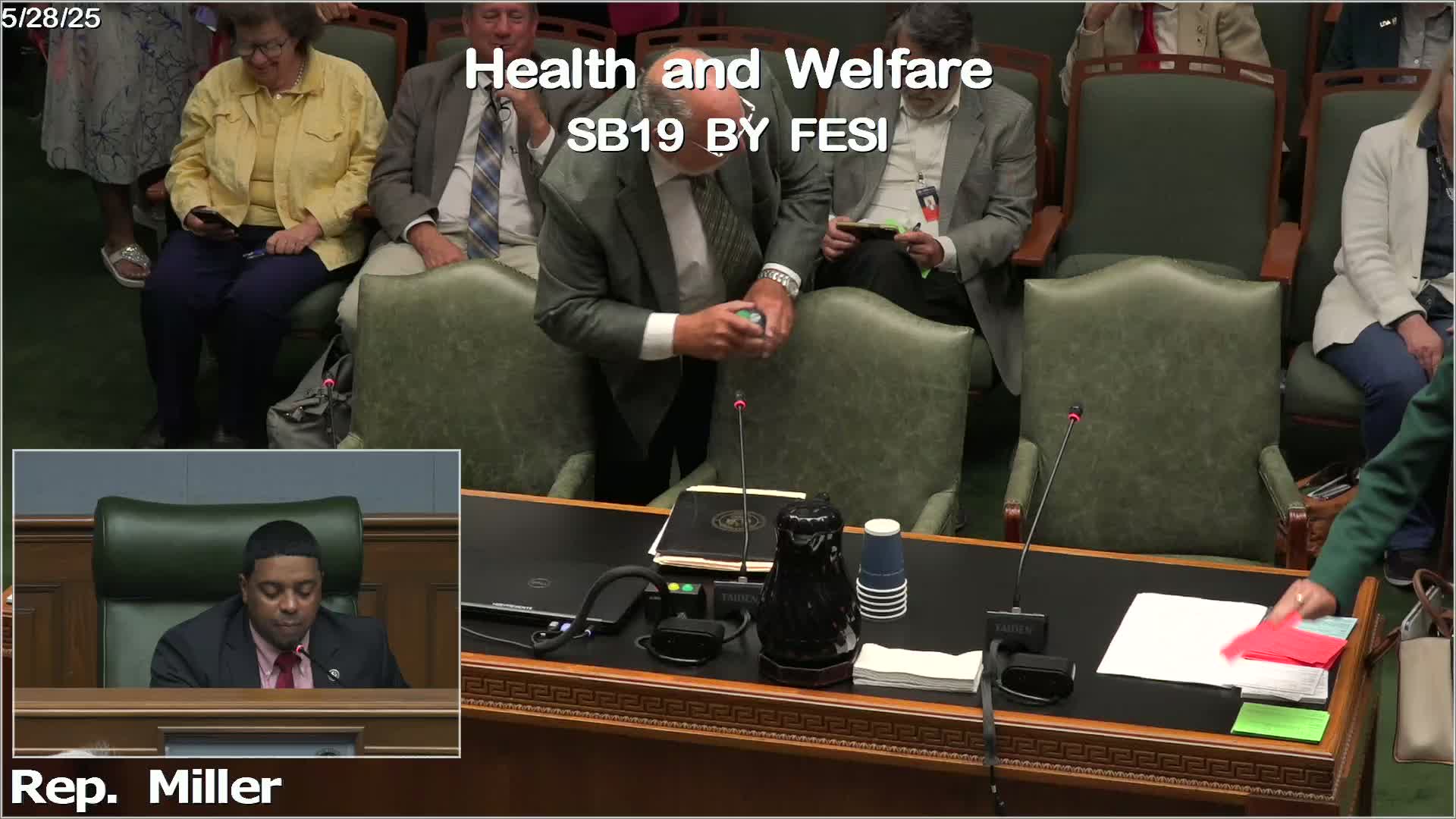
The House Health and Welfare Committee on May 28 reported Senate Bill 19, a measure to permit the dispensing of ivermectin for human use under a standing order, after members adopted a clarifying amendment that the standing order must be issued by a health care professional with prescriptive authority within the Louisiana Department of Health.
Senator Fessy introduced the bill and the committee heard medical and public testimony both in favor and opposed. Dr. Ralph Abraham, who identified himself as a surgeon general and physician, told the committee ivermectin is “FDA-approved medication for humans” for certain parasitic infections and argued for broader access. Supporters in the audience and several witnesses — including Jill Hines of Health Freedom Louisiana and representatives of advocacy organizations — urged easier access and compared Louisiana to other states that have expanded availability.
Opposition and caution came primarily from professional medical and pharmacy representatives. Pharmacist Jonathan Hartman testified that pharmacists’ statutory duty is to protect patient safety and that making ivermectin broadly available without a prescriber encounter raises concerns about weight-based dosing, off-label use and pharmacist liability. Hartman said pharmacies counsel patients about indications and dosing and that removing the prescriber step could expose patients and pharmacists to risk. Representatives of medical groups and the Louisiana Society of Health-System Pharmacists expressed similar concerns about clinical oversight and standardization.
Representative Stagney offered an amendment clarifying that any statewide standing order must be issued by a health care professional with prescriptive authority within LDH; the sponsor said he accepted the change and the amendment was adopted without objection. The committee then moved the bill forward. The roll call that followed recorded an objection, the committee recalled the roll and the bill was ultimately reported favorably with amendments.
Testimony and committee discussion focused on balancing patient access with safeguards: supporters framed the measure as a patient-choice and access issue, while pharmacists and some physicians emphasized the need for standardized assessment, weight-based dosing and liability protections. The committee did not mandate an OTC classification — the bill establishes an administrative pathway (standing order) through LDH rather than changing federal OTC status.
The committee adopted technical and substantive amendments during consideration and reported the measure to the House with the standing-order requirement referencing LDH prescriptive authority.