Get Full Government Meeting Transcripts, Videos, & Alerts Forever!
Get email alerts on the Infectious Disease Criminalization topic
No spam. Unsubscribe anytime.
Louisiana committee adopts bill criminalizing intentional infection of incurable STIs; advocates and public health experts urge caution
Summary
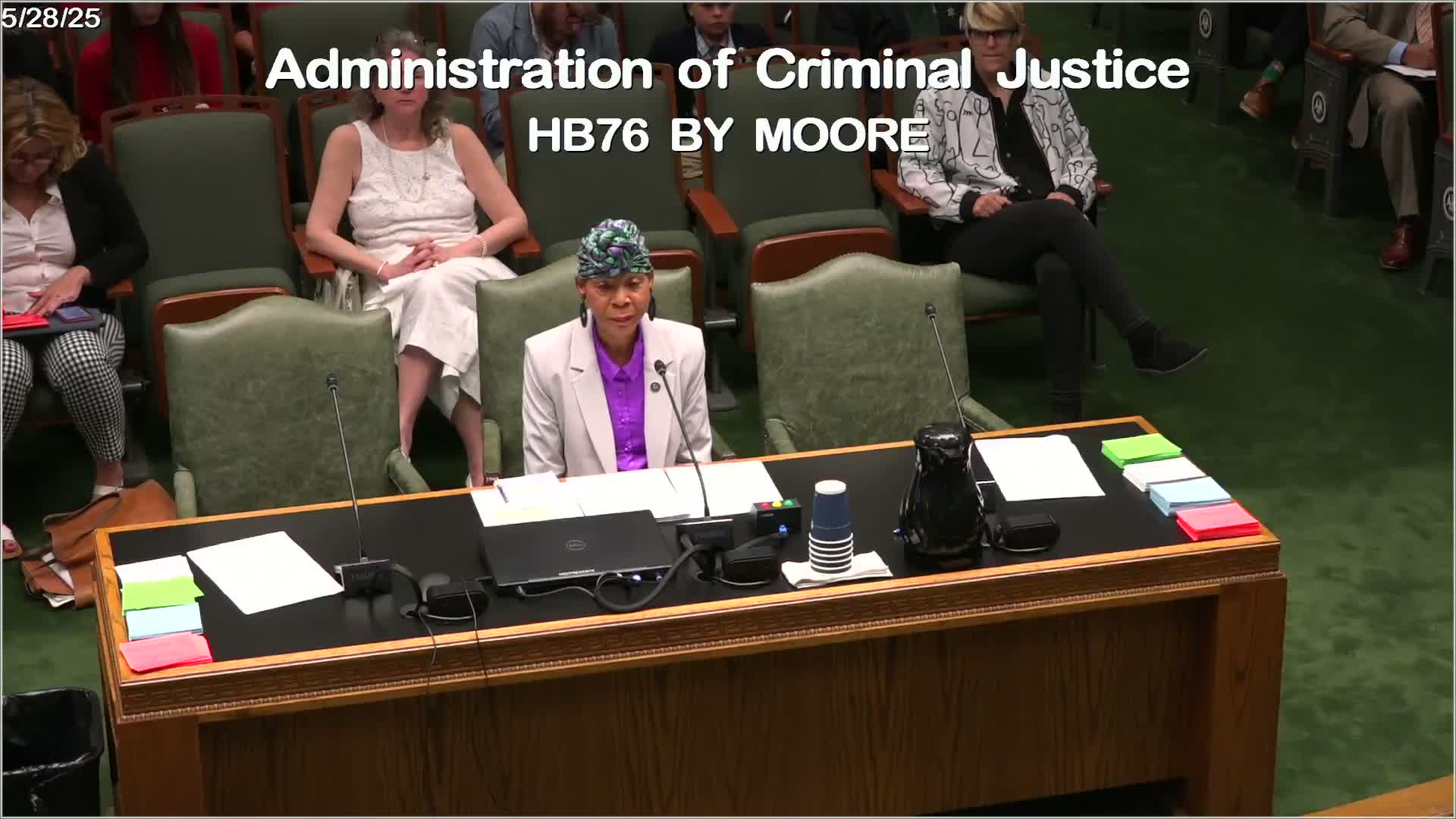
Representative Mandie Moore asked the House Criminal Justice Committee to report HB 76 — a bill that would criminalize intentionally infecting another person with an incurable sexually transmitted infection — and the committee adopted an amendment changing “exposed” to “infected” before voting to report the bill as amended.
Representative Mandie Moore advanced HB 76 through the House Criminal Justice Committee on a 7–5 vote, asking members to criminalize knowingly and intentionally infecting another person with an incurable sexually transmitted infection (STI).
“It is someone who knowingly and intentionally infected someone with these incurable diseases,” Representative Mandie Moore said when describing the amendment she offered to replace the word “exposed” with “infected.” The committee adopted the amendment and later voted to report the bill as amended.
The bill’s author and supporters said the statute is meant to target people who deliberately withhold a diagnosis and then transmit an incurable infection, not to punish accidental or unknown transmission. Moore told the committee she considered existing statutes, including second‑degree battery and HIV specific statutes, and sought narrow language to address intentional acts and to provide “justice” for victims.
Opponents — including criminal defense attorneys, public‑health advocates and physicians — urged the committee to slow the bill’s progress or to craft narrower definitions before it advanced. Megan Garvey of the Louisiana Association of Criminal Defense Lawyers said, “I think this bill is problematic,” pointing to evidentiary, privacy and constitutional concerns such as how prosecutors would prove who infected whom and how intent would be established.
Public‑health witnesses warned that treating multiple infections the same way would have disparate effects. Lauren Jewett, an educator, testified that codifying broad criminal penalties for several different incurable infections could “further stigmatize people who live with and responsibly manage incurable SCIs like HSV and HPV” and could discourage testing. Physician Isolde Butler testified about diagnostic limits for herpes and HPV and said routine STI screening generally does not detect those infections for most people.
Several committee members pressed the author on penalties and scope. Representative Knox asked about statutory penalties in the bill — “fine not more than $1,000 and imprisonment not more than 6 months” — and whether those would remain; Moore said the bill follows penalties comparable to existing second‑degree battery/HIV statutes. Knox and others said the listed penalties felt low for what they described as serious harms, but did not propose a specific change on the floor.
Survivors and advocates offered contrasting testimony. Millicent Foster, who said she has lived with HIV for 23 years and had been undetectable for most of that time, told the committee that despite disclosing her status she had been threatened with prosecution and said criminalization could harm people who disclose. Victims who spoke urged stronger protections and quicker pathways for prosecution in clearly intentional cases.
Committee action and next steps: the committee reconsidered and withdrew an earlier amendment set, adopted a committee amendment that replaces “exposure” with “infection,” and then voted to report HB 76 as amended. The committee recorded the motion to report the bill as amended; the clerk announced “Let HB 76 be reported as amended.” The measure will move to the House calendar with the adopted amendment in place.
The record shows sustained disagreement about definitions of intent, diagnostic capability to prove directionality, and the public‑health consequences of criminalizing broad classes of STIs. Several witnesses and members urged additional drafting work, clearer definitions of “intentional,” and care to avoid chilling testing and treatment.