Get Full Government Meeting Transcripts, Videos, & Alerts Forever!
Get email alerts on the Perinatal Behavioral Health topic
No spam. Unsubscribe anytime.
House committee reports bill to require insurer coverage for perinatal inpatient behavioral‑health care
Summary
The House Insurance Committee on May 28 reported Senate Bill 42 with amendments after testimony from Woman’s Hospital and insurer representatives about denials, oversight and patient need for inpatient perinatal behavioral‑health treatment.
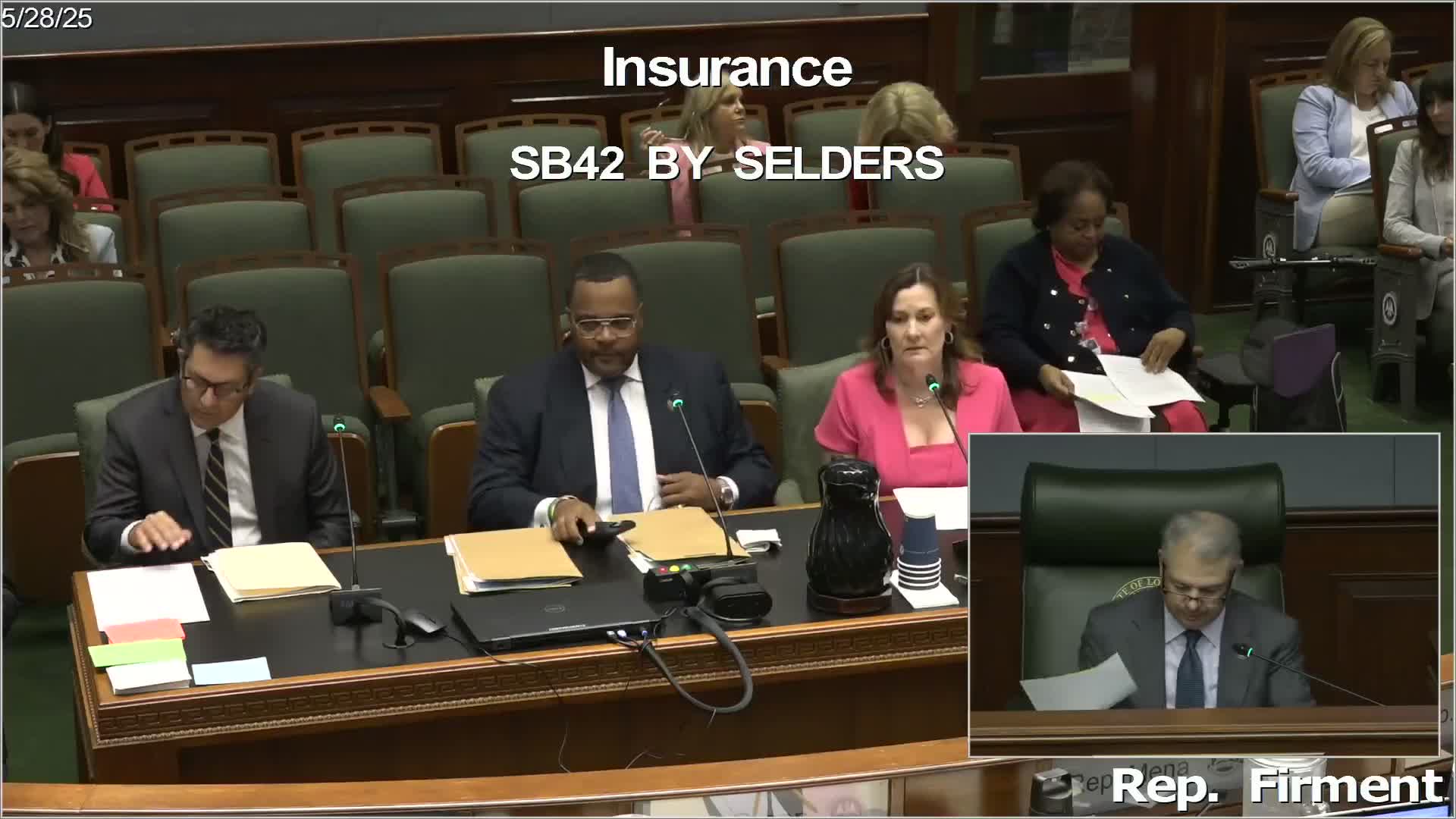
The Louisiana House Insurance Committee on May 28 voted to report Senate Bill 42, a measure aimed at ensuring coverage for voluntary inpatient behavioral‑health treatment for pregnant and postpartum patients, after extended testimony from providers and insurers.
The bill, carried in the Senate by Sen. Selders and presented to the committee by hospital representatives, would require insurers to cover voluntary inpatient treatment for patients with a perinatal psychiatric diagnosis when a treating physician determines the admission to be medically necessary. Supporters said the measure addresses coverage gaps and high denial rates that are preventing vulnerable patients from receiving timely inpatient care.
Supporters from Woman’s Hospital described the unit they opened last September to treat pregnant and postpartum people with severe perinatal mood and anxiety disorders. “We have seen a total of a 70 women who have been affected by perinatal mood and anxiety disorders that are severe enough to require inpatient medical treatment,” said Sheree Johnson, chief nursing officer at Woman’s Hospital. The hospital’s vice president of payer relations, Kevin Guidry, told the committee the hospital has seen denial rates in the 20–23% range for these admissions and said Medicaid accounts for a large share of those denials. “We are experiencing anywhere from a 20 to 23%, denial rate from insurance companies,” Guidry said. He told the committee Medicaid denials in the hospital’s experience make up the majority of denials.
Hospital witnesses said the unit treats pregnant women at any gestational age, allows newborn visitation to support breastfeeding and bonding, and is not co‑ed so it can address women’s trauma histories. Ruth Johnson, vice president of governmental affairs at Woman’s Hospital, told the committee the hospital “swallow[s] that cost” when claims are denied and said the unit required an $8 million retrofit. She said the hospital’s average length of stay is 4.77 days and that 41% of admitted patients have substance‑use issues.
Representatives of Blue Cross and Blue Shield of Louisiana supported the policy goal but opposed language that they said would entirely remove the insurer’s ability to review medical necessity. “What I don’t want is for you all to believe that our presence … is a lack of support for the efforts … It’s just the opposite,” said Dr. Emily Vincent, a board‑certified internal medicine physician testifying for Blue Cross. “We have specific concerns about the language … that completely removes any oversight, any review process that we may have as an insurance company.” Blue Cross noted other states with perinatal inpatient units do not bar insurer review and urged the committee to preserve review rights or include expedited review procedures.
Committee members and witnesses discussed compromise language the insurers had proposed: an initial period (modeled on an Illinois law discussed in testimony) during which admission would be paid without preauthorization and an expedited review process for continued stays. Blue Cross officials proposed a 48‑hour period in which the admission would be covered without review, followed by expedited appeals procedures for denials of continued stay. Proponents said Woman’s current practice already functions in a similar way and that the adopted amendments require treating physicians to “consider recognized evidence‑based standards” such as InterQual or MCG in admission decisions.
The committee adopted amendment set 3,548, which expands the professionals authorized to consult on voluntary inpatient treatment recommendations, adds language about physicians following recognized evidence‑based standards in making admission decisions, and clarifies that coverage may be subject to an insurer’s health plan benefits and dates of applicability. After debate and public testimony, Representative Bagley moved that Senate Bill 42 be reported with amendments; there was no objection and the measure was reported with amendments to the full House.
Supporters and insurers at the hearing agreed on the policy goal — better, timelier access to inpatient care for perinatal patients — but differed on statutory language that they said could either protect patients from untimely denials or remove insurer oversight entirely. The bill will next be considered by the full House, where proponents and opponents said they plan to continue discussions about expedited review language and the role of evidence‑based guidelines.