Get Full Government Meeting Transcripts, Videos, & Alerts Forever!
Get email alerts on the Opioid Recovery topic
No spam. Unsubscribe anytime.
Jackson County commissioners table vote on coordinated opioid recovery funding after questions on staffing and long-term costs
Summary
County commissioners heard a presentation on a coordinated opioid recovery network that would bring $700,000 to the county for 2024–25, but delayed action to the next meeting after questions about whether one-time grant dollars should create recurring positions.
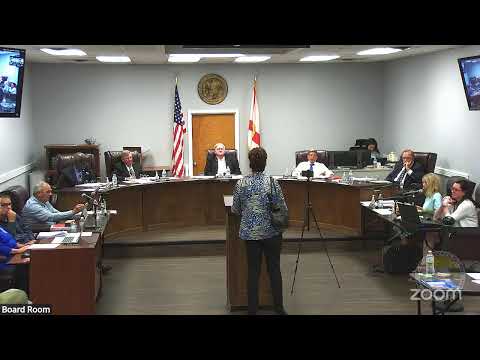
Jackson County commissioners on Tuesday heard a detailed presentation on a coordinated opioid recovery network that would funnel state grant dollars through the Northwest Florida (NWF) Health Network to local providers, and voted to table final approval until their next meeting so commissioners could review details.
The proposal would bring roughly $700,000 for the current grant year, of which speakers said about $500,000 would go to PanCare for treatment services and $200,000 would be allocated to county use, primarily to bolster EMS/fire-rescue capacity. Kelly Faircloth, identified in the meeting as “the circuit administrator for NWF Health Network,” summarized the program and the roles of EMS, emergency departments and treatment providers in a “warm handoff” network. She said the network is “very prescriptive and restrictive” and noted outreach and law‑enforcement carveouts and that next fiscal‑year funding is expected to change. “In your handout…there’s some statistics for 23–24 for EMS suspected overdose responses by ZIP code for Jackson County. It was 247 total,” Faircloth said.
The county asked questions about how the local $200,000 would be used and whether positions funded by the grant could be sustained after one‑time dollars end. Commissioners repeatedly flagged the risk of using nonrecurring funds to create ongoing personnel costs. A PanCare representative (introduced in the meeting as a PanCare staff member) said PanCare would provide treatment services and work toward sustainability, and that Narcan distribution and mobile outreach would be part of the effort. The managing entity role of NWF Health Network — which Faircloth described as receiving and administering state funds and managing reporting — was emphasized several times.
Commissioners asked for more detail on the county plan, the split of funds, staffing implications, and whether positions would be funded permanently. Faircloth and PanCare staff said some of the $200,000 could help start EMS/fire positions but cautioned against fully funding recurring posts with one‑time grant dollars. Commissioner discussion referenced the upcoming fiscal year funding (noted in the presentation as an anticipated $350,000 for the following year) and urged caution on hiring commitments that could outlast grant revenue.
After discussion and requests for additional briefings, the commission voted to table the item to the next meeting to allow commissioners time for follow‑up questions and one‑on‑one briefings with PanCare and NWF Health Network staff. The motion to table was approved by voice vote; commissioners did not adopt the contract at this meeting.
The county will return to the item at its next scheduled meeting with more detail on contract language, staff recommendations for the county’s $200,000 allocation, and options for mitigating the risk of creating unrecoverable recurring personnel costs.