Get Full Government Meeting Transcripts, Videos, & Alerts Forever!
Get email alerts on the Judicial topic
No spam. Unsubscribe anytime.
Tennessee Supreme Court hears challenge to juvenile transfer and Miranda waiver in Gibson County murder case
Summary
At a Boys State session, the Tennessee Supreme Court heard arguments over whether a 17-year-old defendant, Antonio Turner Atkins, was properly transferred from juvenile to criminal court and whether his post-arrest statements should have been suppressed as involuntary or invalid under Miranda.
The Tennessee Supreme Court heard arguments at Boys State in Cookeville over whether Antonio Turner Atkins, a 17-year-old, was properly transferred from juvenile court to criminal court in a Gibson County first-degree murder prosecution and whether statements he made to police should have been suppressed.
Defense attorney Clayborne Ferguson told the court that "once the statement was suppressed, there simply wasn't any evidence left," arguing the transfer lacked the required probable cause and pressing the justices to clarify the standard of review for juvenile-transfer determinations. Ferguson also urged the court to treat repeated police refusal to allow the juvenile's mother into the interview room as a heavy factor — and potentially a rule change — under the Callahan voluntariness framework.
The issue matters, Ferguson said, because Tennessee statutory language and appellate practice have left lower-court transfer decisions difficult to review and because juveniles have different capacities to understand Miranda warnings. He told the justices that Atkins was brought to a police station after an initial on-scene Miranda, that officers read Miranda again at the station, and that the youth repeatedly asked for his mother. Defense counsel described a prolonged interrogation he said lasted about 6½ hours and a confession that occurred at about 8:35 a.m., and he urged the court to weigh parental exclusion heavily when assessing waiver and voluntariness.
Assistant Attorney General Ronald Coleman, representing the state, argued that transfer determinations are reviewed for abuse of discretion, citing this court's longstanding Strickland line, and that the juvenile court's order contained findings supporting mandatory prongs of transfer. Coleman told the court that evidence presented to the juvenile court — testimony that the defendant and an associate were in the area around the shooting, that an associate had brandished a gun shortly before the incident, and that witnesses placed the defendants near the scene shortly afterward — met the low bar for probable cause.
On the Miranda and voluntariness claims, Coleman said officers twice informed Atkins of his Miranda rights and that other Callahan factors (age, literacy, lack of intoxication, breaks during interrogation and the defendant's repeated changes in story) weigh in favor of finding a voluntary waiver and a voluntary confession. He acknowledged the mother's exclusion as "not great," but said the totality of the circumstances did not show that Atkins's will was overborne.
Several justices pressed both sides on legal framing. Justices asked whether the probable-cause question should receive de novo review while the other discretionary factors remain abuse-of-discretion review, how to read the statute's "may" and "shall" language, and whether a juvenile's request for a parent should be treated as functionally equivalent to invoking counsel. Counsel debated whether the statute requires an explicit finding of probable cause before a transfer and whether a legal error on that finding would amount to an abuse of discretion.
Both sides also disputed precisely what officers told Atkins during the interview. Ferguson said investigators told the youth things like "we got you" and warned him about severe penalties; Coleman disputed that characterization and said the most incriminating statements came later in the process as officers obtained more information. The state noted multiple breaks in the interview and that Atkins asked officers to return to the room on at least two occasions.
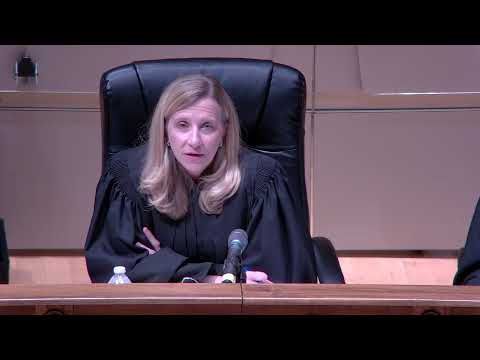
The justices did not rule at the hearing. Chief Justice Holly Kirby said the case would be submitted for decision after argument.
The arguments united several recurring legal strands: (1) statutory interpretation of the juvenile-transfer provisions; (2) the proper appellate standard for reviewing transfer orders and whether probable-cause determinations should be treated differently from discretionary factors; and (3) the application of Callahan and voluntariness doctrine to juvenile suspects who request a parent during interrogation. The court took the case under submission.