Get Full Government Meeting Transcripts, Videos, & Alerts Forever!
Get email alerts on the Landfill Siting topic
No spam. Unsubscribe anytime.
Committee briefed on landfill siting limits as state law tightens siting options
Summary
Director Babcock summarized Land Use Commission deadlines, recent state laws that add buffers and agricultural limits, and the city’s naming of a new site in December 2024; he said the city must integrate the new restrictions into its landfill planning.
The committee was briefed on landfill siting history, permit deadlines and new state limits that reduce available land for a future Waimanalo Gulch replacement.
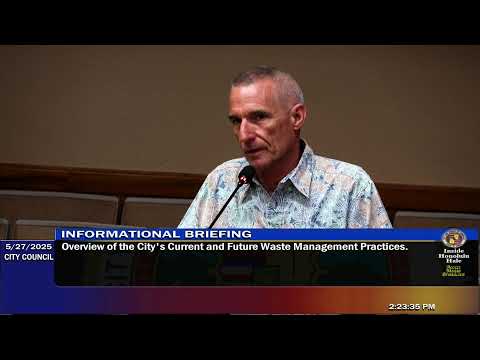
Roger Babcock, director of the Department of Environmental Services, reviewed the 2019 Land Use Commission decision that extended the permit for Waimanalo Gulch Landfill with conditions that included a closure date in 2028 and earlier requirements to identify a replacement site. He told the committee the city later requested and received an extension to the naming deadline and that in December 2024 the city named a site northeast of Wahiawa.
Why it matters: State law changes and federal permitting requirements affect where Honolulu may build a new landfill and how long current facilities may continue accepting waste.
Regulatory changes and timeline: Babcock described Act 73 (2020), which added a half‑mile buffer between a waste facility and residential property lines, hospitals or schools and barred sites on conservation lands. He also described a recently passed bill, cited as House Bill 969, which for islands with populations greater than 500,000 prohibits landfills on Class A agricultural lands and inside the Department of Health’s underground injection control (UIC) line; Babcock said that measure is effective July 1, 2025 and applies to Oʻahu.
Babcock told the committee that after the Landfill Advisory Committee reviewed candidate sites it recommended asking the Land Use Commission for an extension to continue evaluating options, and that the Navy denied certain military‑land requests (the Waipio Peninsula site). He also described a mapping exercise the department ran showing that the UIC and other buffers leave a substantially reduced land area—he said roughly 15 percent of the island area remained outside the UIC line in that analysis.
On protective standards and monitoring: Babcock summarized federal landfill design standards (40 C.F.R. part 258), including dual liners, leachate collection, and groundwater monitoring. He said that Waimanalo Gulch’s monitoring has shown no leachate detections since 1989 and emphasized operational controls including a limit on leachate depth in cells.
Ending: The department is integrating the state restrictions and advisory‑committee findings into its 30‑year functional plan and will return to the council with follow‑up information on permitting, the Department of Health review, and alternative approaches to reduce landfill demand.