Lifetime Citizen Portal Access — AI Briefings, Alerts & Unlimited Follows
Honolulu reviews H-POWER operations, ash‑recovery plan and potential replacement technologies
Loading...
Summary
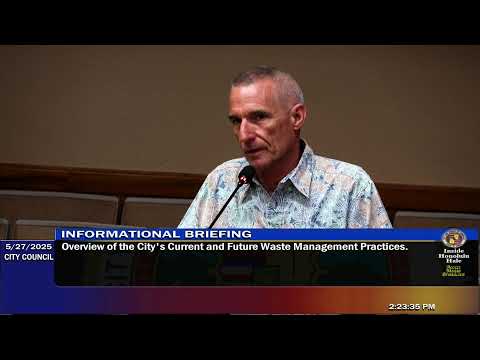
Roger Babcock, director of the Department of Environmental Services, gave the committee an overview of Honolulu’s waste‑to‑energy operations and plans to reduce ash sent to Waimanalo Gulch Landfill.
Roger Babcock, director of the Department of Environmental Services, gave the committee an overview of Honolulu’s waste‑to‑energy operations and plans to reduce ash sent to Waimanalo Gulch Landfill.
Babcock said H-POWER, the city’s waste‑to‑energy complex, runs multiple lines and currently exports about 70 megawatts of electricity to Hawaiian Electric. “The net output when everything’s running is 70 megawatts,” he said, and later stated that the city’s electricity revenue from the facility “equates to about $70,000,000 per year.”
Why it matters: H-POWER’s energy sales and the volume of ash it produces affect landfill demand, city revenue and choices about future facilities. Babcock told the committee the city is pursuing an ash processing project intended to reduce ash volumes and recover additional metals and construction aggregate from bottom ash.
Details: H-POWER consists of an older refuse‑derived fuel (RDF) processing operation with about a 2,000‑ton‑per‑day design (historically operating near 2,200 tons/day) and a 2012 mass‑burn boiler that can process roughly 900 tons per day. Combined gross turbine capacity is about 88 megawatts; after facility use the net exported power is about 70 megawatts. H-POWER produces two ash streams: bottom ash and fly ash. The city’s planned Enhanced Material Recovery Facility (EMRF, also described as the Hawaii Advanced Resource Recovery / HARA project) would separate and condition those ashes, further process bottom ash into an aggregate substitute for asphalt or concrete, and recover more ferrous and nonferrous metals.
Babcock said the ash‑recovery facility is in permitting and design and that the Department of Health permit to reuse ash is required before construction will proceed. He described the expected landfill impact: combined ash currently produces about 20 truckloads per day to the landfill; with the ash recovery facility, ash truck trips would fall to roughly eight per day in the city’s projections.
On facility life and replacement: Babcock said the RDF processing lines are aging and that EPA draft emission rules for RDF facilities could require expensive air‑pollution control upgrades. He said the city is evaluating a range of replacement options and intends to solicit proposals rather than preselect a technology, and that proposals commonly require long‑term contracts to recover capital costs. “We will keep it running for as long as necessary,” he told the committee, referring to the RDF lines while a replacement is designed, permitted and constructed.
Alternative technologies under review include mass‑burn, pyrolysis/gasification and emerging processes that producers and vendors have proposed. Babcock described evaluation criteria that favor technologies with operating references and multi‑year track records and noted the challenge of scaling emerging solutions to the island’s tonnages.
Council questions raised private vendors and pilot options. Babcock said the city has met with multiple technology vendors, including firms proposing microwave‑ or plasma‑based processes, and that pilots or visits to operating facilities are part of the evaluation.
Ending: The city will not construct the ash processing plant without a Department of Health permit and will continue a 30‑year functional plan and a 10‑year capital program that consider energy production, residuals and long‑term contracts for any new technology.