Get Full Government Meeting Transcripts, Videos, & Alerts Forever!
Get email alerts on the Usd Gsd Reallocation topic
No spam. Unsubscribe anytime.
Consultant recommends moving countywide fire costs to GSD; study could raise GSD property bills, prompts council and legal questions
Summary
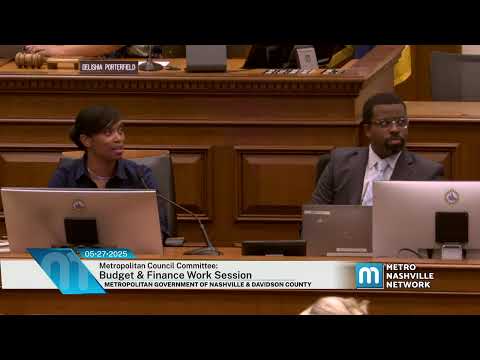
A consultant report presented to the Metro Nashville Budget & Finance Committee recommended reallocating countywide services, including fire protection, to the General Services District (GSD), a shift the mayor's recommended budget incorporated and that council members said requires further review.
A consultant report presented to the Metro Nashville Budget & Finance Committee recommended reallocating countywide services, including fire protection, to the General Services District (GSD), a shift the mayor's recommended budget incorporated and that council members said requires further review.
Consultants Melissa Levin and Mike Burton of Raftelis presented the USD/GSD cost-and-revenue allocation analysis and said the presentation is revenue-neutral for the fiscal‑year‑25 dataset they used. ‘‘What we're looking at when you're looking at the slides and the numbers ... is what happens if we shift cost around and how revenues are kinda shifted to recover those costs. But it's revenue neutral,’’ Levin said. The study used FY2025 budget data to model reallocations and noted legal and practical constraints for implementation.
The study’s core recommendation is to treat services that operate countywide — such as police, transportation management and, the consultants argued, fire protection — as GSD-level costs so all property owners in Davidson County pay for those services through the GSD general fund. Under the model shown, Urban Service District property owners would still pay the USD levy for USD‑only services (for example, street lighting and solid waste) but would pay their share of GSD costs as well.
Raftelis showed an example of the impact on a typical single-family home appraised at $400,000 using FY25 data: the USD tax bill would fall by roughly $12.96 to $3,241, while the GSD tax bill for a property outside the USD would rise by about $211.51 to $3,134. The consultants said the difference occurs because about 76% of total assessed value is inside the USD; when countywide costs are moved to the GSD, USD property owners still carry a large share of those countywide costs because of their share of taxable value.
Council members raised objections and concerns during the presentation. Several asked how the reallocation squares with usage metrics: MNPD reported in 2024 that roughly 81.7% of police dispatches were inside the USD and Metro Fire reported 80.9% of incidents inside the USD. Council members said they wanted clearer metrics tying costs to service delivery and a fuller review of which services should remain USD-only (for example, sidewalks, lighting or certain capital investments). Mike Burton said cost allocation by ‘‘calls for service’’ is a common method but argued that fire protection is a standing readiness service — resources are staged to be available countywide whether or not they are called upon — and that a property-value/benefit approach has precedent in other jurisdictions.
Finance staff acknowledged the study and said they consulted Metro Legal. Finance Director Janine Reed told the committee that because this professional study exists and counsel has been consulted, not implementing the study carries legal risk for Metro; she said she had discussed the issue with Metro Legal and could arrange further legal review for council. Council members asked Finance and Legal for a memo outlining legal risk if the council does not adopt the reallocation as modeled.
Several council members urged delaying any implementation or asked to defer further action for a year to allow more time for district‑level analysis, community engagement and for administration to provide detailed capital and service maps (for example, sidewalk and hydrant infrastructure and district capital spending). Amanda Deaton Moyer of Finance said earlier versions of this analysis had been shared in prior phases, and the consultants said some preliminary findings were previously presented; the consultants also cautioned that any FY26 implementation would require updating the FY25-based numbers to current valuations, program changes and fund‑balance uses.
The committee did not take a vote. Members requested follow-up information including legal opinions, metrics on calls for service and detailed revenue-offset calculations before considering changes to levy structure.
Ending: The Raftelis report is reflected in parts of the mayor's recommended budget; council members requested additional legal analysis, usage metrics and a longer review timeline before adopting any reallocation that would alter district tax rates.