Get Full Government Meeting Transcripts, Videos, & Alerts Forever!
Get email alerts on the Municipal Budget topic
No spam. Unsubscribe anytime.
Mayor's recommended budget funds new hires, restores reserves; council presses for details on judgments, revenues and wish list
Summary
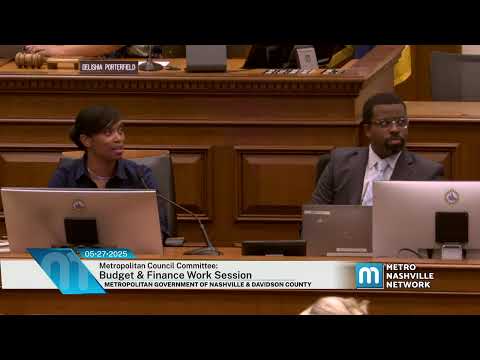
The Metro Nashville Council Budget & Finance Committee heard a presentation from the Office of Management and Budget on the mayor's recommended budget and then questioned finance staff on revenue, reserves and contingency funds.
The Metro Nashville Council Budget & Finance Committee heard a presentation from the Office of Management and Budget on the mayor's recommended budget and then questioned finance staff on revenue, reserves and contingency funds.
The office of management and budget laid out the budget timeline, what is included in the mayor's recommended budget and structural constraints the administration considered. Budget Officer Aaron Pratt said the recommended budget includes full staffing for the ninth precinct, funding for a school security initiative, hiring 41 firefighters and 49 EMS roles, funding for 135 school nurses and new staff for several public-works and service programs. ‘‘This budget we put together this year for the mayor's recommended budget is a good budget,’’ Pratt said.
The presentation matters because the mayor's recommended budget sets the starting point for council's substitute budget and affects tax rates, reserves and service levels.
Most of the committee's questions focused on revenue assumptions, fund-balance policy and risk management. Council members asked for detailed historical and actuarial backup for the judgments and losses account and for the calculations behind the 4% general-fund reserve. Finance Director Janine Reed said the judgments, losses and insurance funds are funded using actuarial information and analysis of anticipated premiums and deductibles. ‘‘There is actually some actuarial evaluation that is used in the calculation and the funding of those funds,’’ Reed said.
Pratt provided several clarifications during the hearing: a gross penny of property tax generates about $7.2 million in gross revenue; the ‘‘net penny’’ available for reallocation after reserve and stabilization adjustments is about $5.05 million; and a one-cent reduction in the tax rate reduces gross receipts by about $7.2 million. Pratt and assistant budget officer Adrienne Grama also described the budget process timeline: mayoral direction in January–February, departmental requests and OMB review through March, a mayor's recommended budget submitted to council in May, council hearings and three readings in June and a July 1 start of the fiscal year.
Committee members repeatedly requested supporting spreadsheets and actuals. Council members asked OMB to provide (1) historical annual judgments-and-losses payouts for the last several years, (2) the actuarial calculations used to set the insurance and judgments funding targets, and (3) an updated revenue projection prior to finalizing the budget so council can see whether additional unanticipated revenues alter fund-balance restoration plans. Pratt said he would follow up with those figures.
Council members also pressed on implementation details: targeted savings of about 1.41% were applied to department budgets as a savings pool, but departments were allowed to request those dollars back this year so operations are not interrupted. Pratt warned that the incremental cost of the compensation package in the recommended budget is not applied to currently vacant positions; departments must manage vacancy savings and other resources during the fiscal year to implement merit/compensation changes.
On the council process, Chair Porterfield reminded members that the initial wish-list submission was a first draft and the final wish list is due June 5, after public hearings. Pratt and staff emphasized the ‘‘due diligence’’ field on the wish-list form: if a council member proposes funding a program that the responsible department did not request, the council member should confirm departmental capacity before the item reaches the substitute budget.
No formal motions or votes were taken at the work session; committee members agreed to follow up with written requests for the data discussed.
Less technical highlights in the recommended budget that OMB enumerated include additional staff for transportation and right‑of‑way inspection, investments in telematics for fleet operations, increased collection and convenience‑center staffing for the new Department of Waste, expanded behavioral-health specialists, and a permanent funding source for school nurses.
Committee members asked for more time and detail on several items, including the scope and calculation of the 4% fund and whether fund-balance restoration could be spread over 36 months per the fund-balance policy; Finance said the policy language and legal interpretation guide the recommended approach and agreed to circulate the policy language and follow up with Metro Legal. Chair Porterfield closed the session by reminding members of the next budget-related meetings.
Ending: Committee members asked OMB and Finance for written backup — actuarial analyses, historical judgments-and-losses costs, and updated revenue estimates — and staff agreed to supply the materials to inform substitute‑budget deliberations.