Get Full Government Meeting Transcripts, Videos, & Alerts Forever!
Get email alerts on the Zoning Ordinance Rewrite topic
No spam. Unsubscribe anytime.
Zoning committee hears detailed update on decade‑long zoning rewrite, consultants recommend testing and staff training
Summary
Consultants and city planning staff told the Atlanta Zoning Committee on May 28 that a multi‑year rewrite of the 1982 zoning ordinance has produced modular drafts, extensive public engagement and proposed code changes — including a new "zone string" approach and standardized administrative variations — and that a testing phase will begin this summer.
Consultants and City planning staff briefed the Atlanta City Council Zoning Committee on May 28 on progress toward a full rewrite of the city’s 1982 zoning ordinance, describing a multi‑year public engagement process, proposed structural changes to the code and a planned testing phase before a complete draft is returned for final review.
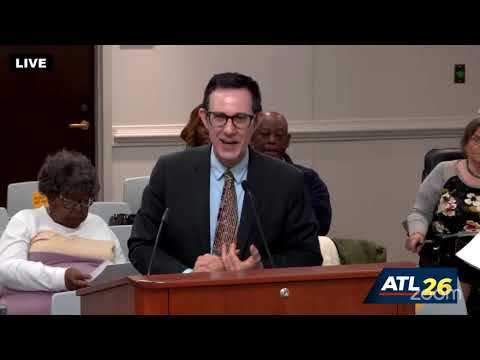
"We've been hard at work over the past couple of years, rewriting, redrafting and, being responsive to comments from our many stakeholders," Caleb Rosicoke, project manager for the consulting team with TSW, told the committee. Rosicoke said the rewrite process began in February 2016 with a diagnostic, included quick fixes adopted in February 2018, and moved into a full rewrite phase beginning in 2022.
Rosicoke summarized how the rewrite has been staged as modular drafts: use standards, form standards, procedures and development standards. He said the team published roughly 85% drafts of three modules to solicit targeted public feedback and logged engagement through an online review tool (Conveio). "We had nearly 35,000 people review the draft zoning ordinance," Rosicoke said, adding that the team received roughly 780 detailed comments through the platform, about 240 direct emails, 1,500 meeting attendees and about 800 online viewers.
Among the substantive code changes described, the consultants proposed a "modified zone string" approach that separates the physical form of development (building height, setbacks, porches, windows) from permitted uses so neighborhoods can retain a preferred form while changing allowable uses without rewriting an entire district. Rosicoke used R‑4 conversion as an example: in the new approach an R‑4 form could map to an "H6" house‑scale form combined with an R2 use package, allowing more modular adjustments to the zoning map.
The team also proposed standardizing administrative variations citywide into three tiers: an administrative modification (very minor, typically up to ~10% variation); an administrative variation (larger, typically up to ~30% variation); and variations above those thresholds that would require Board of Zoning Adjustments (BZA) review. Rosicoke said the draft includes posting requirements for administrative variations so neighbors would be notified when staff grants such approvals.
The consultants said the rewrite will carry forward zoning conditions adopted on or after February 2000 and that legacy Special Public Interest (SPI) districts with highly unique provisions (including SPI 9 and SPI 12 in Buckhead, Midtown SPI 16, Greenbriar Mall and Fort McPherson) will be preserved as "legacy districts." On accessory dwelling units (ADUs), the team said it had reverted to the status quo after public comments: ADU allowances remain unchanged from current practice (one ADU in certain districts; none in others), and the team will not expand ADU counts in the draft.
Rosicoke described an upcoming "zoning testing" phase planned for later this summer to exercise the draft rules against real and hypothetical projects, to train staff who will administer the code, to surface unintended consequences and to identify clarifying edits prior to publishing a complete 100% draft. "This will allow us to do a couple of things. First... it will begin to share the workings of the zoning ordinance with the staff that are going to administer it on a day to day basis," he said.
Committee members asked detailed questions. Council member Susan Hillis asked how administrative waivers would be handled; Rosicoke replied that the new code would standardize three types of variation and limit the scope of staff discretion, typically reserving larger deviations for BZA review and adding notification requirements. Hillis raised a sidewalk example involving curb cuts and variances; Rosicoke pointed to a cross‑reference table in chapters 3 and 8 showing triggers for sidewalk requirements and offered follow‑up discussions.
Council member Jason Dozier recommended engaging local Main Street programs and small‑area planning efforts to translate the zoning tools into corridor‑level implementation; Department of City Planning staff said the office will coordinate small area plans and work with Main Street program staff to apply zoning tools locally.
The consultants recommended further testing and limited refinements rather than wholesale changes; they said the goal is to publish a complete draft by the end of the year for additional review and to begin formal adoption work in the following council term. The committee did not vote on the rewrite itself; the presentation concluded with an agreement to continue outreach, testing and technical follow‑up with council offices and neighborhood groups.
Speakers quoted in this report appear in the committee record and are identified by name and role in the committee transcript.