Get Full Government Meeting Transcripts, Videos, & Alerts Forever!
Get email alerts on the Budget And Cip topic
No spam. Unsubscribe anytime.
Sarasota presents midyear budget and CIP; resurfacing costs and surtax priorities push board to weigh public‑private partnerships
Summary
County staff reported FY‑2025 midyear finances, a five‑year capital improvement program and rising resurfacing costs that are prompting discussion of public‑private partnerships and possible new revenues to meet pavement preservation and major thoroughfare needs.
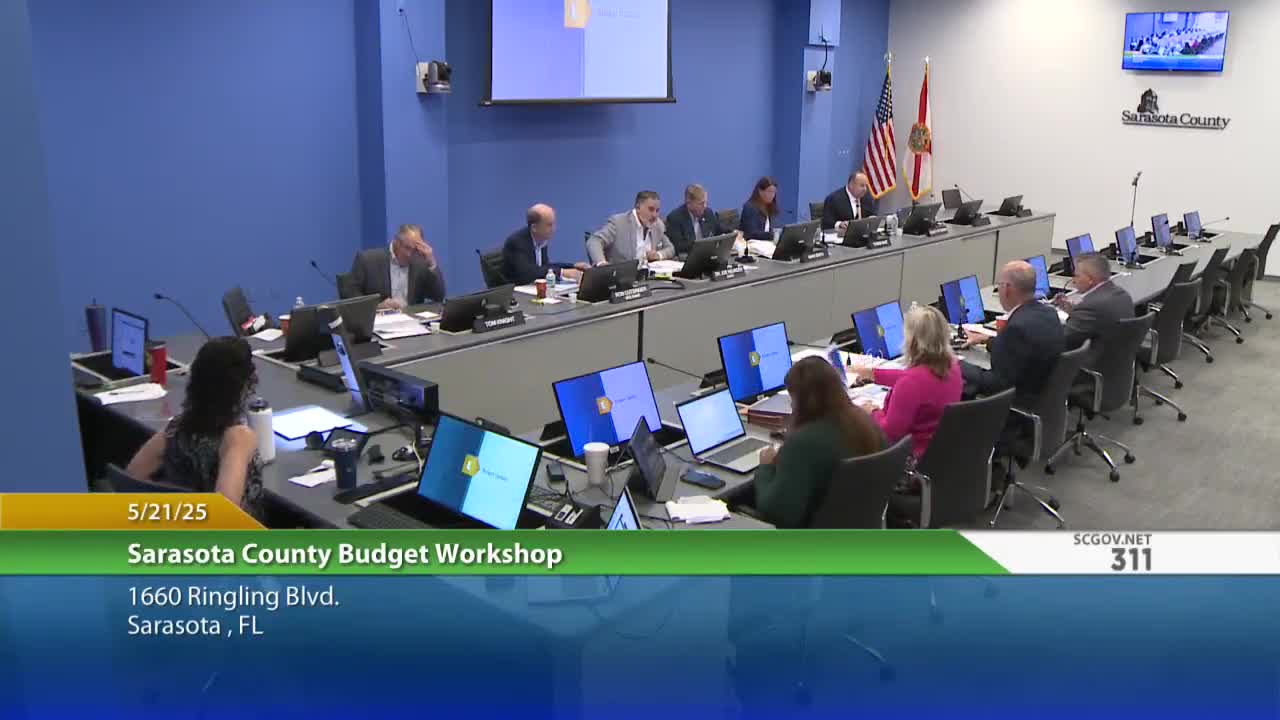
County staff presented a midyear financial update and the proposed Fiscal Year‑2026 capital improvement program at the May 21 budget workshop, highlighting strong utility revenues, storm‑driven permit and recovery work, and pressure on the county’s pavement‑management program from rising construction costs.
Finance director Kim (surname not specified in the record) said major FY‑2025 revenues were generally tracking close to budget through March: utilities were about 7.1% above budget and general fund major revenues were roughly 1% below budget year‑to‑date. Kim noted tourist development tax receipts were down compared with the prior year’s peak, likely reflecting storm impacts on visitation. Staff also said building permits and inspections surged following last year’s storms: the county had a record of more than 50,000 permits in 2023 and was on a high permit trajectory in 2024–2025 as recovery work continued.
Capital projects director Carolyn Eastwood gave an overview of the five‑year CIP, which totaled roughly $778,000,000 for FY‑2026–FY‑2030 in the materials she presented and a FY‑2026 project list totaling about $338,000,000. Major projects and programs highlighted included the Venice Gardens alternative water treatment plant, the expansion and conversion of the Bee Ridge water reclamation facility to advanced wastewater treatment (in compliance with a Florida Department of Environmental Protection consent order), the Seventeenth Street Regional Park, the County Administration Center nearing interior completion, library expansions including the County History Center and Fruitville Library, and Legacy Trail improvements.
Public works staff described pavement‑management pressures: the county has moved to automated, vehicle‑mounted pavement condition inspections and will propose adjusting the pavement level‑of‑service target (historically 60/60) to a 70/70 target to reflect differences in the new measurement technology. Staff reported 45 miles of pavement preservation work this fiscal year and said bids have recently come in significantly higher than planning estimates. That gap has driven program reallocation, use of surtax and gas tax adjustments, and staff discussions about alternatives including a resurfacing assessment, a dedicated resurfacing revenue source, or expanding public‑private partnerships (P3s) with developers to accelerate and defray costs.
Commissioners expressed urgency for specific thoroughfares — Fruitville Road and Lorraine Road were singled out — and asked staff to pursue any viable means to accelerate delivery, including private‑sector partnerships. Staff said they are evaluating P3 and developer partnership options and will return with approaches that preserve bidding and procurement rules.
Surtax (voted infrastructure sales tax) programming: staff outlined surtax project funding, accelerated borrows used to move projects forward, and a five‑year surtax total of roughly $461,000,000 in the materials provided. Staff said they would present a resolution to reprioritize surtax allocations and a FY‑2025 budget amendment at the July budget workshop.
Grants capacity: County administration confirmed that a solicitation for grant‑writing vendors had produced respondents and staff were negotiating with multiple firms to augment the county’s in‑house grants capability.
Why it matters: Rising project costs and uncertain state revenues combine to compress county capital choices. Commissioners emphasized speed on key road projects, resiliency work for barrier‑island roads and beaches, and expanding grant and partnership capacity to stretch dollars.
Next steps: Staff will return with a surtax reallocation resolution and FY‑2026 CIP items at the July workshop, bring financing proposals for large utility projects (Venice Gardens), continue to refine pavement estimates and propose procurement or partnership options to accelerate priority thoroughfares.