Get Full Government Meeting Transcripts, Videos, & Alerts Forever!
Get email alerts on the County Debt topic
No spam. Unsubscribe anytime.
Sarasota reviews debt portfolio; utility financing planned for Venice Gardens treatment plant
Summary
Public financial advisors told the county the debt portfolio remains strong and that staff plans a large utility financing for the Venice Gardens alternative water treatment plant, while monitoring refunding windows for potential savings.
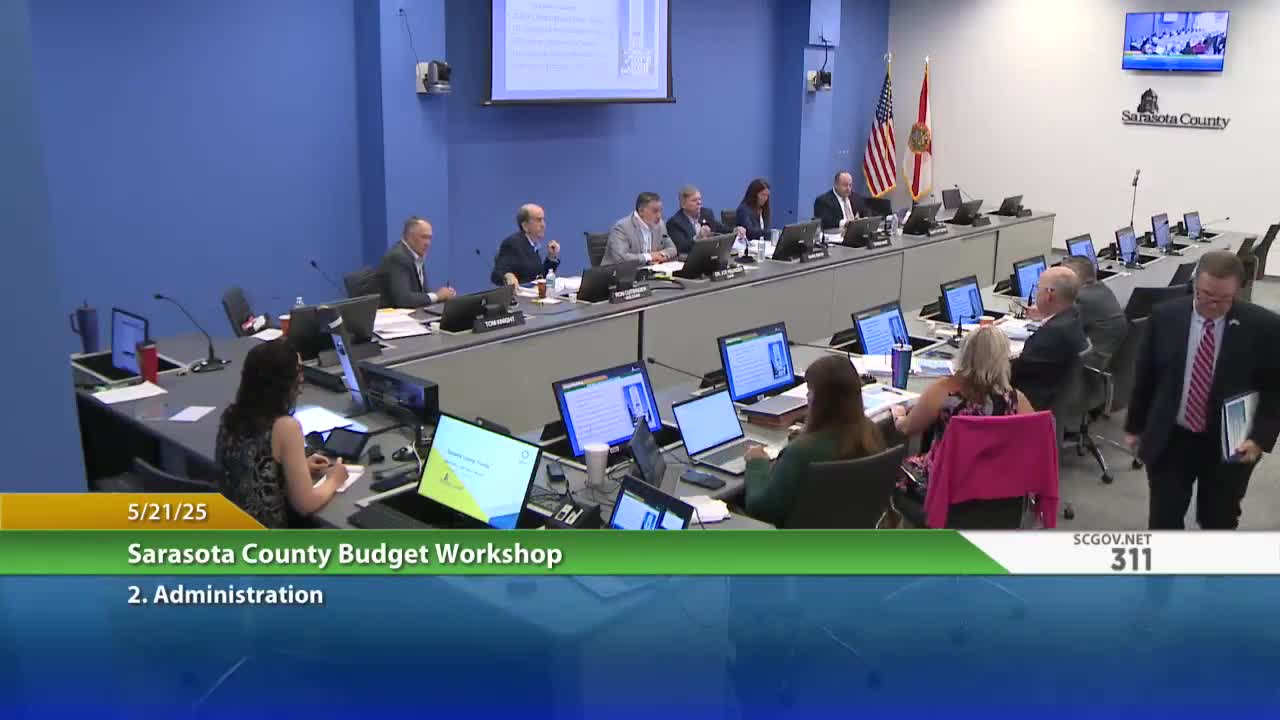
Jay Glover, managing director at Public Financial Management (PFM), presented the county’s debt portfolio review at the May 21 workshop and highlighted credit strengths, recent financing history and planned financings.
Glover said Sarasota County’s outstanding debt is split roughly half to enterprise funds (utility and solid waste) and half to general capital projects. The county’s general obligation rating is the top category cited; other revenue bonds, including the capital improvement revenue bonds secured by the local half‑cent infrastructure sales tax, carry strong double‑A level ratings.
PFM reviewed 2024 financings and 2025 activity. Notable 2024 closings included capital improvement revenue bonds secured by the local sales tax and a solid‑waste revenue bond; true interest costs on 2024 financings ranged in the low‑ to mid‑3% range. In 2025 the county has priced capital improvement revenue bonds for a county support services facility at about 4.19% true interest cost and infrastructure sales tax financings at about 3.77%.
Glover and staff said they are preparing a large utility financing to fund the Venice Gardens alternative water treatment plant (AWT). He also reminded the board that the county used a WIFIA loan in 2021 to lock in a 1.84% rate on a long‑term utility financing and that draws from that facility commenced in 2024 to fund capital needs.
PFM identified potential refunding opportunities tied to utility bonds issued in 2016 (callable April 1, 2026). Glover said a current refunding could generate roughly $1 million to $2 million in net present value debt‑service savings, depending on market conditions. Commissioners asked about the size and timing of potential refundings; PFM reiterated that refundings are evaluated when market conditions produce sufficient debt‑service savings.
Why it matters: The planned utility financing for Venice Gardens and potential refundings affect rate‑payer debt service and long‑term financial flexibility. The county’s strong ratings and recent use of low‑cost WIFIA financing give staff options for managing debt service and capital schedules.
Next steps: Staff said they would bring the Venice Gardens financing for board consideration in the next months, monitor markets for refunding opportunities, and continue to test coverage ratios and rating agency metrics when planning new debt.