Get Full Government Meeting Transcripts, Videos, & Alerts Forever!
Get email alerts on the Stormwater Maintenance And Dredging topic
No spam. Unsubscribe anytime.
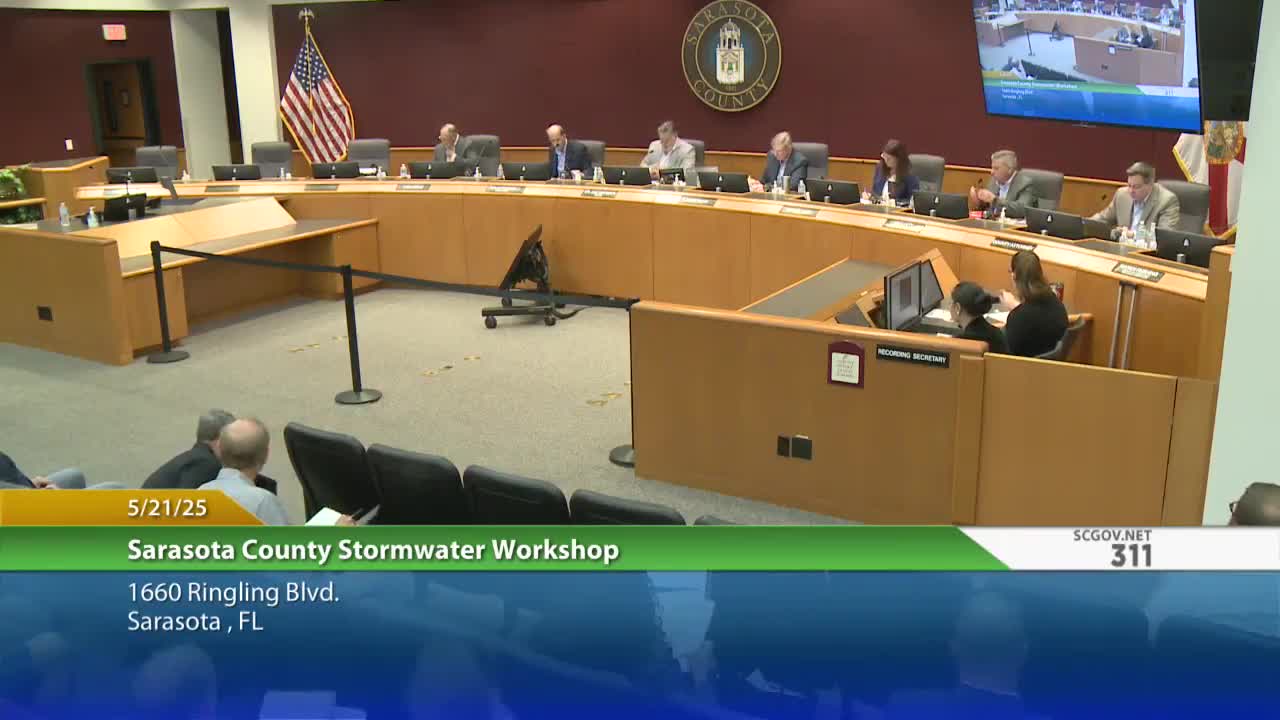
Sarasota County approves expanded stormwater maintenance plan; residents press for faster Phillippi Creek and slough dredging
Summary
At a May 21 workshop, the Sarasota County Commission approved a proposed level of service that would expand routine stormwater maintenance to include creeks and waterways. Staff presented a multi‑year funding plan and residents urged faster dredging of Phillippi Creek, Cowpen Slough and other hotspots as hurricane season approaches.
Sarasota County commissioners on May 21 approved a proposed expansion of the county’s stormwater maintenance program to include creeks, streams and other waterways and heard repeated pleas from residents for immediate dredging and repairs along Phillippi Creek and Cowpen Slough.
The action follows a public presentation by Spencer Anderson, Sarasota County public works director and county engineer, who outlined current maintenance activity, work completed since last year’s storms and a proposed “level of service” that would add routine waterways maintenance and increase maintenance frequency for existing assets. Anderson said the staff proposal includes an initial-year cost estimate of about $16 million (including one‑time equipment purchases) and an ongoing annual cost of roughly $13–15 million if waterways dredging is added to the utility’s scope.
Why it matters: commissioners and residents said the timing is urgent with hurricane season only weeks away and repeated flooding in neighborhoods that drain into Phillippi Creek and other channels. Many speakers credited county crews’ post‑storm work but said sediment and vegetation have accumulated in creeks for decades and require dredging, not only narrower “navigable channel” work.
County presentation and numbers
Spencer Anderson told the board the stormwater environmental utility’s FY24 revenues are roughly $27 million and that field services and contracts currently account for about $13–14 million of the utility budget. His staff outlined three funding approaches for adding waterways maintenance to the county program: a rate increase to the existing utility billing unit, a countywide ad valorem millage, or project‑specific assessments. Anderson presented a planning‑level estimate of $10 million per year devoted to routine waterways dredging (a planning estimate subject to refinement), plus additional contract and equipment costs in the first year.
Anderson said the county has submitted an expedited application to the U.S. Army Corps of Engineers to permit removal of eleven high‑spot segments within Phillippi Creek (the phase‑1 work) and that full channel and oxbow work would require additional permitting (phase 2) and environmental review. He said the West Coast Inland Navigation District (WCIND) is coordinating a separate navigable‑channel project and is working on permits, staging and contractor procurement.
Public comments and hotspots
Dozens of residents and neighborhood representatives told the commission the county has under‑maintained several creeks and ditches for decades and should use county resources rather than leave property owners to pursue individual permits and assessments. Key claims and requests included:
- Nadia Bowen (Southgate Community Association): “The idea that residents should bear the cost of dredging Phillippi Creek in perpetuity is unacceptable.” She asked the board to recognize Phillippi Creek as both a stormwater conveyance and a navigable waterway and to assign long‑term maintenance responsibility to county stormwater services.
- Kelly Brown (Coalition of City Neighborhood Associations): asked the commission to allocate a portion of previously committed SRQ resilience dollars specifically to Hudson and Whitaker Bayous and to increase regular maintenance budgets for local canals and drains.
- Karen Kirsch (Saddle Creek): described Cowpen Slough as “almost entirely consumed by trees, silt and other vegetation” and said the slough had not been dredged in “approximately 50 years,” attributing significant flooding risk to the lack of maintenance and to a gate structure that she said should be operated and, where appropriate, automated.
Other speakers (Christie Molyneux, Seth Johnson, Charles Reith, Ken Natoli and several neighborhood task forces) pressed for (1) inventory and clearing of obstructions through Oscar Scherer State Park and (2) county adoption of a formal maintenance “level of service” and map showing “hot spots.” Several urged the county not to limit action to navigable‑channel dredging, arguing that dredging a narrow channel will not restore the creek’s capacity bank‑to‑bank.
What the board did and next steps
The commission voted to adopt staff’s proposed level‑of‑service framework for maintenance (motion approved unanimously). The motion accepted the staff proposal in principle and directed continued development of implementation details, permitting steps and funding scenarios for formal budget consideration. Anderson told the board the county would pursue the Army Corps’ expedited review for the phase‑1 high‑spot dredging and continue work to report back on specific projects, staging and anticipated timelines.
Staff and commissioners also identified several near‑term operational items: removal of two old trestle bridges that trap debris (targeted for removal by Aug. 1), repair and replacement work at the Cowpen Slough breach that has been stabilized with interim repairs, and routine removal of downed trees and debris in canals and pump station maintenance. Anderson said staff is also integrating GIS asset data and the county’s work‑order system so residents can see asset histories and report clogged inlets or segments directly.
What was not decided
The board did not select a funding source during the workshop. Anderson presented three options — utility rate increase, a dedicated millage/ad valorem assessment, or project‑by‑project assessments — and described the budget impacts for each. Commissioners asked for further analysis of how the current $27 million utility is spent and for comparisons to other jurisdictions before choosing a revenue approach.
Resident and board concerns
Residents repeatedly asked that dredging exceed narrow navigational channels and include oxbows and coves where sediment has accumulated. Multiple speakers said the county’s prior navigable‑waterways program (an MSTU/MSBU model adopted in 2001) had not produced sustained maintenance countywide and that a broader, county‑funded approach was needed. Commissioners asked staff to return with clearer cost breakdowns, timelines, and a prioritized list of assets so the board — and the public — can see what work will occur first.
Quote highlights
"The idea that residents should bear the cost of dredging Phillippi Creek in perpetuity is unacceptable," said Nadia Bowen of the Southgate Community Association. Spencer Anderson told the board the county had submitted materials for an expedited Army Corps review and was working to integrate permits and contractor availability with available funds. Commissioner Jonathan Mast said the board must proceed carefully but signaled support for directing staff to flesh out funding options and project schedules.
Background and context
Phillippi Creek drains a large portion of south‑central Sarasota County and was a recurring subject during public testimony. The county discussed use of SRQ resilience funds (the board previously allocated up to $30 million for resiliency projects) and noted WCIND’s parallel navigable‑channel project. Anderson also flagged a pending state preemption bill (Senate Bill 180) that affects the county’s ability to adopt more restrictive development regulations; that bill influenced a separate board motion to pause further regulatory changes at this workshop.
What to watch next
Staff will return with a more detailed capital plan, permit timelines (Army Corps and state), a prioritized list of waterway segments, and refined cost estimates for inclusion in the FY26 budget process. Commissioners and residents said they want visible, verifiable progress on immediate hot spots before hurricane season reaches its peak.