Get Full Government Meeting Transcripts, Videos, & Alerts Forever!
Get email alerts on the Levy topic
No spam. Unsubscribe anytime.
Pasco board weighs shorter replacement levy; asks staff to prepare 2- and 3-year scenarios
Summary
Board members signaled support for a shorter-term replacement levy amid uncertain assessed-value growth and directed staff to prepare two- and three-year levy scenarios to preserve levy-equalization funds while managing tax-rate volatility.
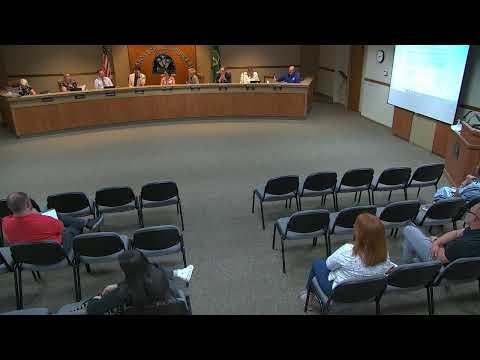
The Pasco School Board on Tuesday discussed options for its replacement levy and directed district staff to prepare scenarios for two- and three-year levies rather than a four-year package, citing uncertain real-estate assessed-value growth and the need to manage local tax rates.
Dr. Castilleja, the district staff member leading the levy briefing, reviewed the levy’s recent history and explained the role of state levy equalization (LEA). “We must have a voter approved levy of at least $1.5 to receive the LEA,” Dr. Castilleja said, noting that the district expects to collect about $34,100,000 in levy dollars next year and that the state will add roughly $15,000,000 in LEA funds if thresholds are met.
The nut graf: Board members said market uncertainty following a slowdown in assessed-value growth makes a four-year levy less prudent. Multiple directors suggested preparing shorter-term options; Vice President Steve Simmons and Director Phillips explicitly urged staff to model two- and three-year replacement levies so the board can decide later in the fall once assessed values are clearer.
Dr. Castilleja walked the board through assessed-value and levy-rate history: the district’s levy amount and the corresponding cost-per-thousand have shifted with strong assessed-value growth in prior years and a correction in 2025 that raised the district’s cost per thousand to about $1.89. Staff emphasized the trade-off that voters approve the overall levy amount while property assessed values determine the annual cost per thousand.
Board members discussed timing and next steps. The board will receive more detailed financial modeling in August from the district’s finance partners (including bond advisors) and is slated to decide levy amounts and term in October. If the board sets a levy resolution in November it will also appoint the required pro/con committee for voter information materials. Several board members said they prefer a shorter term to preserve flexibility and to avoid surprising taxpayers; Director Ken (first name not stated) proposed preparing both 2- and 3-year scenarios to maintain options.
No formal vote was taken. Staff agreed to prepare two- and three-year replacement levy scenarios and to present more detailed rate and revenue modeling at upcoming study sessions so the board can make a final decision by the fall schedule.