Get Full Government Meeting Transcripts, Videos, & Alerts Forever!
Get email alerts on the Economic Forecast topic
No spam. Unsubscribe anytime.
UCF economist tells Sarasota commissioners national fiscal uncertainty clouds forecasts; local outlook remains resilient
Summary
Dr. Sean Snaith of the University of Central Florida told Sarasota commissioners that national fiscal and trade uncertainty — including high federal debt, tariff policy and election‑linked uncertainty — makes forecasting difficult, but he said Florida and the Sarasota metro area remain relatively resilient.
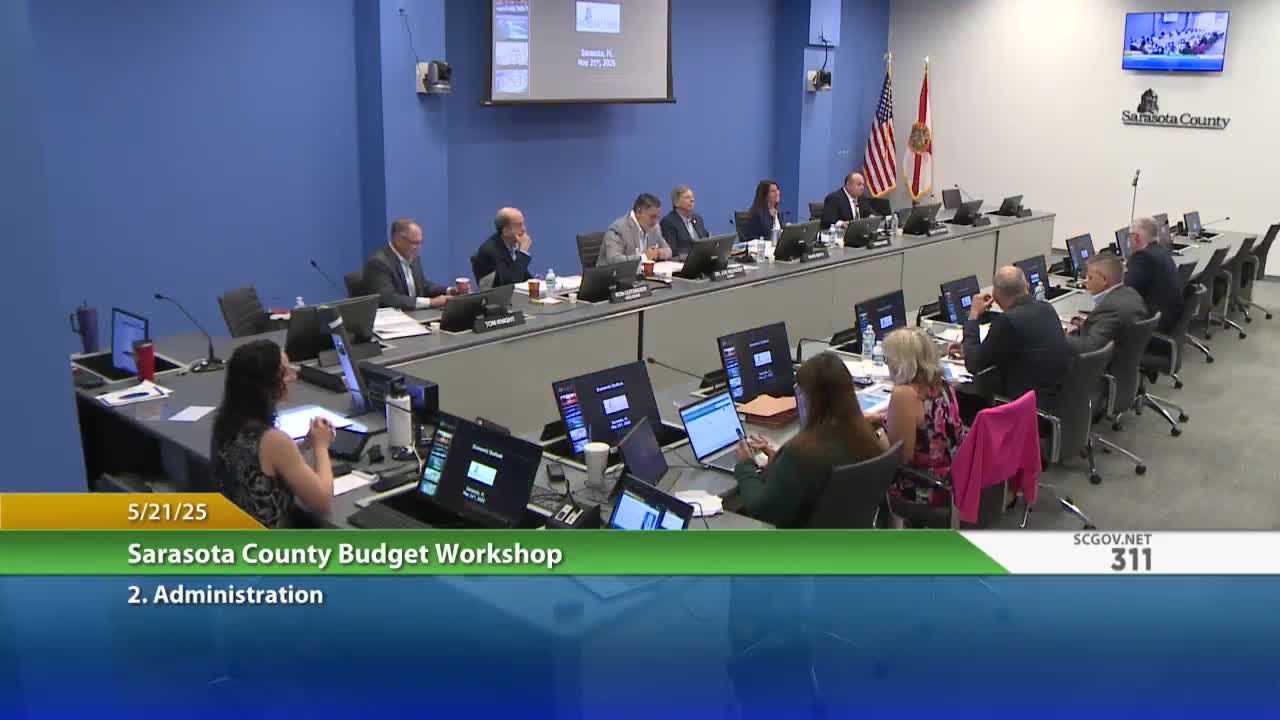
Dr. Sean Snaith, director of the Institute for Economic Forecasting at the University of Central Florida, told the Sarasota Board of County Commissioners on May 21 that unprecedented policy and geopolitical uncertainty has made economic forecasting unusually difficult but that Florida’s labor market and Sarasota’s tourism and housing markets are holding up.
Snaith described several structural and policy forces he said complicate national forecasts: the expansion of federal debt and deficits, recent credit‑rating actions, tariffs and trade actions, and election‑linked policy uncertainty. “The interest payments on this debt are now over a trillion a year,” he said, citing federal interest‑cost projections. He said the federal deficit and rising interest costs are squeezing discretionary budgets and complicating partnerships that local governments rely on for transportation and other projects.
On trade policy, Snaith said tariffs have clear economic effects but cautioned that tariffs generally cause a one‑time increase in affected import prices rather than sustained inflation driven by money‑supply growth. He also described tariffs as a negotiation tool that can be used to extract concessions from trading partners, and he identified China, Mexico and Canada as the most exposed major trading partners.
Turning to housing and Florida’s local economy, Snaith said housing markets have calmed since post‑COVID surges. He described Florida’s market as closer to balance, with inventory rising — he cited a roughly 5.5‑month supply measure as an indicator of a balanced market — and said the local labor market remains strong. He added that Sarasota’s tourism sector continues to perform well: visitation held up following earlier shocks and he observed strong local hotel demand during the workshop visit.
Commissioners asked about the local consequences of federal and state fiscal policy. Snaith said his central concern was policy uncertainty driving business caution on investment and that the federal process of governing via continuing resolutions and executive actions adds planning risk for local governments. He declined to produce a fixed numeric forecast at the workshop, saying rapid policy shifts make point forecasts unreliable: “It’s tough to make predictions, especially about the future.”
Why it matters: Snaith’s remarks frame the county’s budget and capital‑planning environment. Rising federal interest costs and uncertain state actions could reduce or delay funding for county projects that depend on federal or state partnerships; a continued strong labor market and steady tourism receipts, by contrast, support local revenues.
What commissioners heard: The presentation highlighted risks — federal debt and trade policy uncertainty — and local strengths — resilient tourism and a strong labor market. Commissioners used the presentation to probe potential budget effects and to confirm staff planning assumptions ahead of FY‑2026 budget work.
Proposed next steps: Staff and commissioners said they will monitor federal and state developments during the budget cycle and adjust assumptions at the July budget workshops if new information warrants changes.