Get Full Government Meeting Transcripts, Videos, & Alerts Forever!
Get email alerts on the Climate Resilience topic
No spam. Unsubscribe anytime.
City staff outlines climate resilience projects, flags frozen federal grants and near-term savings
Summary
City staff briefed the City Utilities Committee on the Climate Resilient ATL action-plan engagement, near-term utility savings from a rate change, EV readiness rulemaking and several grant awards and freezes affecting local projects.
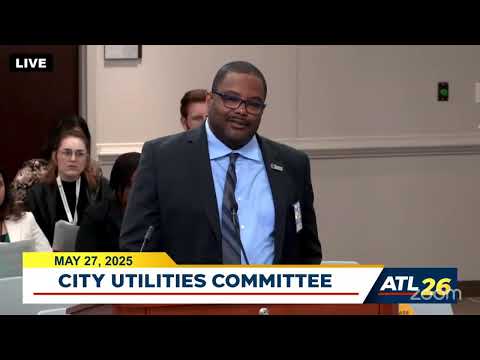
City staff updated the City Utilities Committee on the Climate Resilient ATL action-plan, describing an 18-month engagement process and laying out near-term program work on fleet electrification, food access and municipal solar opportunities.
The presentation summarized city partnerships — including Invest Atlanta, the Department of City Planning and external technical partners — and said staff aims to engage at least 2,500 residents. The presenter told the committee, “my goal is that nobody's gonna come up to me and say they didn't know that the city was working on this,” and urged council members to help publicize outreach in their districts.
The presenter highlighted a short-term rate-analysis with Cherry Street Energy that identified nine city facilities eligible for a utility rate change. The analysis, which staff said has been discussed with Georgia Power, “could produce a savings this year of $27,000 for the city,” and staff estimated “over the remainder of our contract term, that's another half a million dollars of savings on [the] city's utility bills.” Staff said hearings for the Public Service Commission’s integrated resource plan began the day of the presentation.
On fleet electrification, staff said the electric-vehicle readiness ordinance was updated and will take effect Jan. 1, 2026. The presenter reported a roughly $3,200,000 grant to replace some medium- and heavy-duty vehicles across departments including Public Works, the airport and Watershed. Staff also noted Atlanta Fire and Rescue and the Atlanta Fire and Rescue Foundation were deploying two Rivian electric emergency vehicles.
Staff described community-facing efforts: a food ecosystem survey tied to the city’s fresh food access map and a youth climate fund. The presenter said the city was awarded an additional $100,000 in addition to $50,000 received in 2024 for the Atlanta Youth Climate Action Fund; staff celebrated the first Youth Climate Action Summit on Earth Day and said about $40,000 remained to distribute. They also said roughly 63 applications were in the queue for youth awards.
Committee members pressed staff on program details and risks. Councilmember Isha Collins asked whether there is formal legislation for energy audits and how outreach will be coordinated across existing programs; staff said the audits tie to earlier ARPA donation agreements and to program lists from Invest Atlanta, the Department of Watershed Management and other city programs, and that staff are consolidating lists on the Neighborly platform used by Invest Atlanta for owner-occupied rehab programs. Collins asked about timing; staff said an extension of 90 days had been set and that an additional $200,000 would be available in the next fiscal year to sustain Weatherize work until a Q3 “Solar for All” launch.
Councilmember Alex Waller asked about federal reimbursement risk, noting many grant awards are reimbursement-based. Staff described a stalled airport charging grant that was roughly $12 million and said the city is exploring legal options to unfreeze those funds. Staff also said roughly $500,000 from an energy-efficiency conservation block grant and a ~$400,000 USDA composting grant were in reimbursement status and that the posture is to continue paperwork so the city is positioned to draw funds when reimbursements become available. “Yeah, it's very much, whiplash,” the presenter said describing the grant uncertainty.
Staff also raised workforce development coordination with the Department of Labor and Employment Services on residential-focused workforce pipelines for Weatherize and roof-replacement programs, and noted the Office of Constituent Services had partnered with Fulton Atlanta Community Action Authority and Georgia Power on sign-up events for federal energy-assistance and weatherization programs.
Committee members requested follow-ups. Councilmembers asked staff to provide heat maps and canvass-cost breakdowns for recent outreach (staff said Sustainable Georgia Futures’ allocation for canvassing was approximately $240,000 supplemented by philanthropic support), details on users of the fresh food app, and implementation timing for audits, Solar for All and related pilot programs.
The briefing closed with staff requests for council help in outreach and continued engagement as the action plan and related regulatory participation (including the Public Service Commission proceedings) proceed.