Get Full Government Meeting Transcripts, Videos, & Alerts Forever!
Get email alerts on the Transportation Delivery Drones topic
No spam. Unsubscribe anytime.
Rowlett OKs zoning text amendment to allow Zipline drone hubs and kiosks
Summary
The Rowlett City Council approved a zoning text amendment requested by Zipline to add unmanned aircraft system (UAS) hubs and kiosks as new uses in nonresidential zones, allowing hubs by special use permit and kiosks by right under the applicant's proposal; the council voted 6-0.
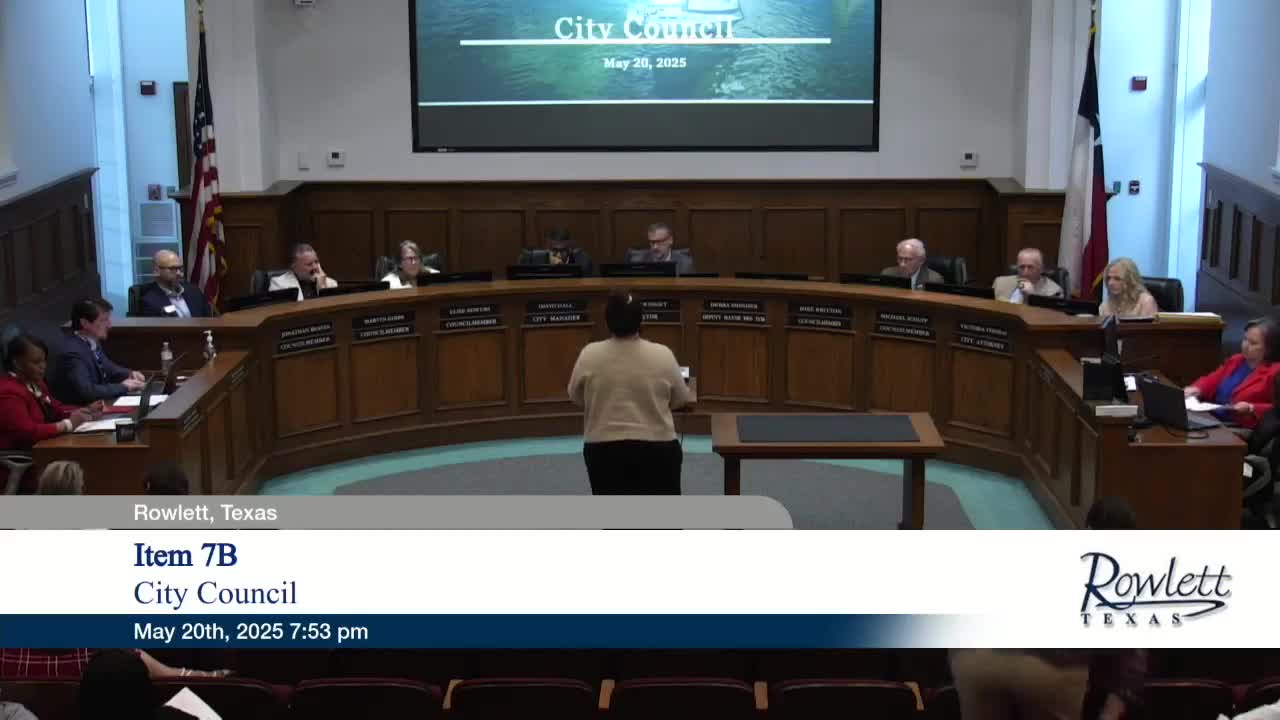
The Rowlett City Council voted 6-0 on May 20 to approve a text amendment to the city's zoning code that adds unmanned aircraft system (UAS) hubs and UAS kiosks as new, regulated uses in nonresidential zoning districts.
The change authorizes UAS hubs — sites that house, charge and launch delivery aircraft — by special use permit and would allow small UAS kiosks by right in nonresidential zones under the applicant's version of the ordinance. The council approved the applicant's requested draft (attachment 1) following presentations from city staff and Zipline representatives and a public hearing that drew no speakers.
The ordinance adds a definition for “unmanned aircraft system,” sets screening and siting requirements for hubs (including a six-foot screening standard), and addresses pedestrian access and setbacks. Planning and Zoning unanimously recommended approval with modifications and asked the council to consider a larger residential buffer; the applicant had asked for a 50-foot separation from residential properties, while Planning and Zoning recommended at least 200 feet. Council approved the applicant's package as submitted.
Zipline representative Stephanie Cook described the company’s existing U.S. operations and its delivery method: a small cargo “zip” is winched down from an aircraft to make backyard or front-yard deliveries; Zipline said the aircraft operates at roughly 300 feet altitude during transit. Cook told council the smaller UAS kiosks would occupy up to 300 square feet, the “zip” payload capacity is up to 8 pounds, and initial service radii typically start at about 1.5 to 2 miles and can expand. She said measured sound during dock or delivery operations is in the 53–64 decibel range, comparable to distant car traffic at 300 feet, and that the company uses onboard sensors, redundancies and a monitored operations center to reduce safety risk.
Council members asked about noise, privacy and parking. Staff told council hubs would be allowed as either principal or accessory uses; because hubs can be proposed on existing developed lots, the applicant asked that parking minimums be allowed to be reduced by up to 10% through the special use permit process. On privacy, Zipline said it collects only the minimal data needed to fly and deliver, that the company encrypts data and blurs faces when imagery is used for operations. Council members discussed whether kiosks should require a special use permit; some members favored additional review for kiosks, others said requiring SUPs for kiosks could be unnecessarily restrictive and that the SUP requirement for the hub gives the council control over core operations.
The council’s approval allows Zipline and similar operators to pursue permits and, in Zipline’s case, return with a site-specific special use permit application for a hub. The text amendment applies citywide to nonresidential zones; any hub location would later require a separate SUP review and vote.
Speakers included city planning staff and Zipline; no public commenters spoke at the hearing.
Councilmember Reeves made the motion to approve the applicant's draft; Councilmember Bowers seconded. The vote was 6-0.
What happens next: Zipline indicated it will return with a site-specific SUP application for a proposed hub; the council retains authority to set conditions or deny specific SUPs.