Get Full Government Meeting Transcripts, Videos, & Alerts Forever!
Get email alerts on the District Budget Forecast topic
No spam. Unsubscribe anytime.
Maple Heights treasurer warns of $3M-plus county repayment, urges budget planning in five‑year forecast
Summary
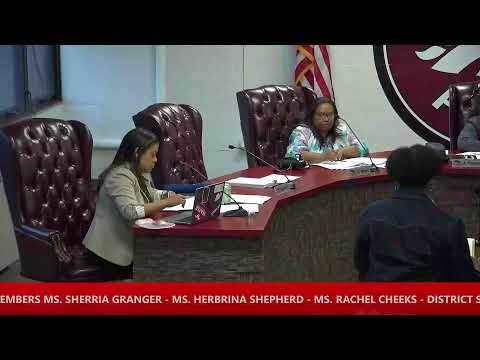
Maple Heights Board of Education Treasurer delivered a detailed May five‑year forecast on May 27 and the board approved the forecast as presented.
Maple Heights Board of Education Treasurer delivered a detailed May five‑year forecast on May 27 and the board approved the forecast as presented.
The treasurer said the district ended the year with a $6,320,000.00 gain but cautioned the board that the number may not hold going forward because of several liabilities and modelling assumptions. “We had a gain this year of 6,320,000.00,” the Treasurer said.
The forecast matters because most district revenue — about 57% — comes from the state, the Treasurer said, and expenditures are concentrated in personnel (about 70%). The forecast models the House version of the pending state budget and shows revenues flattening while expenditures rise in later years, producing a crossing of revenue and spending in the 2027–2028 period.
During the presentation the Treasurer identified three immediate risks: repayment of an overcollection of the district’s emergency tax levy by the county fiscal officer (estimated at more than $3,000,000 but awaiting final county calculations), uncertainty in the final state budget, and a projected revenue surplus/deficit in fiscal year 2028 that will require planning.
The Treasurer described how the county overcollection arose after recent property revaluation increased assessed values but millage rates were not reduced before collections were made; the county must determine the repayment schedule. “We’re gonna have to pay it back,” the Treasurer said, adding the district modeled a three‑year repayment in the forecast and will wait for the county fiscal officer’s official direction.
The presentation also reviewed current fund deficits and near‑term fixes. The Treasurer said nine funds were in the negative at the time of the report, eight of them grant funds, and that purchase‑to‑close actions (PCRs) had been issued for some grants and cash receipts had begun arriving. The ESSER fund (Fund 507) showed a negative balance and will require either transfers in or expenditure adjustments; the Treasurer said staff will research the overspend and bring corrective actions to the June meeting. The student activity fund (300), driven mainly by athletics, was also in deficit and is expected to be corrected with a transfer when year‑end figures are finalized.
On forecasting methods, the Treasurer said the district used current actuals and standard inflation assumptions (roughly 2–3% in some categories) and included a late addition to account for special education invoices that arrived after initial projections. The Treasurer said May actuals included invoices that added roughly $270,000 to special education expenditures compared with earlier projections and that amount was added to the forecast to improve accuracy.
Cash position and reserves were highlighted. The Treasurer said the district’s cash balance is roughly 48.5% (reported as 48.5453832 in the presentation) and that days cash on hand are above the Government Finance Officers Association (GFOA) prudent range of 60–120 days; however, the forecast shows days cash declining in later years if current trends continue. The Treasurer urged the board to watch the proposed state legislation (referred to in the presentation as “HB 96” / hospital 96 in the discussion) that could reduce local funding when cash balances exceed a statutory threshold.
The Treasurer asked the board to expect a mass budget revision for Title 6B and to authorize budget transfers or advances at the June meeting to address funds currently in a negative position. The Treasurer also requested the board see and approve an investment report at the June meeting to confirm compliance with the Ohio Revised Code on investing school district funds.
Board action: The board voted to approve the financial report for the month ending April 30 and later voted to approve the five‑year forecast as presented. A separate motion to table a fiscal services (payroll) agreement was adopted after additional discussion; the Treasurer and board agreed to return that contract for further review. No other formal commitments were made during the forecast presentation.
The Treasurer’s presentation emphasized that the forecast is a planning tool and that final results will depend on the state budget outcome and the county fiscal officer’s calculations on the overcollection.
The board is scheduled to receive related budget revisions and the requested investment report at its June meeting.