Get Full Government Meeting Transcripts, Videos, & Alerts Forever!
Get email alerts on the Home Rule Charter topic
No spam. Unsubscribe anytime.
Williamsport council hears state briefing on home rule charter, tax options and timeline
Summary
City officials and residents attended a DCED presentation on adopting a home rule charter, covering what home rule would change, possible new tax options (earned income tax, real estate transfer tax), timeline to place a government study commission on the ballot and consultant funding via the state STAMP program. No vote was taken.
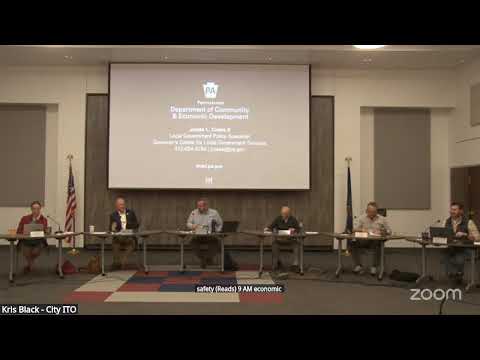
Williamsport City Council received an informational briefing May 27 from the Pennsylvania Department of Community and Economic Development on the process, timeline and fiscal options for adopting a home rule charter.
The presentation, led by Jonas Kras of the Governor's Center for Local Government Services, explained that a home rule charter replaces portions of state municipal code with a locally drafted charter approved by voters and can alter government structure and local tax authority. "Home rule charters provide a county or municipality with its own unique constitution rather than following state municipal codes, which often could be seen as, like, cookie cutter, really the standard," Kras said.
Why it matters: Council members repeatedly framed home rule as a tool to give the city more flexibility on taxes and governance amid long-term budget pressures, an aging population and a large nonprofit-owned land base. Kras and council members discussed options that home rule can enable — including earned income tax and local real estate transfer tax changes — and the practical steps to place a government study commission on the ballot for voters to consider whether to draft a charter.
Kras told the council that home rule can remove state caps on certain local taxes and allow municipalities to "pick and choose" which parts of the municipal code to retain. He said home rule frequently is proposed to improve fiscal procedures, administrative clarity and citizen participation. Kras listed constraints that home rule cannot override, including the U.S. Constitution, the Pennsylvania Constitution, the election code, ethics law, the Sunshine Act and parts of the Municipalities Planning Code.
Council members and residents focused on revenue options. Councilmember Eric said the city needs to "figure out ways that we can increase revenue in the city, but also not rely solely on, property taxes." Kras and the deputy executive director at the Governor's Center said earned income tax (EIT) and local real estate transfer taxes are among the common revenue tools communities consider after adopting home rule. Kras explained the home rule process could also enable changes to administrative rules, rental and blight enforcement, and the structure of elected versus appointed officials.
Timing, ballot mechanics and costs were detailed: a referendum to create a government study commission (GSC) may be placed on the ballot by governing body ordinance or by petition; petition and filing windows are tied to specific “Tuesdays before” election deadlines the presentation listed for 2025 (for example, petitions may be picked up June 17, 2025, and circulated during a narrow window in August). Kras said a GSC must hold an organization meeting within 15 days of election certification and must determine whether to recommend home rule within nine months. If the GSC recommends home rule, it then has up to 18 months to draft a charter for referendum.
On funding, Kras said that if the city’s Strategic Management (STAMP) consultant recommends home rule, DCED can fund professional consultants for drafting the charter: the state would cover roughly 90 percent of consultant costs under STAMP, leaving the municipality responsible for about 10 percent. Kras and council members estimated the consultant expense for a charter and code drafting at about $25,000–$50,000.
Several council members asked about non-tax levers and other tools. City Treasurer Kevin Mackey and others discussed pursuing payment-in-lieu-of-taxes (PILOT) agreements with nonprofits and checking whether some tax‑exempt parcels meet the standards for exemption. Council members also raised land-value taxation as an independent option (not requiring home rule) and asked DCED to share examples.
Public-safety regionalization came up repeatedly as a related fiscal pressure. Kras said the Governor’s Center offers regional police, fire and EMS studies at no cost to municipalities and that Lycoming County was already engaged in such a study; he said regionalization recommendations can be funded through STAMP if they appear in the consultant report.
No formal motion or vote occurred; Kras emphasized the session was informational. Council members and members of the public asked questions about risks (chiefly the difficulty of drafting a charter correctly), time commitment for GSC members, whether elected or administrative officials can serve on a GSC, and experience from other municipalities such as Lancaster and Altoona. Kras said municipalities rarely reverse home rule after adoption; amendments are possible later by referendum.
Council members said they wanted more time to consider the options and to hear the STAMP consultant’s recommendations. Kras said he would share DCED materials and examples (including Lancaster’s public videos) and urged the council to consult multiple sources while preparing a charter. The council closed the public meeting without taking action and listed upcoming committee and council meetings. The city will decide whether to place a GSC referendum on a future ballot or wait for STAMP recommendations.