Get Full Government Meeting Transcripts, Videos, & Alerts Forever!
Get email alerts on the Police Hiring Performance topic
No spam. Unsubscribe anytime.
SPD reports hiring surge but flags potential $6.8M$10M salary shortfall; 911 response time improves to 7 minutes
Summary
Seattle Police Department and council central staff told the Public Safety Committee they are seeing an "unprecedented" hiring pace (about 14 new recruits per month), producing a net gain of 19 officers in the first quarter but creating a potential $6.8 million to $10 million salary funding gap for 2025.
Seattle Police Department officials and council central staff told the City Council's Public Safety Committee that SPD's recruiting has accelerated and that the department is likely to add more officers than originally budgeted this year — a development that could leave a salary shortfall if the city does not identify offsets.
Greg Doss, council central staff, briefed the committee on the department's quarterly hiring, overtime and performance report. Doss said the department has seen "about 14 hires per month," a recent and sustained increase that has produced a net gain of 19 officers in the first quarter (12 more hires than planned and seven fewer separations). Angela Sossey, executive director of budget and finance for the Seattle Police Department, joined the presentation and described the department's updated projections and operational context.
The department provided multiple projections. Sossey said SPD's conservative, revised annual hiring projection is 32 hires. Doss described a high-end projection based on the current 14-per-month pace that would yield 69 hires by year end; later in his summary Doss said the department could see as many as 76 new officers under more optimistic assumptions. The committee heard that SPD had reported 60 hires through April 18 in a separate staffing update.
Those additional hires have a budgetary consequence. Central staff said the difference between budgeted staffing and the likely hires translates into a potential salary funding gap of roughly $6.8 million on the low end and up to $10 million on the high end for 2025. The department and central staff said they are meeting monthly with the mayor's office to examine existing savings and external funding options; the department said it is unlikely to request a midyear supplemental appropriation immediately and may wait until later in the year to judge actual hiring before seeking council action, if any.
The committee also reviewed overtime spending and performance metrics. The city's 2025 overtime budget for SPD is $53 million; SPD spent roughly 20% of that through the first quarter, central staff said, and the department is currently on track to operate within the increased 2025 overtime budget. Central staff noted parts of overtime growth relate to labor agreements that included a $225 premium for special-event shifts and a prior agreement raising pay; those agreements were referenced as factors that encouraged recruitment.
On response times, the committee heard that the city's median 9-1-1 response time improved from 7.9 minutes to 7.0 minutes. Central staff and SPD said the improvement follows a review and reclassification of call priorities and possibly the "care effect" ' the impact of alternative responders (the CARE program) handling some calls and thereby freeing SPD officers to answer other 9-1-1 calls more quickly. Angela Sossey also told the committee the department is seeing improved retention: "We are seeing a decrease in the number of fully trained officers separating from the department," she said.
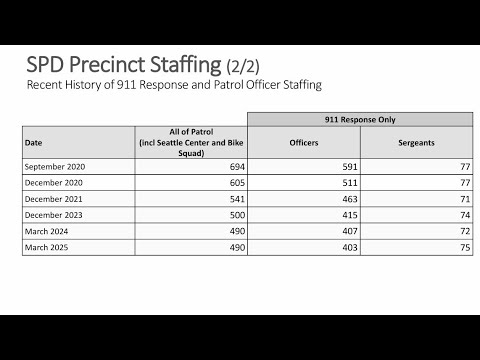
Committee members pressed on precinct differences and foot/bike beats. The North Precinct continues to have the slowest response times, committee members said, and council members repeatedly urged additional operational support for that precinct. Central staff reported there are currently about 490 sworn positions assigned to patrol (403 responding to 9-1-1 calls and 75 sergeants) and that a historical target of about 550 9-1-1 responding officers is the threshold at which the department can again staff proactive functions such as foot or bike beats without relying on overtime. The department and central staff said it takes months for new hires to complete academy and field training before they are fully deployable.
The committee also discussed recruitment of women. Central staff reported that female applicants and hires have hovered around 13'14% of applicant pools and recruit classes; the department is conducting step-by-step reviews to identify if and where female candidates are dropping out of the process and Deputy Chief Underwood is reviewing disqualifications. Doss and Sossey attributed some of the recent hiring success to organizational changes enacted by ordinance last year that centralized recruitment and to the wage increases the council approved to raise SPD salaries.
Public comment earlier in the meeting tied into the committee discussion: multiple speakers raised concerns about police crowd management during recent protests at Cal Anderson Park, argued for independent review of force and permitting decisions, and urged the council to center the safety of historically marginalized communities in crowd-control planning. Chair Robert Kettle said SPD will complete an after-action report and that the committee will review crowd management policies as part of its oversight work.
What comes next: central staff will continue quarterly reporting. The department and central staff said they will monitor hiring and separations and report further; central staff flagged the possible salary shortfall and said the city is exploring internal savings and external funding before deciding whether to request supplemental appropriations later in the year.