Get Full Government Meeting Transcripts, Videos, & Alerts Forever!
Get email alerts on the Ethics And Renters Rights topic
No spam. Unsubscribe anytime.
Hundreds urge Seattle Council to reject ethics rollback and protect renters' rights; attempt to reopen public comment fails
Summary
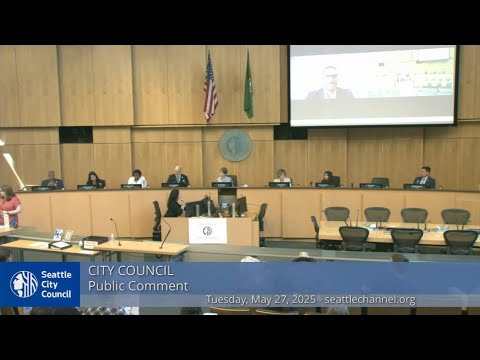
Hundreds of residents and advocates used the council's public-comment period on May 27 to urge Seattle's City Council not to weaken the city's ethics rules or roll back renter protections.
Hundreds of residents and advocates used the council's public-comment period on May 27 to urge Seattle's City Council not to weaken the city's ethics rules or roll back renter protections.
Speakers said an ethics rewrite under consideration would enable council members with financial interests in rental housing to vote on measures that affect their own investments, and many tied the proposal to potential rollbacks of renter protections such as caps on late fees and eviction limits.
The public-comment period drew sustained and often emotional testimony. Alex Olson, who identified himself as a renter and a member of Workers' Strike Back, said: "The fact that you need to repeal your own ethics to carry out this agenda tells us everything we need to know." Sydney Amor, another renter and District 5 resident, said, "Disclosure without recusal doesn't prevent corruption. It just makes the corruption more brazen and obvious."
Multiple speakers named specific donations and donors. One commenter said Council Member Maritza Rivera received $284,000 and Rob Sacca received $230,000 from real-estate interests; others alleged Council President Sarah Nelson and Council Member Joy Hollingsworth accepted campaign funds from Greystar and the National Association of Realtors. Those are claims by commenters and are reported here as such; the transcript contains those assertions but the article does not verify them.
Speakers also recounted individual experiences they said illustrated the need for stronger ethics safeguards. One resident described a dispute with a major corporate landlord that took over two years in small-claims court to resolve, while others warned that repealing the ethics law would make it easier to erode renter protections enacted in prior council sessions.
During the meeting, Council President Sarah Nelson briefly closed the public-comment period after an hour and recessed the meeting due to disruptive behavior. After reconvening remotely, Nelson moved to suspend the rules and reopen public comment so people who had left the chambers could speak; the motion to extend public comment was called and failed on a roll call, 4 in favor and 4 opposed. The clerk recorded "Aye" votes from Kettle, Moore, Rink and Solomon and "No" votes from Rivera, Sacca, Sullivan and Strauss; the motion failed and public comment remained closed.
Council members did not vote on the ethics changes at this meeting. The issue was raised repeatedly in person and by phone, with numerous speakers urging the council to maintain recusal requirements and oppose any amendment that would allow disclosure without recusal.
Speakers urged voters to hold council members accountable in elections. Public testimony included calls for new political organization and labor-backed campaigns to oppose lawmakers perceived as aligned with landlord or developer interests.
The large turnout and concentrated testimony mean the ethics proposal and any related ordinance on renters' rights are likely to draw sustained public scrutiny as they move through committee and potential votes. Council members and staff indicated committee briefings and further review will follow; no ordinance was adopted on these matters during the May 27 meeting.