Get Full Government Meeting Transcripts, Videos, & Alerts Forever!
Get email alerts on the Public Participation topic
No spam. Unsubscribe anytime.
Highland Park planning board will allow Zoom for non-hearing public comment, requires in-person testimony for hearings
Summary
Counsel told the Highland Park Planning Board that Zoom may be used for general public comment and non-hearing referrals, but the board will require in-person testimony for formal hearings to protect applicants' rights; counsel will draft notice changes.
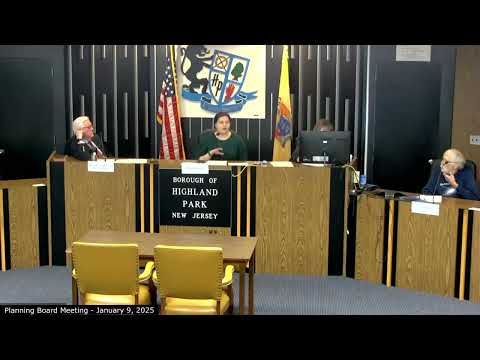
The Highland Park Planning Board agreed to permit public participation by Zoom for non-hearing comment and for commentary on referrals, but it will require anyone testifying in a formal board hearing to appear in person, board counsel said at the Jan. 23 reorganization meeting.
Roger Thomas, the planning board's attorney, told members that the board hears three types of public participation: general public comments, comments on matters referred by the town council (non-hearing), and formal applications/hearings. For the first two, Thomas said, Zoom may be used because the board is not taking sworn testimony in those contexts. For the third — formal hearings where the board serves a quasi-judicial function — Thomas said in-person testimony is required so applicants can preserve the right to cross-examine witnesses and to create a record that would withstand judicial review.
"When we hold a hearing for an applicant who is bringing an application for the board, we are serving the judicial role in that capacity," Thomas said. "We take testimony, we examine evidence, and the applicant has the right to cross examine anyone who gives testimony either in support or in opposition to their application. And because of that, having the public provide input on hearings by Zoom creates a challenge in that it affects the rights of the applicants and how they present their application." The counsel cited section 6.05 of the board's rules of conduct in explaining the in-person testimony requirement.
Board members discussed logistics and uniformity with borough council procedures. Several members supported closing the public comment period before board responses, mirroring a council practice intended to avoid back-and-forth exchanges that could turn into debates. The board agreed that people joining remotely should state their name and address when commenting; the chair and counsel said the address helps the board determine whether a commenter is a resident, property owner, or nonresident.
The chair asked whether commenters must be borough residents; the board's response was that the rules do not generally restrict public comment to residents, though residency can be relevant to the substance of remarks. The board directed counsel to prepare revised notice language for meeting postings to explain when Zoom participation is permitted and to clarify the in-person requirement for hearings. Counsel said he would draft those notice changes for the board's February meeting.
The board decided not to immediately amend the formal Rules of Order; instead, counsel will review whether textual tweaks are necessary and return recommended edits at the February meeting. The board noted that state legislative work is ongoing regarding the designation of official newspapers and other notice provisions, and that they may need to revisit newspaper designations once that legislation moves.