Get Full Government Meeting Transcripts, Videos, & Alerts Forever!
Get email alerts on the Homeless Services topic
No spam. Unsubscribe anytime.
Cobb County study finds shelters produce few permanent exits; recommends rapid rehousing and supportive housing investments
Summary
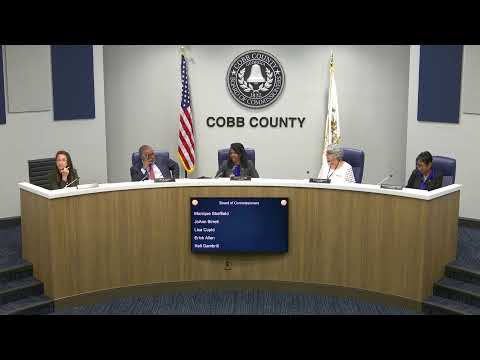
A county-commission work session presentation on May 27, 2025, summarized a yearlong system‑modeling review of Cobb County’s homeless services and recommended shifting funding toward rapid rehousing and permanent supportive housing to boost exits to permanent housing.
A county-commission work session presentation on May 27, 2025, summarized a yearlong system‑modeling review of Cobb County’s homeless services and recommended shifting funding toward rapid rehousing and permanent supportive housing to boost exits to permanent housing.
The presenter for the modeling work, Melanie (Cobb Homeless Alliance), told the Board that “87% of the total volume moving through the system moves directly into emergency shelter, 1,537 households,” and that only about 13% of those shelter stays result in exits to permanent destinations. She said the review’s goal was “to better understand how the homeless service system is functioning, with the aim of more efficiently and more equitably serving the population in need.”
Why it matters: Commissioners were told that emergency shelter is essential but that the model shows shelters have low long‑term exit rates compared with rapid rehousing (RRH) and permanent supportive housing (PSH). Melanie said the modeling found “the best bank for our buck would be to invest in rapid rehousing programs and permanent supportive housing programs because these map onto much better percentages of exits to permanent destinations.” The presentation framed the shift as both more effective for clients and more cost‑efficient over time.
Key findings and numbers presented - 87% of people entering the homeless‑service system enter emergency shelter (presenter’s figure: 1,537 households). - About 13% of those leaving shelter move to permanent destinations, compared with substantially higher exit rates for RRH, transitional housing and PSH (exact comparative percentages were shown in slides). - The presenter said county recidivism—the share of households reentering the system after exiting—has risen from roughly 4–5% to about 7–7.5% in recent years.
Presenters tied the modeling to funding and program design. Kimberly Roberts, managing director for the Cobb County CDBG office, described the county’s HUD grants and how federal rules shape what the county can allocate. Roberts summarized the county’s FY2024–2025 HUD awards as presented: CDBG roughly $3,400,000; HOME roughly $1,200,000; and ESG approximately $269,000 in 2024 and $278,000 in 2025. She explained program rules that affect allocations: a 15% cap on CDBG public services, a 20% HOME CHDO set‑aside (15% construction/5% CHDO operating as described), and a 60% cap on ESG emergency shelter and street outreach funds. Roberts said applications are prepared in the fall for the next year and that the county often budgets preliminarily using 70% of prior allocations until HUD announces final awards.
Roberts also reviewed outcomes reported in the county’s CAPER for the 2024 program year: about 5,800 residents received assistance through CDBG; CDBG expenditures listed included roughly $1.7 million for public facilities and $500,000 for public services; HOME expenditures supported roughly 278 families with tenant‑based rental assistance and construction of eight new affordable single‑family homes; ESG funds assisted about 4,800 residents with emergency shelter and related services. Roberts said full program reports are on the county’s website.
Law enforcement and enforcement tools A county law enforcement representative outlined field challenges, particularly illegal encampments clustered in the Bells Ferry corridor and other locations. The speaker said teams now bring outreach materials to camps and work with service partners but also encounter people “who want to remain unhoused” because of mental illness, addiction or other barriers.
The law enforcement speaker described Marietta’s recent ordinance changes and the county’s interest in mirroring those rules. He said the Marietta language bars camping on private property without owner permission and that officers are now using a revised criminal trespass form that includes the ordinance language and a property‑owner signature to help enforce private‑property prohibitions. The speaker said the goal is a unified approach across jurisdictions to reduce displacement from one area to another.
Discussion, next steps and board direction Discussion emphasized coordination across funding streams and agencies. Commissioners asked for additional details on the modeling, survey results used to set HUD priorities, recidivism tracking and how to handle people who decline services.
Melanie and other presenters urged the board to adopt shared countywide goals, coordinate funding toward shared outcomes, and form a standing homeless action subcommittee or structured strategic planning sessions with stakeholders. Commissioners signaled interest in follow‑up: one commissioner requested a one‑on‑one briefing; another indicated willingness to rotate representation on a future subcommittee. No formal motions or votes were recorded during the work session on these items.
Quotes (selected) - Melanie, Cobb Homeless Alliance: “Emergency shelter is a critical service. It's absolutely essential to a functioning homeless service system... the vast majority volume only moves through emergency shelter.” - Melanie: “The best bank for our buck would be to invest in rapid rehousing programs and permanent supportive housing programs because these map onto much better percentages of exits to permanent destinations.” - Kimberly Roberts, managing director, Cobb County CDBG office: “The grants that I'm gonna talk to you about today is not necessarily all dedicated to the unhoused… CDBG is the county's most flexible grant program and the largest that is provided to the county from HUD.” - Law enforcement representative: “Our main mission, our strategy is first is to make sure that all the resources... they get those because not everybody needs to go to jail.”
Ending Presenters left the Board with concrete next steps: staff and stakeholders will pursue follow‑up briefings with commissioners, explore formation of a homeless action subcommittee, and continue redesign of coordinated entry and data sharing to track exits and returns to homelessness. Fuller program and performance reports referenced by presenters are posted in the county’s consolidated annual performance evaluation report (CAPER) and on the county website.