Get Full Government Meeting Transcripts, Videos, & Alerts Forever!
Get email alerts on the Noxious Weeds Budget Fy26 topic
No spam. Unsubscribe anytime.
Bonner County reviews Noxious Weeds budget, director proposes $25,000 contractor plan and asks for vehicle repair detail
Summary
At a May 27 budget workshop, the Bonner County Noxious Weeds director proposed the department's fiscal 2026 budget with a shift to contracted roadside weed control, line-item proposals for travel, education and printing, and a request from commissioners for a detailed vehicle repairs cost breakdown.
Bonner County held a budget workshop May 27 to review the Noxious Weeds program's proposed fiscal 2026 budget, during which the Noxious Weeds director proposed maintaining several operating line items, recommended contracting roadside spraying for District 1 at about $50 per lane mile for an estimated 500 lane miles (roughly $25,000), and was directed to provide a detailed breakdown of anticipated vehicle repairs.
The proposal matters because the department is shifting from an in-house seasonal crew to a contractor model for roadside operations in 2026. That change affects labor, equipment and maintenance costs and could allow the county to declare surplus on a spot-spray rig while creating a capital-replacement plan, the director said.
The director proposed keeping the travel allotment at $2,000 to cover winter association meetings in Boise, quarterly executive board meetings around the state and occasional travel to testify or present. She said, "I'm proposing to keep the travel line item static at 2,000." Education was proposed at $500 to cover conference registration and local workshop costs; the director noted she needs about 16 continuing-education credit hours annually to maintain her professional license.
On printing and outreach, the director requested $500 in the books-and-printing line as a fallback if an Idaho Fish and Wildlife Foundation grant for new local noxious-weed handbooks is not awarded. She said the county could treat that expense as a one-time enhancement if the grant covers printing. The director also proposed budgeting $800 for advertising next year to run required legal notices in the county newspaper and a supplemental run in the River Valley Beacon to reach rural readers in the southwest corner of the county.
The department presented several operational figures: a tentative county match of $1,000 for the handbook grant; right-of-way herbicide work estimated around 500 treated acres; and a Selkirk Cooperative Weed Management Area cost-share award of $12,000 this year, which the director said she and her Boundary County counterpart typically split roughly equally.
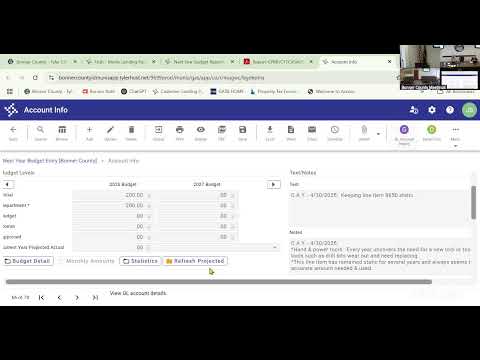
Commissioners pressed for more detail on vehicle repairs and maintenance. The director had proposed $2,500 for vehicle repairs (down from $3,000 the prior year) but was asked to itemize known high-cost items such as a transmission service and new tires to determine whether the line should be higher. One commissioner asked the director to "get the actual in the vehicle repairs line item to break down the actual costs that I'm anticipating for the services and items that I'm anticipating to happen," and the director agreed to update the Munis budget entry and notify finance staff by email.
On fuel, the director proposed $2,000; a commissioner suggested holding $2,500 to provide additional cushion given volatile prices. For professional services, the director restated that this year's contractor rate had been $45 per lane mile and she proposed $50 per lane mile for next year as an allowance for inflation, applied to an estimated 500 lane miles in District 1.
Other line items discussed: dues and memberships at $150 for the Idaho Association of Noxious Weed Control Superintendents; tools and small equipment left at $200; shop and other supplies; and a small miscellaneous fund the director uses for association expenses and unanticipated minor costs. The director described ongoing efforts to shift materials to digital formats where feasible but said many landowners still prefer printed handbooks for field use.
The board did not take formal votes at the workshop. The director said she will return with an itemized vehicle-repair estimate to inform any recommended adjustments to the repairs and maintenance line and will update Munis and email finance staff when she has entered the changes. The Idaho Fish and Wildlife Foundation award decisions are expected in August; if awarded, the printing work would be completed in October or November and would be recorded as a FY26 project.