Get Full Government Meeting Transcripts, Videos, & Alerts Forever!
Get email alerts on the Budget topic
No spam. Unsubscribe anytime.
City financial report: revenues trending above expectations; HUD awards $346.8 million in disaster recovery funds
Summary
Deputy budget director Donnie Johnson and Deputy CFO Nikhil Patel reported that through the nine months ending March 31, 2025 the city’s revenues are tracking to outperform budget while expenditures are below estimates; HUD awarded $346,846,000 in CDBG-DR funds and the administration projects roughly $71.9 million in over-collection for the year.
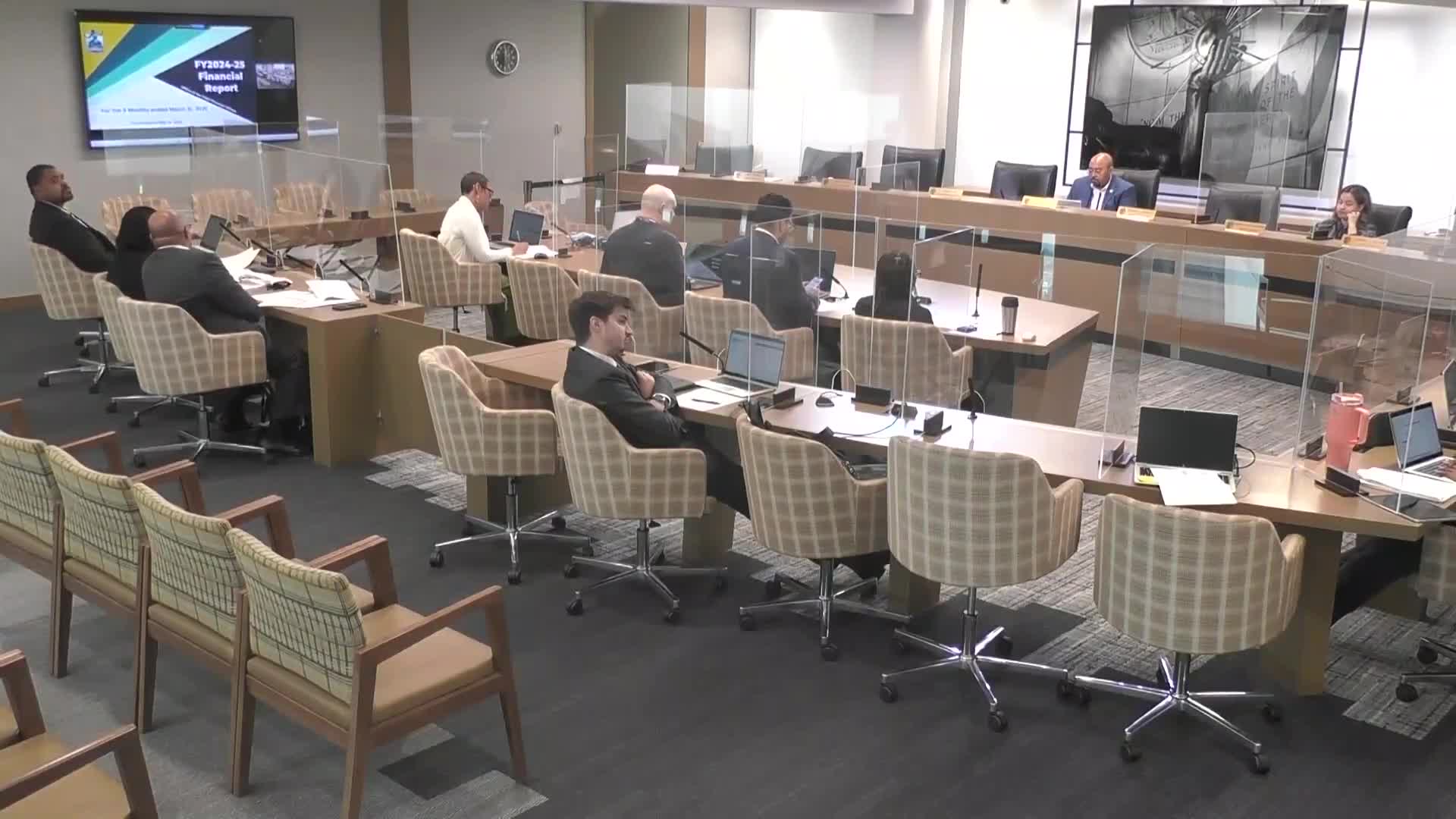
Detroit — City officials told the Budget, Finance and Audit Standing Committee that Detroit’s finances are generally on track for fiscal year 2025 as revenues continue to outperform projections and expenditures run below estimates, while several one-time and timing items are shaping the city's cash position.
"We are on the whole continuing to be on a good track. Our revenues are still on track to over perform on an annual basis and our expenditures are on track to underperform," Deputy Budget Director Donnie Johnson said during the committee meeting.
Johnson and Nikhil Patel, deputy chief financial officer and treasurer, reviewed the fiscal nine‑month report ending March 31, 2025. Key items the administration highlighted include transmission of the approved FY26 budget and four‑year plan to the Financial Review Commission; confirmation of Tanya Sautomire as chief financial officer; and federal confirmation that the city was awarded $346,846,000 in Community Development Block Grant — Disaster Recovery (CDBG‑DR) funds related to the 2023 federally declared storm events.
The report projects an expected $71.9 million in revenue over‑collections for the full year, the administration said. Officials noted a monthly timing shortfall for municipal income taxes that they expect to recover in subsequent months, and they cautioned that certain corporate filings can be extended up to six months and that full corporate-year liability may not be clear until later in the calendar year.
Patel outlined drivers of a year‑over‑year decline in the city's cash position of about $494 million through March. "That year over year change is $494,000,000 and that's driven by the following 5 factors," he said, listing: contributions to legacy pension systems (about $112 million), net capital projects and bond proceeds spend‑down (about $228.9 million net of $49.8 million in new bond proceeds), ARPA spend‑down (about $294.5 million net of $17.4 million in loan repayments), enterprise spend‑down (about $32.7 million for items including DDOT terminal renovations), and a $5.1 million reduction in a fire insurance escrow.
Officials also reported investment returns above 4 percent on portions of the city's portfolio and about $71 million in total gains, including unrealized gains. The city’s debt portfolio showed no major changes in the March report, and the administration said debt service payments are current.
Committee members asked about dependency on one‑time funding sources such as ARPA and potential federal funding reductions. Patel and Johnson said the city is aiming to match one‑time revenues to one‑time expenses and to avoid using nonrecurring funds for recurring obligations. "Some programs would likely come to an end if there are certain federal funding sources that we just can't supplant with our general fund," Johnson said, while emphasizing contingency planning for a range of scenarios.
The committee voted without objection to receive and file the report.