Get Full Government Meeting Transcripts, Videos, & Alerts Forever!
Get email alerts on the Drinking Water Safety topic
No spam. Unsubscribe anytime.
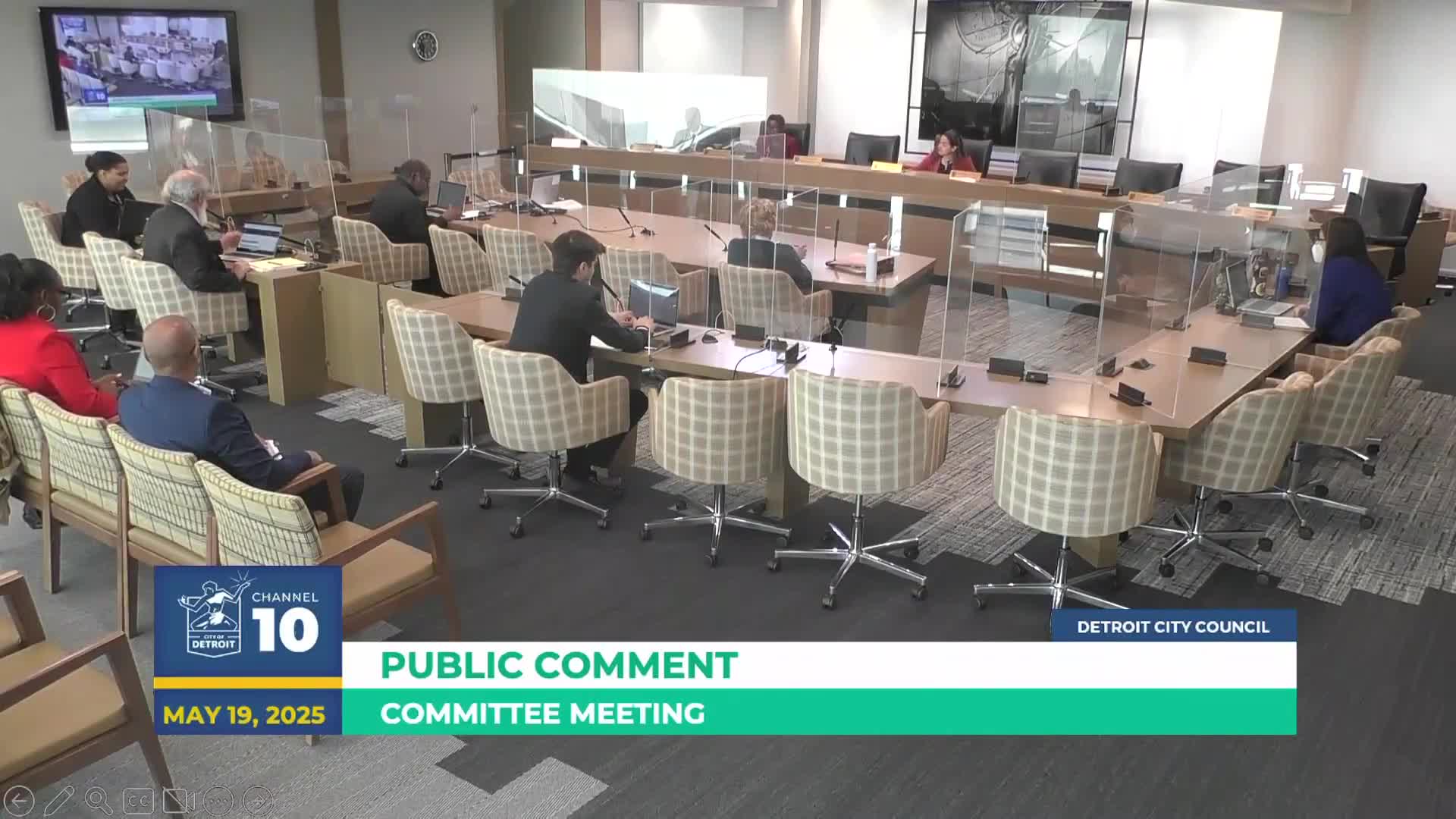
Council committee advances ordinance to require backflow preventers, inspections to protect Detroit drinking water
Summary
A Detroit City Council committee sent an ordinance to the council’s new-business calendar that would define cross connections, require backflow prevention devices and set an inspection schedule to bring the city into compliance with EGLE requirements; DWSD said residents will receive most simple devices at no cost.
A Detroit City Council committee advanced an ordinance to define and prohibit cross connections and require installation and testing of backflow prevention devices in the city’s water system, sending the measure to the council’s new-business calendar with a recommendation to approve.
The proposal, presented by Detroit Water and Sewerage Department staff during a 10:30 a.m. public hearing, is intended to bring the city into compliance with the Michigan Department of Environment, Great Lakes, and Energy (EGLE) and the department’s administrative consent agreement. Nikia Branch Benson of DWSD said the new language would list examples and require protective devices and testing: “So what we’re looking to do with the new ordinance is to list examples of cross connection in addition to defining it. We want to require the installation and testing of backflow prevention devices, and then we want to provide, a remedy in the event that people do not comply with the ordinance.”
Why it matters: cross connections — places where potable water could mix with nonpotable sources such as irrigation systems, pools or chemically treated boilers — can cause backflow that contaminates a public drinking-water system. DWSD staff showed a short video demonstration of common household cross-connection risks and described how simple devices and inspection can reduce that risk.
Key facts from the hearing
- Definition and examples: The ordinance would add a clear definition of “cross connection” and enumerate common residential and commercial examples (irrigation systems, hose connections to chemical sprayers, swimming pools, boilers and heat exchangers).
- Device cost and provision: DWSD said backflow preventer devices typically cost between $35 and $600. The department told the committee it expects to provide the simple devices for most residential connections at no cost to residents.
- Inspection cadence: Anil Gosine, DWSD chief planning officer, said the department plans to ramp up residential inspections “based on Eagle's requirements within a 1 to 10 year cycle.” He added the program is not currently inspecting residential properties and the 1-to-10-year cycle means many properties may be inspected only once per decade under the initial schedule.
- Implementation timeline and rollout: DWSD said it plans an initial multi‑year rollout (staff described planning an initial 5‑year period for distribution and installation of devices) with the goal of starting increased inspections in July. The department also described a public outreach campaign — flyers, videos and targeted neighborhood engagement — to notify residents ahead of inspections.
- Enforcement: DWSD said enforcement would emphasize assistance and outreach, not immediate shutoffs. Staff described service interruption as an “ultimate remedy” reserved for properties that do not respond after repeated outreach and remediation attempts; the department said enforcement timelines will vary by assessed hazard and could run from months to years depending on the case.
Public questions and DWSD responses
Residents asked about affordability, appeal and dispute procedures, whether Great Lakes Water Authority (GLWA) would cover costs, and whether rain barrels are permitted. DWSD responded that the city will provide up to five simple devices per household at no cost, there will be no inspection fees for residents, and the department is responsible for the retail/distribution system (DWSD), not GLWA. DWSD noted rain barrels are not prohibited.
Quotations from the hearing
- Nikia Branch Benson, Detroit Water and Sewerage Department: “So what we’re looking to do with the new ordinance is to list examples of cross connection in addition to defining it. We want to require the installation and testing of backflow prevention devices, and then we want to provide, a remedy in the event that people do not comply with the ordinance.”
- Anil Gosine, Chief Planning Officer, Detroit Water and Sewerage Department: “We are ramping up our residential inspections based on Eagle's requirements within a 1 to 10 year cycle.”
- Phil Curry, Detroit Water and Sewerage Department (video presentation): “And once again, I'm Phil Curry for DWSD. And remember, we're always working hard for you.”
Committee action and next steps
A committee member moved to send the ordinance to the council’s formal calendar with a recommendation to approve; the chair noted “hearing no objections” and the item was forwarded to new business. DWSD staff were advised to continue community outreach and to be prepared to present the ordinance to the full council at committee and formal sessions.
Clarifying details extracted from the hearing
- Typical backflow device price range cited: $35–$600 (DWSD). - DWSD will provide up to five simple backflow preventers per household for residential connections. - DWSD plans to begin increased residential inspections in July and aims to stage the program over an initial five‑year rollout; inspections are planned on a roughly 1‑to‑10‑year cycle depending on risk. - DWSD described enforcement as escalating from outreach to, ultimately, service interruption only after other remedies are exhausted; timelines will vary by assessed hazard.
Speakers (attributions available for quotes used)
[{"name":"Nikia Branch Benson","role_title":"DWSD staff","affiliation_type":"government","affiliation_name":"Detroit Water and Sewerage Department"},{"name":"Anil Gosine","role_title":"Chief Planning Officer","affiliation_type":"government","affiliation_name":"Detroit Water and Sewerage Department"},{"name":"Phil Curry","role_title":"DWSD staff (presenter in video)","affiliation_type":"government","affiliation_name":"Detroit Water and Sewerage Department"},{"name":"Vice Chair","role_title":"Vice chair, committee","affiliation_type":"government","affiliation_name":"Detroit City Council committee"},{"name":"Chair","role_title":"Committee chair","affiliation_type":"government","affiliation_name":"Detroit City Council committee"},{"name":"Miss Duncan","role_title":"Clerk/technical support","affiliation_type":"government","affiliation_name":"Detroit City Council"}]
Authorities cited
[{"type":"ordinance","name":"Detroit City Code, Chapter 19 (Food) Article 3, Sanitation Standards, Division 22 Water, Plumbing and Waste, Plumbing Systems, Subdivision E, Operation and Maintenance","referenced_by":["Nikia Branch Benson"]},{"type":"regulation","name":"Michigan Department of Environment, Great Lakes, and Energy (EGLE) cross connection program/requirements","referenced_by":["Nikia Branch Benson","Anil Gosine"]}]
Actions (formal items extracted)
[{"kind":"other","identifiers":{"agenda_item_id":"10:30_public_hearing_ch19_cross_connection"},"motion":"Send ordinance to formal/new business with recommendation to approve","mover":"not specified","second":null,"vote_record":[],"tally":{},"legal_threshold":{"met":false,"notes":"No roll-call recorded; committee proceeded on 'hearing no objections'"},"effective_dates":{},"outcome":"sent to new business","notes":"Committee forwarded the ordinance to new business with recommendation to approve after public hearing; DWSD to continue outreach and present at committee/formal sessions."}]
Discussion vs. decision
- Discussion: Presentation of ordinance text, video demonstration of cross-connection risks, questions about cost, appeals, GLWA responsibility, timeline and outreach. - Direction/assignment: DWSD to continue outreach and prepare for committee/formal consideration; begin planning a phased rollout and public education. - Formal action: Committee voted (by unanimous consent / no objections) to send the ordinance to new business with a recommendation to approve.
Proper names
[{"name":"Detroit Water and Sewerage Department","type":"agency"},{"name":"Michigan Department of Environment, Great Lakes, and Energy","type":"agency"},{"name":"GLWA","type":"agency"},{"name":"Nikia Branch Benson","type":"person"},{"name":"Anil Gosine","type":"person"},{"name":"Phil Curry","type":"person"}]
Clarifying details (structured)
[{"category":"device_cost","detail":"backflow prevention devices cost range","value":"35-600","units":"USD","approximate":true,"source_speaker":"Nikia Branch Benson"},{"category":"device_provision","detail":"DWSD will provide devices for most simple residential connections","value":true,"units":"boolean","approximate":false,"source_speaker":"Nikia Branch Benson"},{"category":"inspection_cycle","detail":"planned residential inspection cadence","value":"1-10","units":"years","approximate":true,"source_speaker":"Anil Gosine"},{"category":"rollout_period","detail":"initial DWSD distribution and installation plan","value":5,"units":"years","approximate":true,"source_speaker":"Nikia Branch Benson"}]
Community relevance
{"geographies":["Detroit"],"funding_sources":[],"impact_groups":["residential customers","seniors","children"]}
Searchable_tags:["water","backflow","DWSD","EGLE","public health","ordinance","Detroit"],
provenance:{"transcript_segments":[{"block_id":"2","local_start":0,"local_end":186,"evidence_excerpt":"I will now like to call to order our 10:30AM public hearing. Our 10:30AM public hearing is to amend chapter 19 of the 02/2019 Detroit City Code, food article 3, sanitation standards division 22 water, plumbing, and waste, plumbing systems subdivision e, operations and maintenance by amending sections 19 dash 3 dash 7 7 2, prohibiting a cross connection by repealing and replacing sections 19 dash 3 dash 7 7 3, scheduling inspection and service for a water system device to backflow device.","reason_code":"topicintro"},{"block_id":"20","local_start":2248,"local_end":2576,"evidence_excerpt":"So, it prohibits the creation of a cross connection by connecting a pipe or a conduit between a drinking water system and a non drinking water system of unknown quality. ... We want to require the installation and testing of backflow prevention devices, and then we want to provide, a remedy in the event that people do not comply with the ordinance.","reason_code":"topicfinish"}]},
salience:{"overall":0.78,"overall_justification":"Formal ordinance change on drinking-water safety aligned with EGLE requirements; committee advanced item with recommendation to approve.","impact_scope":"local","impact_scope_justification":"Affects all Detroit drinking-water retail customers and residential properties.","attention_level":"high","attention_level_justification":"Public-health implications and regulatory compliance; committee action moves policy forward.","novelty":0.45,"novelty_justification":"Update to an existing city code to align with state requirements rather than a brand-new program.","timeliness_urgency":0.76,"timeliness_urgency_justification":"DWSD cited EGLE administrative consent agreement and a target start for inspections in July; outreach and compliance timelines are imminent.","legal_significance":0.68,"legal_significance_justification":"Ordinance change with enforcement remedies and regulatory alignment with EGLE.","budgetary_significance":0.32,"budgetary_significance_justification":"DWSD will supply many residential devices at no direct cost to residents; program has internal costs but no major new appropriation recorded in the hearing.","public_safety_risk":0.8,"public_safety_risk_justification":"Cross-connections can contaminate potable water and affect vulnerable populations.","affected_population_estimate":670000,"affected_population_estimate_justification":"Approximate number of Detroit retail water customers; citywide effect noted in hearing.","affected_population_confidence":0.5,"affected_population_confidence_justification":"Estimate based on city population scale; transcript did not give an explicit customer count.","budget_total_usd":0.0,"budget_total_usd_justification":"No consolidated program budget presented at the hearing.","policy_stage":"committee","policy_stage_justification":"Item introduced and forwarded to new-business/formal calendar with recommendation to approve."},
engagement_forecast:{"newsworthiness":{"national":0.05,"regional":0.12,"local":0.9,"justification":"Local public-health and utility policy; high relevance to Detroit residents but limited regional/national interest."},"notify_recommendation":{"audience":"city","reason":"Local public-health ordinance with imminent implementation and direct impact on Detroit water customers.","audience_regions":["Detroit"]},"predicted_click_through":0.12,"predicted_click_through_justification":"Strong local interest; lower broader interest."},
graph_signals:{"jurisdictions":["US-MI-DET"],"jurisdictions_justification":"City of Detroit ordinance and DWSD program.","ontology_topics":["drinking_water","public_health","utility_regulation"],"ontology_topics_justification":"Matches DWSD program and EGLE regulatory alignment.","entities":[{"id":"dwsd","name":"Detroit Water and Sewerage Department","type":"agency"},{"id":"egle","name":"Michigan Department of Environment, Great Lakes, and Energy","type":"agency"}],"entities_justification":"Primary implementing agency and regulatory authority."}