Get Full Government Meeting Transcripts, Videos, & Alerts Forever!
Get email alerts on the Public Camping Ordinance topic
No spam. Unsubscribe anytime.
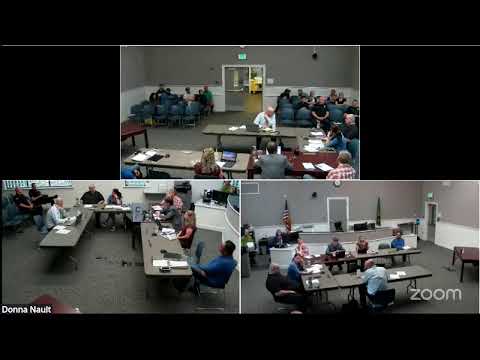
Shelton council reviews new public-camping ordinance language, directs staff to draft enforcement policies
Summary
At a May 27 study session the Shelton City Council discussed a revised public-camping ordinance, heard legal and cost implications from staff, and directed the city manager and attorneys to prepare detailed enforcement policies ahead of a public hearing next week.
Shelton City Council members and staff spent a May 27 study session reviewing a revised public-camping ordinance and how the city would enforce it if adopted, with staff emphasizing legal risks, costs and the need for written policies before enforcement proceeds.
The discussion centered on a new draft ordinance and a recommendation that the city manager or designee develop administrative policies and procedures that would guide law enforcement and other staff on citations, removal and handling of personal property. Mark Ziegler, the city—s team manager, described the typical enforcement contact: "the individual will be contacted in person, advised of the public camping ordinance, and given the opportunity to voluntarily leave," and said officers could issue citations or make arrests if individuals refused to vacate.
City attorneys warned that litigation risk now looks different than it did after earlier cases such as Martin v. Boise, and they discussed more recent rulings including the Grants Pass litigation and a May 15 King County Superior Court opinion upholding Burien—s ordinance. Kathleen, the city attorney, told the council that while the U.S. Supreme Court—s recent decisions reduce the chance of a blanket invalidation of such ordinances, the city remains exposed to "as-applied" lawsuits that challenge how the law is implemented and advised keeping detailed records and tight policies.
The session included staff summaries of operational and fiscal impacts. Ziegler presented municipal-court and case-processing estimates based on local averages: the municipal court budget was reported at $5,753,000 and staff used an annual-facing case count (about 532 cases) to compute a notional processing cost of roughly $1,888 per case (this combined municipal, prosecution and public defense estimate was presented as an illustration). Public-works and parks crews were reported to have spent about 121 hours year-to-date on related cleanups; police reported roughly 44 hours in May on contacts related to people experiencing homelessness. Staff also described existing limited services in the area, a single designated crisis responder (DCR) funded by a $100,000 grant working 40 hours a week, and a mitigation-site example in Longview (Hope Village) that staff said cost "a little over a million dollars" to set up with an operating contract described in the presentation as about $400,000 a year.
Several council members raised operational questions that the draft ordinance does not resolve, including where personal property would be stored, how long notice periods should be, treatment of pets, and how to avoid repeated, short-distance moves by the same individuals. Councilmembers and staff discussed model policies used in other Washington cities (Spokane, Burien, Aberdeen and Lakewood were cited) and the idea of delegating implementation details to an administrative policy so the city can adapt procedures as law and practice evolve.
Public comment included strong, opposing views. Morgan Thompson, a Shelton resident, urged enforcement and stricter consequences and said, "I want Shelton to be a hand up, not a handout," citing concerns about downtown safety and business impacts. Other commenters urged compassion and services-first approaches, warning that enforcement alone would not solve homelessness and stressing outreach and connection to housing and health services.
Council procedural steps: the council confirmed the item has been scheduled for a public hearing next Tuesday and directed staff and the city attorney to finish a draft policy ahead of that hearing. Staff said the ordinance would not be enforced until policies were finalized; if the council takes action following the public hearing, the ordinance would become effective following publication in the paper of record (staff identified a likely publication timeline that would put an effective date roughly two weeks after final council action).
The study session made clear that the council—s next steps are to (1) hold the scheduled public hearing, (2) consider an action-item vote at a subsequent meeting (or by motion to suspend rules to act sooner), and (3) rely on a city-manager-level administrative policy developed with police, legal and relevant staff to define enforcement details.
The council did not adopt the ordinance at the study session and no formal recorded vote took place. The public hearing and any vote are scheduled for subsequent meetings, where the council will also receive the draft administrative policy staff proposes to use as the operational guide for enforcement.