Get Full Government Meeting Transcripts, Videos, & Alerts Forever!
Get email alerts on the Cwc Boces Budget topic
No spam. Unsubscribe anytime.
Board approves CWC BOCES budget; BOCES recommends cap on dual-enrollment courses amid 25% revenue drop
Summary
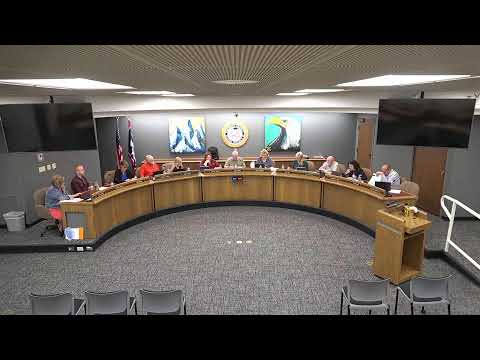
The Fremont County School District #25 Board of Trustees approved the 2025–26 CWC BOCES budget after hearing that property tax reductions are expected to cut BOCES revenue roughly 25%. BOCES staff proposed a cap of 10 college dual-enrollment courses per student to manage the shortfall; concurrent-enrollment at high schools would not be limited.
Matt, a CWC BOCES representative, presented the 2025–26 Central Wyoming College (CWC) BOCES budget and told the Fremont County School District #25 board that recent property tax cuts will reduce expected BOCES revenue by roughly 25 percent, leaving an estimated revenue for the county BOCES of about $340,000.
The BOCES representative said the program pays college tuition for dual-enrollment courses that high school students take directly from CWC. Because projected revenue will not cover current expenses, the BOCES board recommended capping the number of dual-enrollment courses a student may take while in high school at 10 courses across the student's high-school career. The proposal would not limit concurrent-enrollment courses offered at high schools; students could continue to take concurrent-enrollment classes at their high school without counting toward the 10-course dual-enrollment cap.
Why it matters: The cap aims to preserve the program’s fiscal sustainability while continuing student access to college credit. Under the proposal, a typical plan would allow, for example, one dual-enrollment class per semester as a sophomore, two per semester as a junior and senior, totaling about 10 courses over four years — roughly equivalent to 30 college credit hours if courses are three credits each.
Board members asked detailed questions about specific line items and alternatives. One member asked why a $129,000 “CWC support” line appears on Fremont County’s BOCES budget but not on the Hot Springs line. The presenter said that line covers college operational support (IT, financial aid, business office services and other institutional fees) and supplements tuition payments when BOCES revenue falls short. The presenter said Hot Springs’ BOCES levy and reserves allowed Hot Springs School District #1 to hold its mill at a quarter mil for this year.
Board members discussed whether an individual district could cover additional costs for its own students rather than the whole county BOCES. The presenter cited a state-law constraint that dual-enrollment courses must be free to the student and family if the high school is awarding credit, but said the question of whether one district could levy additional funds for only its students would require legal clarification. Board members referenced a past Attorney General opinion (circa 1999) and an earlier CWC lawyer’s memorandum that offered differing views about levy limits; the presenter recommended the board ask the community college commission and the state department of education and consult legal counsel for a definitive answer.
Board action: The board moved and voted to approve the 2025–26 CWC BOCES budget “as presented.” The motion passed by voice vote.
Clarifying details taken from the meeting: BOCES estimated revenue for Fremont County about $340,000 after property tax changes; proposed cap is 10 dual-enrollment courses per student over high school career; concurrent-enrollment offered at high schools remains unlimited; a CWC support line of about $129,000 was described as covering institutional operating costs; Hot Springs held its levy at a quarter mil using reserves. The recommendation to explore district-specific levies was discussed but no formal direction to implement a levy was adopted at the meeting.
Looking ahead: Board members asked staff to bring back more information and to query state agencies and legal counsel about whether a single district could levy for its share of dual-enrollment costs or otherwise subsidize college graduation-at-high-school programs for its students.